Moroccan Artisanat: The Hands, History and Living Arts of Morocco
From zellige, cedar and carved plaster to carpets, leather, jewellery, pottery and embroidery—the story of Morocco told through the hands of its artisans.
MoroccoPassport EditorialPublished 29 September 2026Long read · about 20 minutes
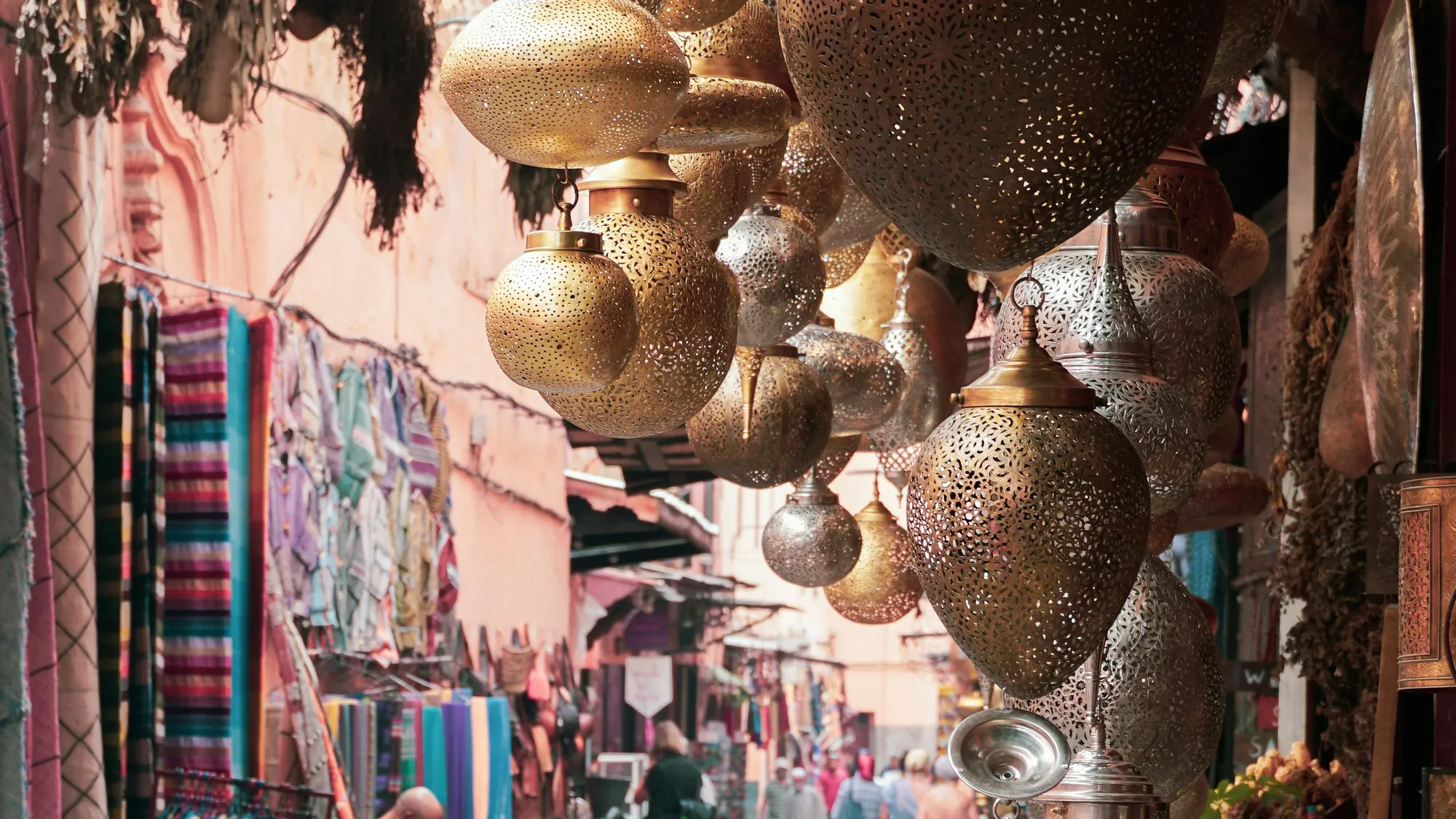
A souk lane with pierced-metal lanterns and hanging textiles
Moroccan artisanat is not simply a collection of beautiful objects. It is a living archive of Morocco: Amazigh symbols woven into wool, Andalusian geometry assembled one fragment at a time, cedar carved for palaces and homes, clay shaped according to regional traditions, silver transformed into identity and leather worked in medinas where knowledge still passes from master to apprentice.
Every carpet, tile, caftan, basket, lantern and musical instrument begins with material, place and human skill. Together, these traditions tell a larger story—of Morocco’s Indigenous foundations, its African and Mediterranean connections, its exchanges with Al-Andalus, its Jewish and Muslim communities, its imperial cities and rural regions, and the artisans who continue to renew this inheritance today.
What “artisanat” means here. In Morocco, artisanat covers a wide field: handmade objects, production in small workshops, and skilled trades practised by individuals, families and cooperatives. Officially it even includes service activities. This page concentrates on the crafts with the strongest cultural content—the tiles, textiles, ceramics, woodwork, metalwork, leather, jewellery and instruments through which Moroccan history is most visibly carried.
Artisanat at a Glance
A Heritage That Is Also an Economy
Artisanat is not a museum category in Morocco. According to the Ministry of Tourism, Artisanat and the Social and Solidarity Economy, it is the Kingdom’s second-largest employer. The Ministry’s figures cover the whole sector, however—not only heritage crafts—so they need to be read in context.
≈ 2.4 million
working people across the entire artisanat sector, as reported by the Ministry
≈ 420,000
artisans in crafts with strong cultural content—about 17% of the sector’s employment
30%
work in utility crafts—the production of practical, functional goods
53%
work in service crafts, which the Ministry’s standards show include trades such as hairdressing and the traditional hammam
Read the numbers carefully
Only a minority of the sector’s total workforce produces the culturally rich objects discussed on this page. It would be misleading to describe all 2.4 million people as heritage craft producers. The Ministry’s 2030 strategy nonetheless identifies pottery, rural carpets and jewellery as priority heritage sectors.
Who makes the work
Production ranges from a single artisan at home to family workshops, recognised masters (maalems) with apprentices, small enterprises and cooperatives—many of them led by women. Knowledge passes formally through training centres and schools, and informally through families, neighbourhoods and years at a workbench.
No single origin explains Moroccan craft. Its forms were built up in layers—Indigenous, African, Mediterranean, Islamic, Andalusian and Jewish—and each layer was absorbed, reworked and handed on rather than simply stacked on the one before.
Indigenous and ancient foundations
Wool, silver, leather and the logic of place
Long before the imperial cities, the Amazigh (Berber) peoples of the mountains, plains and pre-Saharan valleys worked wool, leather, clay, plant fibre and metal. The materials came directly from pastoral and agricultural life: fleece from flocks, hides from herds, palm and grass from oases and steppes, local clays and, later, silver obtained through trade.
Weaving, jewellery and dress became ways of marking belonging. A carpet’s structure, colour or border, or the form of a fibula or necklace, could signal a region or group—though the precise meaning of individual motifs is often debated and should not be assumed. Trade routes linked these communities to the Sahara, sub-Saharan Africa and the Mediterranean, bringing new materials and ideas.
These are not frozen traditions. Amazigh weavers and silversmiths have always adapted to new dyes, tools, markets and tastes, and continue to do so today. Our feature on the Amazigh of Morocco explores this living civilisation in more depth.
Islamic dynasties and urban workshops
Cities of specialists
From the Idrisid foundation of Fez between 789 and 808, successive dynasties built cities that concentrated skill. UNESCO notes that Fez reached its height under the Marinids in the thirteenth and fourteenth centuries, when most of the medina’s madrasas, fondouks, palaces, residences, mosques and fountains were built. Marrakesh, founded by the Almoravids in 1070–72 and later the Almohad capital, became another great centre of patronage. Meknes, Rabat, Salé and Tétouan each developed their own workshop cultures.
Inside these medinas, trades were grouped by street and quarter, and organised through guild-like corporations that regulated work and quality. At their centre stood the maalem, the master artisan, who trained apprentices over years. Commissions came from palaces, mosques, madrasas, fountains and private houses. The resulting visual language—geometry, calligraphy, vegetal ornament and a deep command of materials—was shared across zellige, plaster, wood and metal.
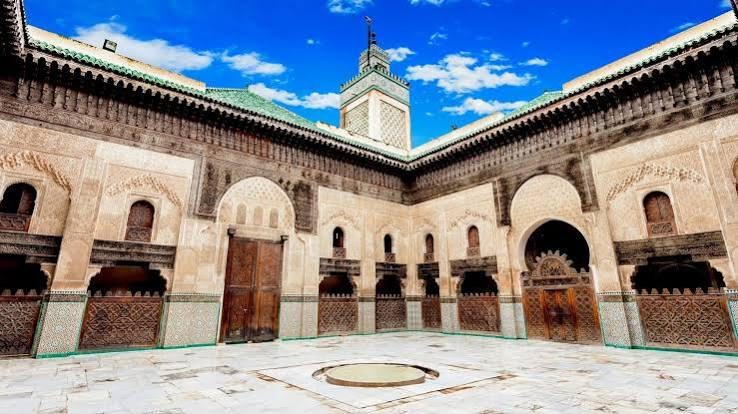
A Marinid-era madrasa courtyard in Fez. Zellige, carved plaster and carved cedar work together as one decorative system.
Morocco and Al-Andalus
A Two-Way Cultural Current
It is often said that Spain shaped Moroccan design, or that Morocco shaped Spain’s. Both statements are too simple. For centuries the Strait of Gibraltar was less a border than a corridor, and craft moved across it in both directions.
From Morocco to Al-Andalus
The Almoravids and Almohads, dynasties based in Morocco, governed territories on both sides of the Strait. UNESCO describes Marrakesh under them as a major centre of the western Muslim world, with influence reaching into Andalusia. They carried political, architectural and artistic forms north.
From Al-Andalus to Morocco
Andalusians settled in Moroccan cities over many centuries—after upheavals in Córdoba in the ninth century, after successive Christian conquests, and after the expulsions of Muslims and Jews from Iberia. Fez, Tétouan, Rabat, Salé and Chefchaouen all received these communities.
Between those two currents moved craftspeople, scholars, musicians, builders, merchants and entire families. In Fez, UNESCO notes that the original city comprised two quarters on either side of the river: the banks of the Andalusians and of the Kairouanese. Historians associate the Andalusian Quarter with refugees from Córdoba who arrived early in the ninth century.
Later arrivals shaped whole towns. UNESCO records that Tétouan, long the main point of contact between Morocco and Andalusia, was rebuilt after the Reconquest by Andalusian refugees, and that its art and architecture show clear Andalusian influence. The city is known for its school of arts and crafts, Dar Sanaa. Since 2017 it has also been a member of the UNESCO Creative Cities Network in the category of Crafts and Folk Art. UNESCO notes that its craft neighbourhoods encompass zellige, Taajira embroidery, encrusted and painted wood, and wrought ironwork. Morisco communities expelled from Spain in the early seventeenth century also settled in Rabat and Salé.
These communities contributed to urban culture: courtyard houses, gardens, music, embroidery, woodwork, plasterwork, ceramics and ornament. Yet Moroccan craft is not a copy of Spanish architecture. It belongs to a connected Maghrebi–Andalusian world. UNESCO’s description of Fez captures this well: local knowledge and skills are “interwoven with diverse outside inspiration”—Andalusian, Oriental and African.
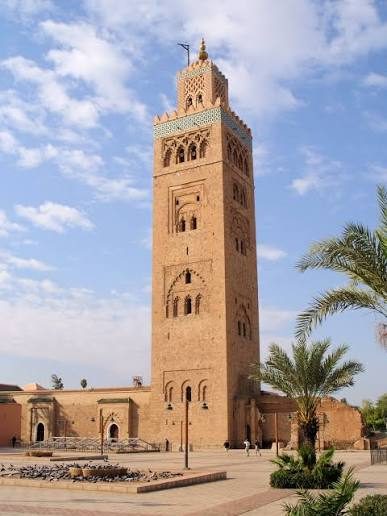
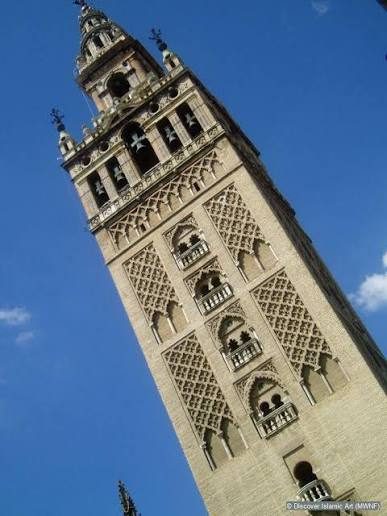
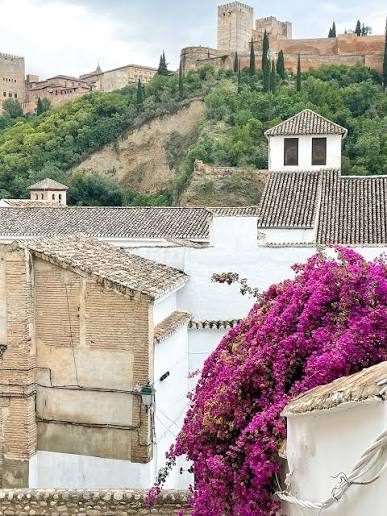
The Koutoubia minaret, Marrakech—an Almohad landmark that UNESCO records as 77 metres tall.The Giralda, Seville—built as the minaret of an Almohad mosque and later crowned with a Renaissance belfry.Houses in Granada below the walls of the Alhambra, the last great Nasrid palace-city.
Swipe sideways to see the full table →
Shared forms across the Strait—compared, not copied
Element
In Morocco
In Al-Andalus
Minarets
The Koutoubia, Marrakech, and the unfinished Hassan Tower, Rabat
The Giralda, Seville—an Almohad minaret; the three are often compared as a family of Almohad towers
The inward house
The dar and riad: rooms turned toward a courtyard, fountain or garden
The patio house of Córdoba, Seville and Granada
Geometric tile
Zellige: hand-cut glazed pieces assembled into patterns
Cut-tile mosaic (alicatado) in Nasrid and Mudéjar interiors
Plaster and ceilings
Carved plaster (gebs), carved and painted cedar ceilings, muqarnas
Carved stucco (yesería), wooden ceilings and muqarnas, as at the Alhambra
Water and shade
Garden traditions such as the Agdal and Menara in Marrakesh, which UNESCO counts among the medina’s historic setting
Courtyard pools and irrigated gardens, as in Granada’s Generalife
Jewish artisans held an important place in jewellery and metalworking in many Moroccan towns and communities, contributing skills that crossed commercial, religious and cultural boundaries. Their work served Jewish and Muslim clients alike.
The Musée d’art et d’histoire du Judaïsme in Paris, which holds a documented set of gold wedding jewellery made for a Jewish woman in northern Morocco, notes that Jews expelled from Spain in 1492—many of them gold- and silversmiths—revitalised Moroccan jewellery, and that Fez and Tétouan remained the principal centres of urban jewellery. Urban pieces tended toward gold set with pearls and precious stones. Rural jewellery was generally silver.
The mellahs, the Jewish quarters of Moroccan cities, housed workshops that doubled as shops. Jewish artisans and merchants were also active in embroidery with metallic thread, ceremonial clothing, tailoring and the trade in leather and textiles. Motifs and techniques moved between Jewish, Muslim and Amazigh communities, who often supplied, commissioned and learned from one another. Few crafts can be assigned exclusively to one community, and the evidence rarely supports doing so.
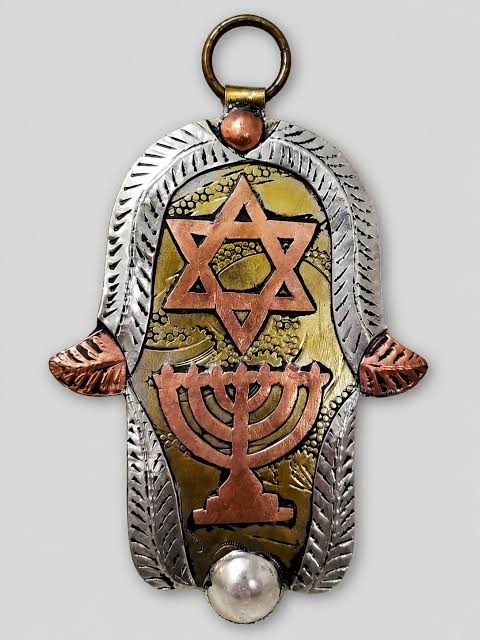
A hamsa pendant bearing a Star of David and a menorah. The hand-shaped amulet is shared across Jewish and Muslim North African traditions.
Twentieth-century art schools and training centres—Tétouan’s Dar Sanaa among the best known—formalised skills once learned only in workshops. Cooperatives, many led by women, have given weavers, embroiderers and basket-makers more control over pricing and sales. Designers now bring zellige, carpets and brass into contemporary interiors and fashion.
The state has also built a system of protection. The Ministry reports 344 craft standards, some of them mandatory for products that affect safety, such as culinary pottery, babouches and teapots. It has also developed 69 collective certification marks, including the national “Morocco Handmade” label. A law introduced geographical indications for craft products, and the Ministry cites legal action to protect Fez zellige and Taza-Taounate basketry against imitation.
The pressures are real, however. Mass-produced imitations undercut handmade work. Buyers push for lower prices, compressing what artisans are paid for their time. Rising material costs also play a part, and many young people see little future in a trade that takes years to master. Whether heritage survives depends as much on fair compensation and respect as on protection laws.
The Craft Atlas
The Principal Moroccan Crafts
Thirteen entries, each with its own materials, gestures and geography. Each entry describes what the craft is, how it is made, where it is strongest and what to notice when you see it.
Hand-cut glazed zellige set in a diamond lattice.
Zellige
Architectural ceramics · Geometry
Zellige is a mosaic made from pieces of glazed terracotta, each cut by hand into a precise shape and then assembled into geometric patterns. Clay tiles are fired and glazed in single colours. Cutters then chip away each piece with a sharp-edged hammer until it matches a template. The pieces are laid face-down in the pattern and bound with mortar.
It covers fountains, walls, floors, courtyards, madrasas and mosques, turning the logic of geometry into architecture. The characteristic slight irregularity of each piece catches light differently from mass-produced tile.
Fez is the leading centre of production, where workshops shape, fire, glaze and cut the pieces. Zellige is also laid and restored in Tétouan, Meknes, Marrakesh, Rabat and beyond. Palettes, piece sizes and pattern repertoires vary from workshop to workshop and city to city, and the Ministry cites legal action to protect Fez zellige against imitation.
Materials
Local clay, mineral glazes, mortar
Key centres
Fez above all; also Tétouan, Meknes and Marrakesh
Varies by
Palette, scale of pieces and pattern complexity
Notice
Printed or moulded “zellige-look” tiles have a uniform surface and regular joints; true zellige shows individual cut edges and small variations in glaze.
Blue-and-white glazed ware, the palette most associated with Fez.
Pottery and Ceramics
Clay · Glaze · Regional palettes
Moroccan ceramics are not a single style, and not all of them come from Fez. Potters shape clay on the wheel or by hand, dry it, fire it in kilns and, for decorative ware, glaze and paint it before a second firing.
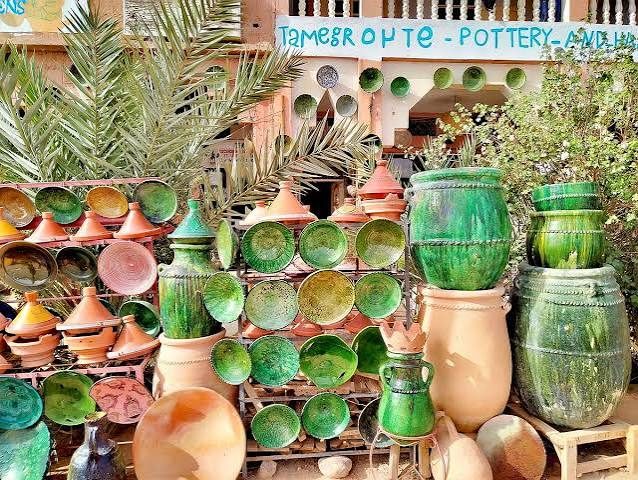
The Moroccan National Tourist Office describes regional palettes: blue patterns in Fez, yellows in Safi and greens in Meknes. Safi is known for bold, multicoloured painted ware. In the Drâa Valley, Tamegroute produces a distinctive rough green glaze. The Ministry has commissioned expertise to preserve that colour as potters move from wood to gas kilns. Alongside decorative ware, rural earthenware—cooking pots, tagines, water jars and storage vessels—remains a practical, everyday tradition. Salé’s Oulja potters’ complex is another centre worth knowing.
Materials
Regional clays, mineral glazes and pigments
Key centres
Fez, Safi, Tamegroute, Salé, Meknes and many rural villages
Varies by
Decorative versus functional ware; glaze colour; hand-built versus thrown
Notice
Brush marks, slight asymmetry and the weight of the piece. For cooking ware, ask whether it is intended for the stove—the Ministry applies mandatory standards to culinary pottery.
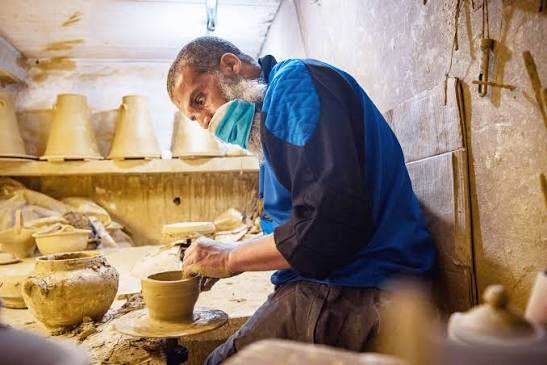
A potter throwing a vessel on the wheel.Green-glazed ware outside a Tamegroute pottery.A zellige cutter shaping glazed pieces by hand.
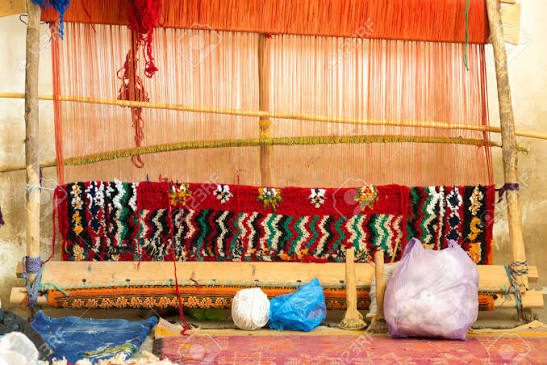
An upright loom with work in progress.
Carpets and Weaving
Wool · Loom · Women’s knowledge
Moroccan carpets range from thick knotted pile to flatweaves (hanbel or kilim). Wool is washed, carded, spun and dyed—with plant and mineral dyes, synthetic dyes, or both—then woven on upright looms. Knotted carpets are built row by row, each knot tied by hand.
The Moroccan National Tourist Office notes that rugs are traditionally handmade mostly by women, using knotting techniques rooted in Amazigh culture. Regional identities are strong. Beni Ourain weaving from the Middle Atlas is known for undyed wool and dark linear designs. Azilal pieces are often bright and freely composed. Taznakht and the Siroua region are associated with wool rugs and flatweaves, and Rabat has an urban carpet tradition of its own. The Ministry has supported research into extracting natural pigments for dyeing wool.
Beware of invented “meanings.” Some motifs carry recognised associations, but many carpets are sold with universal symbolic explanations that have no evidence behind them. MoroccoPassport hopes, in future, to document the work of individual weavers directly—in their own words.
Materials
Sheep’s wool, cotton warps, natural and synthetic dyes
Key centres
Middle Atlas, Azilal, Taznakht and Siroua, Rabat, Ouarzazate region
Notice
The back of a knotted rug shows individual knots; fringes are the warp threads, not sewn on. Abrash—gentle bands of colour variation—often reflects hand-dyed wool.
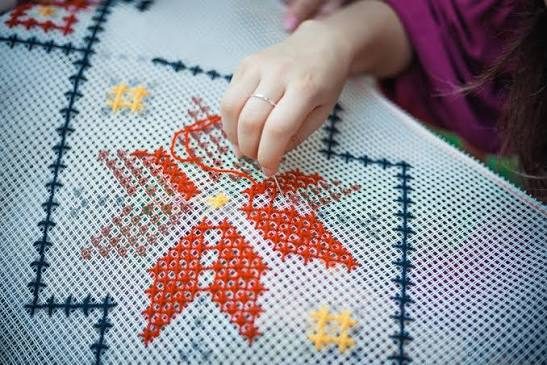
Counted-thread embroidery worked by hand.
Embroidery and Textiles
Thread · Household and ceremony
Urban embroidery was traditionally practised by women at home, for trousseaux, cushions, curtains, towels and ceremonial dress. Each city developed recognisable conventions of stitch, colour and composition.
Fez is often associated with fine counted-thread work, frequently in a single colour and designed to look good on both sides. Rabat and Salé embroidery is generally denser and more floral, with Salé keeping its own local conventions. The northern cities of Tétouan and Chefchaouen, shaped by Andalusian settlement, are known for their own colourful traditions.
Materials
Silk and cotton threads, linen and cotton grounds, metallic thread for ceremonial pieces
Key centres
Fez, Rabat, Salé, Tétouan, Chefchaouen
Notice
Turn the piece over: hand embroidery shows small irregularities and thread ends; machine embroidery shows dense, uniform backing threads.
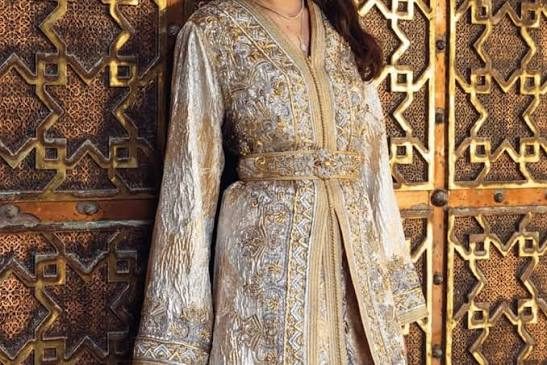
An embroidered caftan with a matching belt.
The Moroccan Caftan
UNESCO intangible heritage · Inscribed 2025
The caftan is best understood as a meeting point of many crafts, not a single one. UNESCO, which inscribed “Moroccan caftan: art, traditions and skills” on its Representative List in 2025, describes the weavers who produce brocade, velvet and silk; the tailors who shape the garment; and the artisans who make its buttons, braids and embroidery.
To those UNESCO lists, one can add the cutters, finishers, fitters and designers who adapt it to each wearer. According to UNESCO, these skills pass informally through families and workshop apprenticeships, and formally through training centres and fashion schools. The caftan is worn at weddings, religious celebrations and festivals.
Skills involved
Weaving, cutting and tailoring, embroidery, braiding (passementerie), button-making, finishing, design and fitting
Notice
Hand-made silk buttons and braided trims (sfifa) are slow, skilled work—often a clearer sign of quality than the fabric alone.
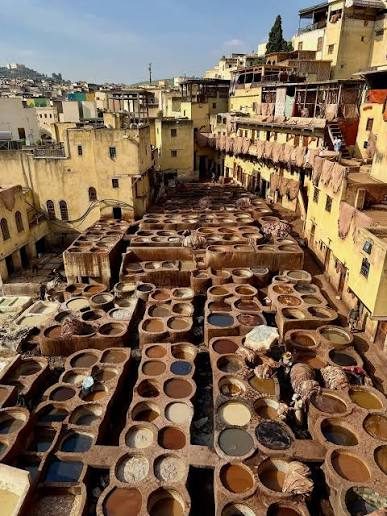
The Chouara tannery, Fez.
Leatherwork
Tanning · Dyeing · Stitching
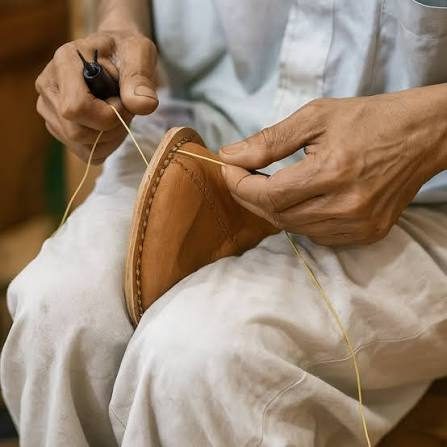
Fez’s tanneries, the Chouara above all, are among Morocco’s most photographed places. The Moroccan National Tourist Office notes that the skins of cows and goats are processed there for leather goods. Hides are cleaned, softened and treated, then dyed in open stone vats. Afterwards, other artisans cut and stitch them into babouches, bags, belts, book covers, poufs and saddlery. Marrakesh is another major centre of leather goods.
The postcard view hides hard work. Tannery labour is physically demanding and involves prolonged contact with water, treatments and dyes. Conditions and environmental practices vary. Rehabilitation and modernisation efforts have sought to improve them, but visitors should see a working industrial site, not a picturesque backdrop. Babouches, notably, fall under the Ministry’s mandatory product standards.
Hand-stitching leather.
Key centres
Fez and Marrakesh; smaller workshops nationwide
Notice
Even stitch spacing, finished edges and the smell and feel of real leather; coated synthetics feel plasticky and crack at folds.
Carved wooden door panels with interlaced ornament.
Woodwork
Cedar · Thuya · Carving and painting
Atlas cedar, fragrant and durable, is the noble wood of Moroccan architecture. It is carved into doors, screens, friezes, corbels and ceilings, and painted with geometric and floral designs in houses, madrasas and palaces. Its joinery and carving sit directly beside plaster and zellige in the same interiors.
In Essaouira, artisans work thuya—a local tree whose burl and root wood has a dense, figured grain—into boxes, tables and marquetry, inlaid with lighter woods and sometimes metal. The Moroccan National Tourist Office identifies Essaouira as the centre of this craft. Because both cedar and thuya come from forests under pressure, sustainable sourcing and regeneration matter as much as the skill of the carver.
Chisel marks in carving, hand-painted lines that vary slightly, and tight inlay joints. Ask where the wood comes from.
Plaster, cedar and zellige in a Fez madrasa.
Carved Plaster and Architectural Ornament
Gebs · Geometry · Calligraphy
Gebs (or gypse) is carved plaster. It is applied to walls, arches and cornices, then cut while still workable into geometric interlace, vegetal scrolls, calligraphy and honeycomb muqarnas. The carver draws the design, then removes material with chisels and knives, often in several depths so that light and shadow model the surface.
In a complete interior, the three materials form a vertical sequence: zellige at the base, carved plaster in the middle and carved cedar near the ceiling. UNESCO notes that restoration in Marrakesh has revived related trades: zellige, tadelakt lime plaster, painted and sculpted wood, plastering and wrought iron.
Key centres
Fez, Marrakesh, Meknes, Rabat, Tétouan
Notice
Crisp undercuts and hand-varied depth; cast resin panels repeat identically and sound hollow.
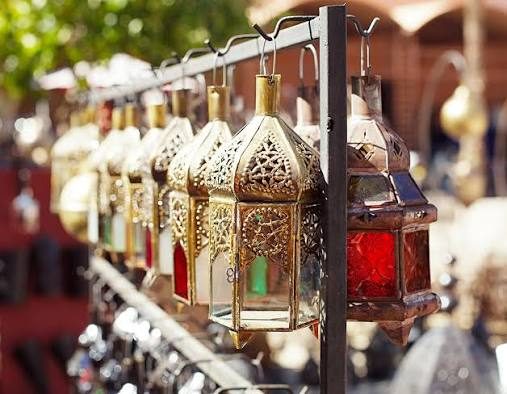
Metal lanterns with coloured glass panels.
Metalwork
Brass · Copper · Silver · Iron
Moroccan metalworkers hammer, engrave, chase, pierce and cast brass, copper, silver and iron into trays, teapots, lanterns, door fittings, basins and architectural screens. Dinanderie—the working of copper and brass sheet—is a speciality of Fez, Marrakesh and Tétouan. The Ministry has supported research into Fez dinanderie, and applies mandatory standards to teapots.
In 2023, UNESCO inscribed the arts, skills and practices associated with engraving on gold, silver and copper through a multinational nomination involving Morocco, Algeria, Egypt, Iraq, Mauritania, Palestine, Saudi Arabia, Sudan, Tunisia and Yemen. Wrought iron, meanwhile, gives medina houses their grilles, balconies and window screens.
Key centres
Fez, Marrakesh, Tétouan, Safi
Notice
Hand-engraving varies subtly along a line; machine-stamped patterns are perfectly regular and shallow. Heavier gauge metal usually signals better work.
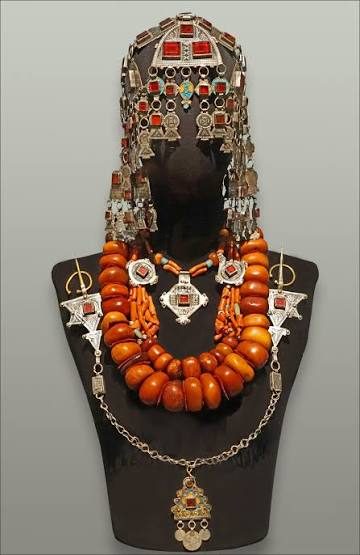
A ceremonial silver jewellery ensemble on display.
Jewellery
Silver · Gold · Identity
Moroccan jewellery divides broadly into two worlds. Rural and Amazigh jewellery is predominantly silver: fibulas, head ornaments, heavy necklaces, bracelets and pendants set with enamel, coral, amber or glass. The Souss and Anti-Atlas, with Tiznit as its best-known market, are strongly associated with this tradition. The Moroccan National Tourist Office also lists Guelmim, Taroudant, Agadir and Essaouira as centres of silver production.
Urban jewellery in cities such as Fez and Tétouan favoured gold, pearls and precious stones, and owed much to Jewish goldsmiths, as described above. Jewellery marked marriage, status, wealth and belonging, and some pieces were believed to protect their wearer. Specific symbols, though, did not carry one fixed meaning everywhere, and single universal interpretations should be treated with caution.
Key centres
Tiznit and the Souss, Anti-Atlas, Guelmim, Essaouira, Fez, Tétouan, Marrakesh
Notice
Silver content (ask about hallmarks), solder joints, enamel quality and weight. Old-looking is not the same as old.
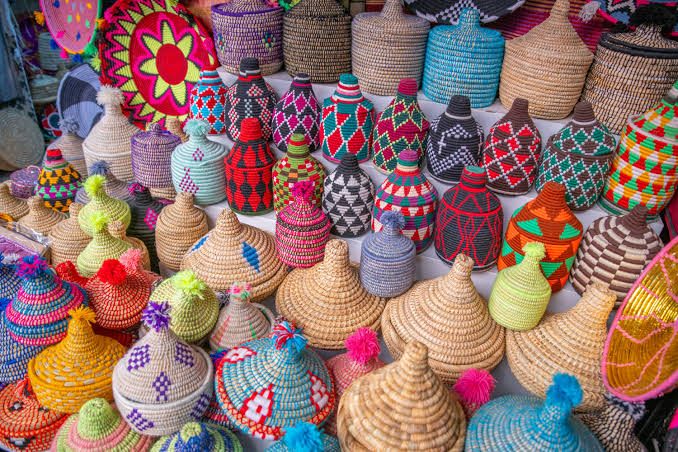
Woven lidded baskets in a market.
Basketry and Plant Fibres
Palm · Reed · Alfa grass
Dwarf palm, date palm, reed, rush and alfa (esparto) grass are coiled, plaited and woven into baskets, mats, bread covers, hats, storage containers and saddle bags. In rural households these objects are working tools, and today designers use the same techniques for contemporary lighting and furniture.
The Moroccan National Tourist Office mentions wicker, raffia and palm objects in Fez, Marrakesh and Salé. The Ministry cites legal action to protect the basketry of Taza-Taounate.
Notice
Tight, even coils; firm rims; natural fibre smell. Dyed accents may be natural or synthetic—ask.
Two guembri lutes on a stand.
Musical Instruments
Wood · Skin · String
Instrument-making connects craft to Morocco’s musical traditions. The oud, the short-necked lute central to Andalusian and Arab music, is built from shaped wooden ribs, a carved soundboard and rosette. The guembri (or sintir), the bass lute of Gnawa music, has a wooden body covered with animal skin and gut strings. The bendir is a frame drum with a stretched skin, and darbouka goblet drums traditionally combine a fired-clay body with a skin head. Essaouira, home of the Gnaoua festival, is especially associated with guembri makers; Fez and Marrakesh have long-established luthiers.
An oud.
Notice
Decorative “souvenir” instruments are often unplayable. A maker will usually let you test tone, action and tuning stability.
Leather babouches on display racks.
Clothing and Everyday Objects
The craft of daily life
Much of Moroccan artisanat lives in ordinary use rather than display: babouches worn at home, leather belts, woven blankets and covers, painted wooden furniture and boxes, lanterns, tea trays, djellabas with hand-made buttons and braid. These objects are made to be used, repaired and eventually replaced—and their quality shows most clearly after years of use, not in a shop window.
Regional Atlas
Where the Crafts Live
A craft map of Morocco, city by city and region by region. The associations below are cultural and historical descriptions, not boundaries.
Nomadic and oasis traditions: tent textiles, leather cushions and bags, silver jewellery and palm-fibre work.
Associations are not absolute. Artisans migrate, workshops innovate and techniques overlap. A “Fez” pattern may be made in Marrakesh; a young designer in Casablanca may train with a Tétouan master. Regional labels describe tendencies and histories, not fixed borders.
A zellige craftsman at work. Each piece of a panel is shaped individually by hand.
The People Behind the Objects
The Artisan Is Not Invisible
Behind every object stands a person, a workshop and usually a long apprenticeship. The maalem is more than a skilled worker. He or she is a recognised master responsible for quality, for the workshop’s reputation and for training the next generation. Apprentices may spend years on preparatory tasks before they are trusted with a finished piece.
Transmission happens in many ways: from parent to child, within neighbourhood workshops, in cooperatives, in state training centres and in art schools. A great deal of Moroccan craft—weaving, embroidery, basketry—has been produced by women working at home, often unrecorded and underpaid. Cooperatives have made some of this work visible and given women stronger bargaining power.
A handmade object contains time. When its price is negotiated down to the cost of materials, that time is what disappears.
Craft is physical labour. Cutting zellige, knotting a carpet, tanning hides and hammering copper take strength, precision and patience, and can bring repetitive strain, dust and chemical exposure. Fair compensation means paying for those hours and those risks, not only for the object.
Attribution matters too. Too often, artisans appear in travel imagery as anonymous figures, or in retail as unnamed “suppliers.” Naming a maker—with their permission—acknowledges authorship and helps a reputation travel.
Finally, preserving a technique is not the same as freezing it. Artisans have always adapted to new materials, markets and ideas. A young weaver using a contemporary palette, or a metalworker designing for modern interiors, is continuing the tradition, not betraying it.
A Practical Guide
How to Recognise Meaningful Craftsmanship
This is not a shopping list. It is a way of looking—useful in a museum, a riad or a workshop as much as in a souk.
Material
Is it what it claims to be—wool, silver, cedar, leather, glazed clay? Touch, weight and smell tell you a great deal.
Irregularity, not carelessness
Hand-work shows small variations. Sloppy joins, loose threads and cracked glaze are not “charm”—they are poor workmanship.
Construction
Look at backs, joints, hems and undersides. Good makers finish the parts you are not meant to see.
Hand finishing
Hand-cut edges, hand-painted lines and hand-stitched seams can be seen up close.
Regional technique
Does the style fit the place and technique claimed for it? Ask where, and by whom, it was made.
Time required
A knotted carpet may take weeks or months. If the price implies hours, something is missing.
Maker information
Can the seller name the artisan, workshop or cooperative? Certification labels can help.
Repairability and use
Well-made objects can be repaired. Is it intended for use, and safe for that use?
Price relative to labour
Very low prices usually mean low pay or industrial production—often both.
Honest disclosure
Synthetic dyes, machine-spun yarn or power tools are not necessarily bad. Hiding them is.
Handmade does not have to look old or imperfect. A crisp, contemporary piece can be fully authentic when the process and the maker are represented honestly.
Responsible Buying and Future Principles
From Souvenir to Provenance
A souvenir tells you where you have been. An object with provenance tells you who made it, where, how and from what. MoroccoPassport intends to build any future artisan collection around provenance. For every piece, we want to present:
Real product photography taken by MoroccoPassport
The named artisan or workshop, whenever they give permission
The place of production
Materials
Technique
Dimensions and weight
Approximate production time
Care instructions
Honest disclosure of handmade and machine-assisted stages
Fair compensation for the maker
Safe, protective packaging
Clear international shipping information
Transparent returns and damage procedures
Cultural context—without invented stories
A MoroccoPassport artisan collection is in development. Future products will be photographed individually and documented with their maker, materials, region and technique.
Follow the Artisanat Project
Receive MoroccoPassport’s weekly email, including updates as we document artisans and workshops across Morocco.
Figures and specific historical claims on this page are drawn from the following sources. Where a claim comes from a single institution, it is attributed in the text.
Ministère du Tourisme, de l’Artisanat et de l’Économie Sociale et Solidaire — Stratégie de l’Artisanat (sector employment figures and priority sectors).
Ministère du Tourisme, de l’Artisanat et de l’Économie Sociale et Solidaire — Qualité et Innovation (standards, certification marks, geographical indications, research on dyes, Tamegroute glaze and Fez dinanderie).
Musée d’art et d’histoire du Judaïsme, Paris — Jewellery of a Jewish woman in Morocco (documented Jewish Moroccan wedding jewellery; Fez and Tétouan as centres of urban jewellery).
On the Córdoban migration to Fez in 818: “Ecos de la revuelta del arrabal de Córdoba (202/818) en el Magreb al-Aqsa: la historia de una emigración andalusí en Fez,” Universidad de Salamanca research record.
Photographs are editorial illustrations supplied to MoroccoPassport. Captions describe only what can be identified in each image. See our editorial standards.