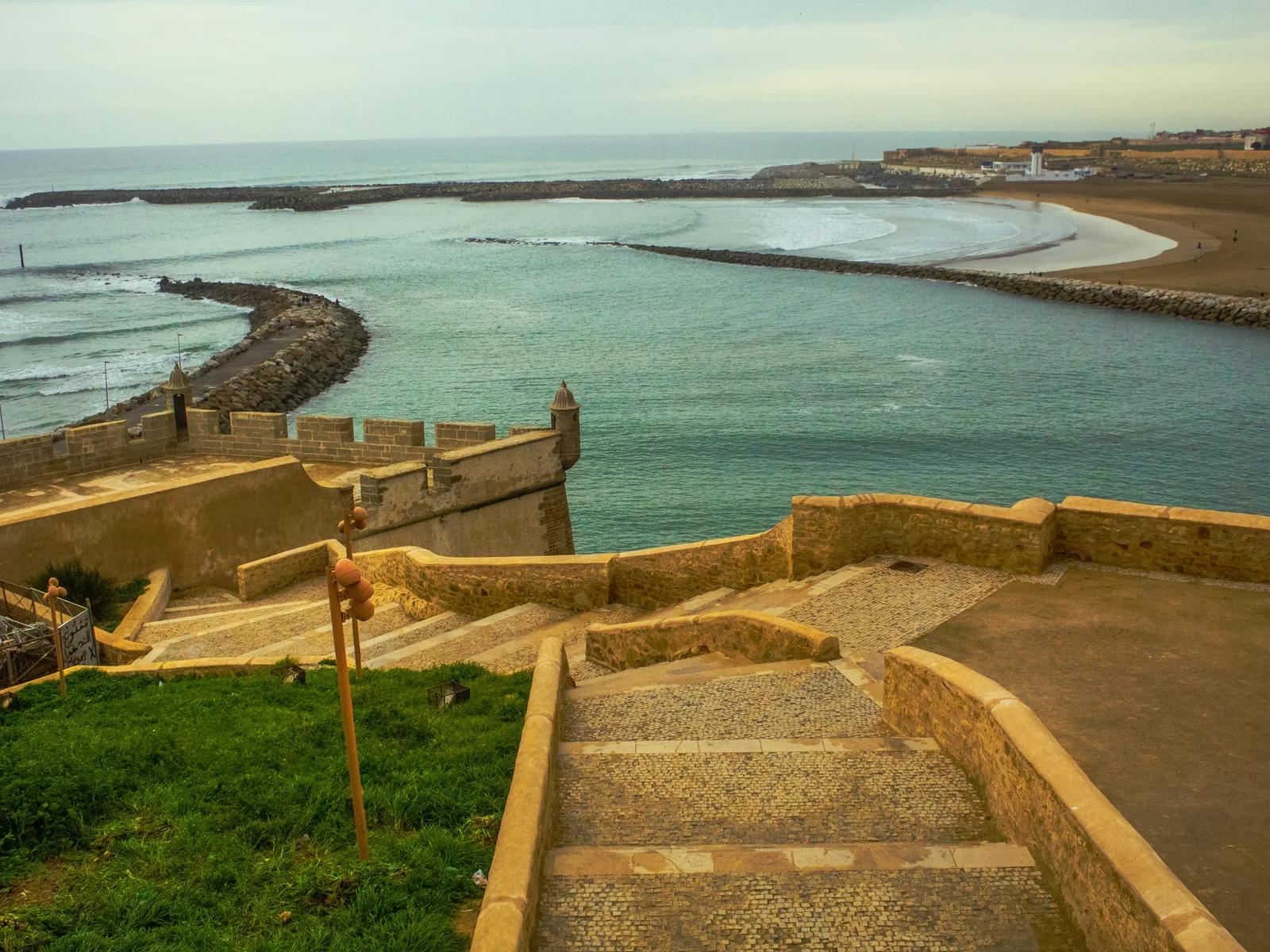
Stand at the edge of the Kasbah of the Udayas and look across the Bou Regreg toward Salé.
Today, small boats cross the water beneath a modern skyline. Families walk beside the river, fishermen work near the estuary and the Atlantic light turns the old walls from pale gold to deep ochre. It is one of the most peaceful views in Rabat.
Four centuries ago, the same river opened onto a more dangerous world.
Ships entered beneath fortified heights carrying sailors, merchants, weapons, diplomats and captives. Lookouts watched the Atlantic horizon. European representatives arrived to negotiate treaties and the release of prisoners. Communities shaped by exile, commerce and conflict built a maritime power across the two banks.
This was the world commonly remembered as the Republic of Salé.
The name is evocative, but the history is more complicated than the legend. The corsair republic was not confined to the modern city of Salé, and it was not a romantic democracy of free pirates. Its story belonged to the Bou Regreg estuary — to Salé on the northern bank and the settlement around the kasbah on the southern bank, within present-day Rabat.
The river connected them. It also divided them.
What survives is not a pirate theme park. Instead, the landscape itself holds the story: the fortified kasbah, the monumental gates, the Atlantic entrance, Salé's walls and the river that carried ships between Morocco and the wider world.
This guide follows that landscape while separating documented history from later imagination.
Follow the Young Explorer's Corsair Trail
Explore eight stops from Bab Oudaia to Salé's historic walls and complete an observation challenge at every location.

The Corsairs Return — an artistic reconstruction imagining vessels entering the Bou Regreg during the 17th-century corsair era. AI-generated; not a historical photograph or an exact architectural reconstruction.
Young Explorer's Corsair Trail
The Corsair Captain's Lost Seal
Eight fragments of an old captain's seal have been hidden across Rabat, the Bou Regreg and Salé. Follow the trail, complete each mission and recover all eight fragments. You can play entirely online — visiting the real locations is entirely optional. No boat trip, admission payment or entrance into a religious building is required at any stop.
How to Play
- Begin at the map marker numbered 1.
- Follow the dotted route across Rabat, the river and Salé.
- Select each numbered stop on the map or in the key below to open its matching mission.
- Complete the mission challenge and reveal its historical clue.
- Recover one fragment of the Captain's Seal at every stop.
- Collect all eight fragments to complete the Corsair Trail.
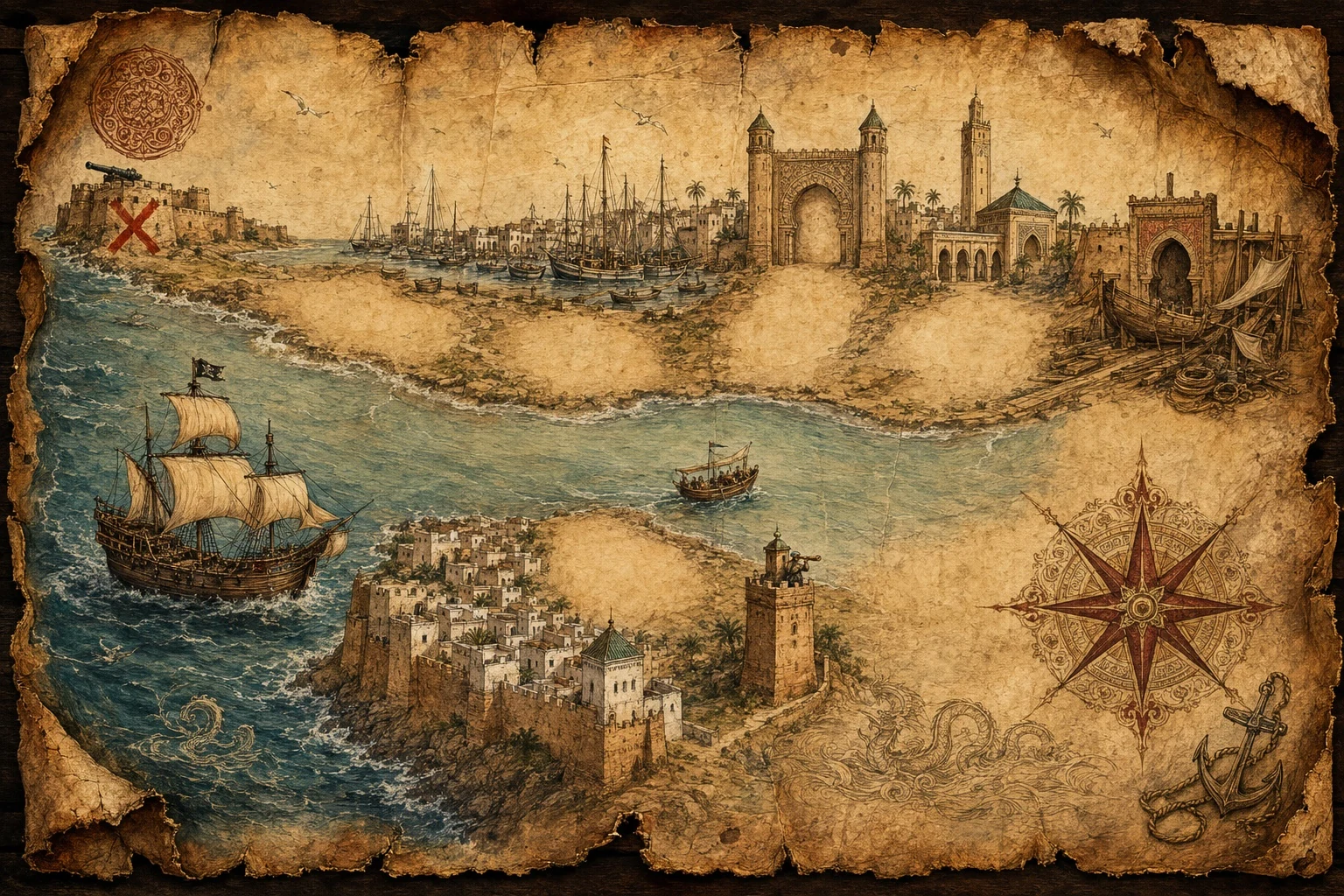
Artistic interpretive visitor map: This illustrated adventure map simplifies distances and streets for storytelling. It is not a precise navigation map. Use official directions and local signs when visiting the sites.
Map disclosure: This artistic treasure-map illustration is a stylised interpretive image created for storytelling purposes. Landmark positions are approximate and do not reflect precise geographical coordinates.
Map Key — Eight Stops
Trail Complete!
You recovered all eight fragments and followed the story of the two cities, their river, ships, defenses and people. A true explorer protects history rather than taking treasure from it.
Complete eight-stop guide (text version for all visitors)
This section provides the full trail guide in text form. All eight missions are playable entirely online — no physical visit, boat trip, or building entry is required.
- Stop 1 of 8 — Kasbah of the Udayas — Fortress Gate (Rabat, south bank): The kasbah commands a strategic position above the Bou Regreg river mouth, where defenders could watch vessels approaching from the Atlantic. Challenge: Which feature makes a fortress easier to defend — a fortified gate, an open beach, or an unprotected doorway? Answer: A fortified gate.
- Stop 2 of 8 — Semaphore Viewpoint — Captain's Lookout (Rabat, kasbah viewpoint): From this high ground, the Atlantic Ocean, the Bou Regreg below, and Salé on the opposite bank are all visible or identifiable on the illustrated map. Challenge: Using the map, which body of water lies directly west of the river mouth — the Atlantic Ocean, the Mediterranean Sea, or an inland lake? Answer: The Atlantic Ocean.
- Stop 3 of 8 — Bou Regreg Crossing — Cross the River: Small traditional boats called flouka have crossed between Rabat and Salé for centuries. Challenge: Which vessel is associated with crossing — a flouka, a desert caravan, or a railway locomotive? Answer: Flouka. Taking the crossing is optional and never required for this game.
- Stop 4 of 8 — Bouregreg Marina and Salé Riverfront — Then and Now: The waterfront has changed dramatically. Historical maritime activity replaced by a modern leisure marina. Challenge: Which phrase describes the Bou Regreg's historical past — sailing vessels and maritime trade, luxury yachts and waterfront restaurants, or a quiet fishing village? Answer: Sailing vessels and maritime trade.
- Stop 5 of 8 — Bab Lamrissa — The Sea Gate Puzzle (Salé): This Marinid gate predates the corsair republic and served as a maritime entrance connected by canal to an arsenal basin. Challenge: Why was its arch so large — to allow vessels toward naval facilities, as a purely decorative feature, or for tourist coaches? Answer: To allow vessels toward naval facilities.
- Stop 6 of 8 — Bab Dar Sinaâ — Build the Captain's Vessel (Salé): This gate is associated with Salé's former shipyard and arsenal. Challenge: Select three materials used in a historical shipyard from: timber, rope, sailcloth, porcelain dishes, stained glass, fine carpet. Answers: Timber, rope and sailcloth.
- Stop 7 of 8 — Great Mosque and Marinid Madrasa — The Scholar's Pattern (Salé medina): This stop is playable online only — do not attempt to enter the mosque or madrasa. Challenge: Which shape repeats at the heart of Marinid geometric decoration — an eight-pointed star, random curved spirals, or simple rectangles? Answer: An eight-pointed star.
- Stop 8 of 8 — Borj Adoumoue — Defend the Estuary (Salé, Atlantic coast): This coastal tower's history connects to Salé's defenses following the Castilian attack of 1260; surviving fortifications developed across later periods. Challenge: Which direction did defenders most urgently watch — the Atlantic approach, the center of the medina, or an inland garden? Answer: The Atlantic approach.
Before the Pirates: A Fortress Above the Atlantic
The Kasbah of the Udayas began long before the corsair republic.
Its position explains its importance. The rocky promontory overlooks the mouth of the Bou Regreg, the Atlantic coast and the northern bank where Salé developed. Anyone controlling this height could observe vessels approaching the estuary and defend access to the river.
A fortress existed here under the Almoravids in the early 12th century. After the Almohad conquest, the site was transformed and incorporated into an ambitious imperial project associated with Rabat — Ribat al-Fath, the "camp of victory."

The monumental gate now called Bab Oudaia or Bab Lakbir remains one of the site's most powerful architectural statements. Its carved stone decoration conveys authority as much as defense. Behind it, the kasbah developed through successive periods, carrying traces of Almohad, Andalusian and later Alaouite history.
The name "Udayas" belongs to a later chapter. UNESCO documentation associates it with the Udaya tribe installed there under Alaouite authority. During the corsair republic's early-17th-century period, the fortress did not yet carry all the meanings attached to its present name.
That distinction matters. The kasbah is both the best place to begin the corsair story and a monument whose history extends far beyond it.
Bab Oudaia (Bab Lakbir) — the Almohad-era monumental gate at the Kasbah of the Udayas, Rabat.
Exile Reaches the Bou Regreg
The transformation of the estuary accelerated after the forced expulsions from Spain in the early 17th century.
Muslim and Jewish refugees arrived in Morocco from the Iberian Peninsula. Among the newcomers were Andalusian communities carrying languages, skills, commercial relationships and painful memories of displacement. Groups settled around the kasbah and in the expanding settlement on the southern bank.
These arrivals did not enter an empty landscape. Salé was already an established Moroccan city with its own scholars, merchants, religious institutions and fortified urban identity. The two banks therefore brought together communities with different histories and interests.
Cooperation was possible because the river offered opportunity. Conflict was possible for exactly the same reason.
The Atlantic connected the Bou Regreg to trade routes, European ports and maritime warfare. The estuary offered shelter, defensive advantages and access to the ocean, although its shifting sands and difficult entrance also demanded local knowledge.
From this mixture of exile, ambition, commerce and political instability, an unusual maritime principality emerged.
When the Estuary Became a Corsair Power

The Kasbah of the Udayas, Rabat — the fortified southern-bank stronghold at the centre of the corsair republic's maritime power.
In the early 17th century, Andalusian communities established a political order around the southern-bank settlement. After revolt and realignment, the communities of the estuary formed an autonomous power commonly known as the Republic of Salé or the Republic of Bou Regreg.
The date 1627 is frequently used for the republic's formation, but its institutions, alliances and degree of independence changed over time. It existed under the shadow of Morocco's dynastic struggles rather than outside Moroccan history altogether.
The word "republic" can mislead modern readers. It should not be imagined as a contemporary representative democracy or an egalitarian brotherhood of pirates. Authority rested among powerful urban, military and commercial interests. Historians continue to examine how independent the republic was at different moments and how its communities shared power. When sources disagree, MoroccoPassport acknowledges the uncertainty rather than presenting the most dramatic version as settled fact.
What made the republic remarkable was its ability to operate as a significant Atlantic power from the mouth of one Moroccan river. Its corsairs ranged far beyond the immediate coastline. Their activities drew the attention of European states, merchants and naval forces. Diplomacy and commerce existed alongside raiding and retaliation.
For a time, the Bou Regreg was not simply the boundary between two cities. It was the center of an international maritime system.
One River, Two Cities
The expression "Salé pirates" is memorable, but it can obscure the geography.
Historic Salé stood on the northern bank. Across the water, the fortified settlement around the kasbah developed into what Europeans sometimes called New Salé or Salé-le-Neuf. That southern settlement became part of modern Rabat.
This explains why sources may use "Salé" in apparently contradictory ways. Sometimes the term refers specifically to the old city on the northern bank. In other accounts, it refers more broadly to the corsair communities and maritime activity of the entire estuary.
The Kasbah of the Udayas is in Rabat, on the southern side of the Bou Regreg. UNESCO's evaluation of Rabat notes that the kasbah became a center of municipal power during the Republic of Bou Regreg and preserves military remains associated with the Andalusian principality, including a structure identified in UNESCO documentation as the Pirates Tower. The Kasbah is not in Salé and should not be described as such.

Interpretive map of the Republic of Salé and the Bou Regreg, showing the historical relationship between Salé, Rabat, the Kasbah and the Atlantic. AI-generated; not an authentic 17th-century chart or a geographically exact survey.

The Bou Regreg viewed from the Kasbah of the Udayas, Rabat — looking north toward Salé on the opposite bank.
Across the river, Salé contributed its established urban, maritime and religious traditions. Its gates and walls still help visitors understand that the northern bank was not merely scenery viewed from Rabat. It was a historic city with its own power.
The most honest way to experience the republic today is to look in both directions. From the kasbah, look north toward Salé. From Salé, turn back toward the kasbah. The story lies in the space between them.
Pirate, Corsair or Privateer?
Popular storytelling calls the sailors "pirates." Historical writing frequently uses "corsairs."
A pirate is generally understood as a maritime raider acting without recognized government authorization. A privateer operates with permission from a political authority, usually against designated enemies. "Corsair" is a broader historical term commonly applied to Mediterranean and North African maritime raiders whose position could involve warfare, state authority, commerce and private profit.
The boundaries were not always clear. One government might recognize a corsair's authority while another considered the same person a pirate. Political legitimacy changed with treaties, dynastic power and the perspective of the observer.
MoroccoPassport uses "Salé pirates" where it helps readers find and understand the subject. Within the historical discussion, "corsairs" is usually the more careful term. Neither word should hide the consequences of their actions.
Adventure — and the Human Cost
The image of a corsair vessel crossing the Atlantic can inspire stories of daring, navigation and resistance. It can also conceal suffering.
Maritime raids produced captives. Men, women and children could be taken, confined, sold, exchanged or held for ransom. Families and religious organizations collected money for their release. European governments and diplomats negotiated over prisoners as part of treaties with North African powers.
Violence was not confined to one side. European states conducted naval attacks, imposed blockades, captured Muslim sailors and participated in their own systems of coercion, forced labor and enslavement. This broader context does not erase individual responsibility. It reminds us that the 17th-century Atlantic and Mediterranean worlds were shaped by competing empires, religious conflict, commerce and captivity. For some people, the corsair economy meant wealth or political power. For others, it meant the loss of freedom.
The Kasbah: Standing Where the Lookouts Watched
The Kasbah of the Udayas is the most evocative place from which to imagine the corsair era.
Enter through the monumental Almohad gate and the noise of the modern capital begins to fade. The lanes inside are now associated with whitewashed walls, blue paint, quiet homes and views over the water. Yet the promontory's defensive logic remains visible.
Move toward the viewpoints overlooking the estuary. The Atlantic opens to the west. Salé stretches along the opposite bank. The river below appears peaceful, but its geography reveals why this location mattered. A lookout stationed here could observe an approaching vessel before it entered the river. Defenders could monitor movement between the ocean and the interior.
The surviving architecture should not be treated as a perfectly preserved corsair stage. The kasbah was altered under successive rulers and restored in later periods. Its current gardens, residential lanes and monuments represent multiple layers of history. Visitors are not entering a frozen century. They are walking through a place repeatedly adapted by the people who controlled the estuary.
Across the Water: Salé's Maritime Memory
Salé deserves more than a distant view from Rabat.
Its old medina contains religious, educational and defensive monuments that predate and outlast the corsair republic. The city was an important center under the Almohads and Marinids, with a deeply rooted scholarly and urban culture.
Bab Lamrissa is one of the clearest reminders of Salé's relationship with the water. The monumental maritime gate dates to the Marinid period, centuries before the peak of the corsair republic. Municipal historical material from the Ville de Salé describes it as an entrance connected with a small port, ship activity and commercial exchange.
Bab Lamrissa was not built by the 17th-century corsair republic. It demonstrates that Salé's maritime infrastructure and ambitions had much older foundations. The nearby walls and gates reinforce the impression of an independent fortified city with its own long history of commerce and learning — one that should not be entirely consumed by the pirate narrative.
Within the medina, the Grand Mosque and the Marinid madrasa reveal another Salé — one shaped by worship, scholarship, craftsmanship and neighbourhood life. The corsairs form one dramatic chapter within a much longer history.
