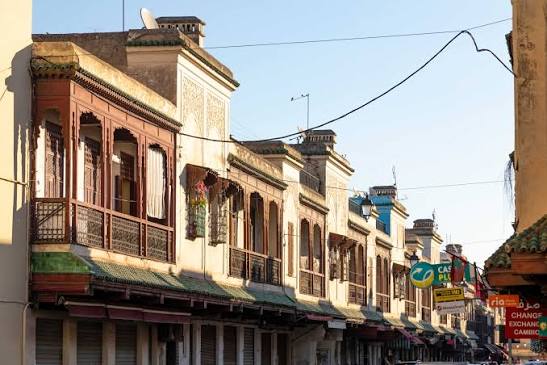
The Mellahs of Fes, Marrakech, Essaouira and Meknes are not ruins. They are not museums. They are living streets where five centuries of Jewish-Moroccan life left an architecture, a culture and a story that visitors can still read in every carved doorway and wooden balcony.
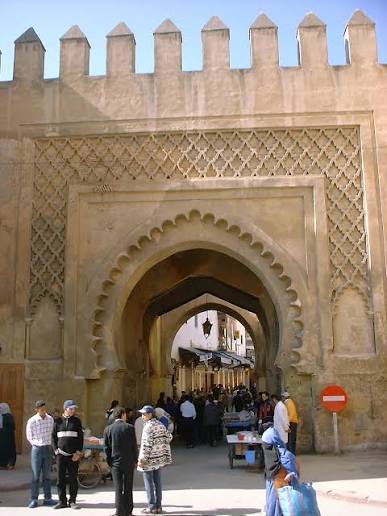
Walk through a Mellah gate and the city changes register. The sounds of the wider medina — the calls of merchants, the clatter of a copper workshop, the murmur of a souk — give way to something quieter and more intimate. The streets narrow. Wooden balconies overhang the lane, their carved fretwork filtering afternoon light into shifting patterns on the stone below. The doorways are taller than their neighbours, their thresholds worn smooth by centuries of comings and goings. Small courtyards open off the lane — former workshops, domestic spaces, communal meeting points — where cats sit in patches of sun and children's voices carry from upper floors. This is a different chapter of Morocco's story, written not in the grand script of dynasties and monuments, but in the daily language of families who built their lives here, generation by generation, across more than five centuries.
Morocco's Mellahs — the historic Jewish quarters that developed within or adjacent to the imperial cities — are among the country's most layered urban spaces. They are not ruins. They are not museums in any formal sense. They are living streets that have absorbed centuries of change while preserving, in their architecture, their synagogues, their cemeteries and the memory of their craft traditions, the material traces of a community whose roots in Morocco stretch back more than two thousand years. To walk through a Mellah with some awareness of what you are seeing is to understand Morocco at a depth that no monument, palace or panoramic viewpoint can provide alone.
Unlike the Mellahs of the popular imagination — places associated primarily with poverty and decline — the great Jewish quarters of Fes, Marrakech, Meknes and Essaouira were, at their height, centres of commerce, scholarship, craftsmanship and cultural achievement. Jewish merchants who held the title of tujjar al-sultan — merchants of the king — handled much of Morocco's international trade, financing expeditions, negotiating with European powers and maintaining commercial networks that stretched from sub-Saharan Africa to Amsterdam. Jewish artisans produced some of the finest gold and silverwork in North Africa. Jewish scholars maintained libraries of religious and legal texts of extraordinary complexity. The Mellahs they built and inhabited were not marginal spaces. They were essential threads in the urban and economic fabric of Morocco's greatest cities.
"The Mellahs were not marginal spaces. At their height, they were centres of commerce, scholarship and artistry — essential threads in the urban fabric of Morocco's greatest cities."
— MoroccoPassport Editorial- Historical period: 1438 CE (first Mellah, Fes) through the 20th century, with major emigrations between 1948 and the 1970s
- Best Mellahs to visit: Fes (oldest and most complete), Marrakech (most accessible), Essaouira (most atmospheric)
- Known for: Wooden balconies, ornate synagogues, historic Jewish cemeteries, gold and silversmithing traditions, the distinct urban character that sets them apart from surrounding medinas
- Ideal for: History enthusiasts, architecture lovers, cultural travelers, and anyone interested in Morocco's remarkable tradition of multi-faith coexistence
What Is a Mellah?
The word Mellah has carried its meaning across six centuries of Moroccan history, though its precise origin continues to generate scholarly debate. The most widely cited explanation connects it to melh, the Arabic word for salt. Some historians suggest that early Mellah residents were engaged in the salt trade; others point to the location of the first Mellah in Fes near salt marshes along the Oued Beht river valley. A third tradition connects the name to the practice of salting the severed heads of enemies before displaying them near the Jewish quarter — a grim practice recorded in early chronicles. None of these explanations is definitive, and all are historically plausible. What is certain is that the word became the standard term for Jewish quarters throughout Morocco, used equally by Muslim and Jewish residents of these cities and carrying, over time, the weight of an entire way of urban life.
The first documented Mellah was established in Fes in 1438, under the Wattasid dynasty. The decision to assign a specific quarter of the city to the Jewish community was not simply an act of segregation in the modern sense. In the framework of Moroccan political culture, Jewish communities lived under the direct protection of the Sultan — a relationship formalised in the status of dhimmi (protected people), which guaranteed Jews the right to practice their religion, maintain their own institutions and govern their own community affairs in exchange for recognition of Muslim political authority. The Mellah was therefore both a physical space and a legal category: a neighbourhood whose residents were simultaneously distinct from and woven into the fabric of the city around them — whose gate could be closed for protection during periods of instability and opened for the commerce that daily connected Mellah merchants to the surrounding souk.
Morocco's Jewish community is among the most ancient in the world. Jewish presence in North Africa predates the Arab conquest by more than a thousand years, with communities established in the region during the era of Phoenician and Roman trade — possibly as early as the 6th century BCE. The Moroccan rabbinical tradition holds that some of these ancient communities never left, meaning that Moroccan Jews are not simply an Andalusian refugee community (though many Sephardic Jews fleeing Spain in 1492 did settle in Morocco) but an indigenous people whose roots in this land are as deep as those of any other Moroccan community.
Over the following centuries, Mellahs were established in most of Morocco's significant urban centres: Marrakech in 1558, Meknes in the 17th century, and others in Essaouira, Rabat, Salé, Sefrou, Demnat and numerous smaller towns. Each developed its own distinct character — shaped by the size of its population, the nature of the local economy, the relationship between the Jewish community and the ruling power, and the specific craft and commercial traditions that took root there. But all shared the essential physical grammar of the Mellah: the proximity to the royal palace or the seat of political power, the specific architectural signatures of Jewish domestic life, the synagogues and schools (yeshivot) and communal bathhouses (mikvehs) that defined the quarter's religious and social infrastructure, and the cemetery at its edge, where the community's dead were laid beneath white plaster tombs in a landscape unlike anything else in a Moroccan city.
An Architecture With Its Own Grammar
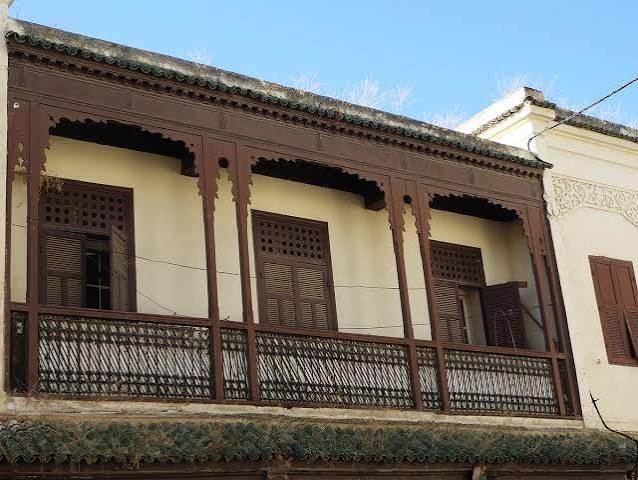
The most immediate way to recognise a Mellah is to look up. Where the streets of a Moroccan medina are typically bounded by blank walls — the privacy of domestic life being a foundational principle of traditional Islamic urban design — the streets of a Mellah are defined by the presence of overhanging wooden balconies. Projecting over the lane by a metre or more, their carved lattice screens filtering light and providing privacy for the rooms behind, these balconies are the defining architectural signature of the Jewish quarter. They appear in every historic Mellah from Fes to Essaouira, each with its own decorative character but all expressing the same underlying difference in how domestic life was oriented toward the street.
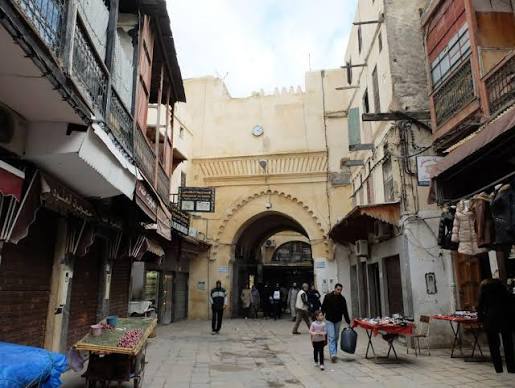
The balcony is not only an architectural feature. It is a social one. In a community whose domestic culture placed slightly different values on the relationship between private and public space than Islamic convention prescribed — where women might observe the activity of the street without being observed themselves, where a householder might call to a neighbour across the lane — the balcony performed a specific cultural function. It allowed the Mellah to be, in its visible character, a more outward-facing, more explicitly inhabited urban space than the surrounding medina. This distinction remains visible today, even in Mellahs where the original Jewish residents left decades ago.
Beyond the balconies, the architecture of the Mellah reflects a distinctive combination of Moroccan domestic tradition and specific community requirements. The houses tend to be taller than equivalent buildings in adjacent Muslim quarters — sometimes reaching four or five storeys — a response to the limited land available within a defined perimeter and a growing population. The doorways are often more elaborately carved than those of the surrounding medina, incorporating zellige tile panels, wrought ironwork and carved plaster in combinations that suggest a community whose commercial success found expression in the embellishment of its domestic facades. Interior courtyards served dual purposes: the ground floors of larger Mellah houses typically functioned as workshops, warehouses or commercial premises, with family life concentrated on the upper floors.
The wooden balconies of the Mellah are not found in the adjacent Muslim medina quarters of the same cities. This distinction — visible, immediate and still present today — is one of the clearest examples of how Morocco's historic communities developed distinct architectural identities within a shared urban framework. The balcony tradition was likely influenced by the architecture of the Andalusian Jewish communities who settled in Morocco after 1492, bringing with them building traditions from the cities of southern Spain.
Walking Through the Great Mellahs
Each of Morocco's historic Mellahs has its own character, its own relationship to the surrounding city and its own particular story. They share the same architectural grammar and the same historical role, but they differ in scale, in atmosphere and in what has survived the passage of time and the emigrations of the 20th century. The four greatest — Fes, Marrakech, Essaouira and Meknes — offer different and complementary encounters with this heritage, and a traveller who visits all four will come away with something considerably more than a single site can provide.
Fes — The Oldest and Most Complete
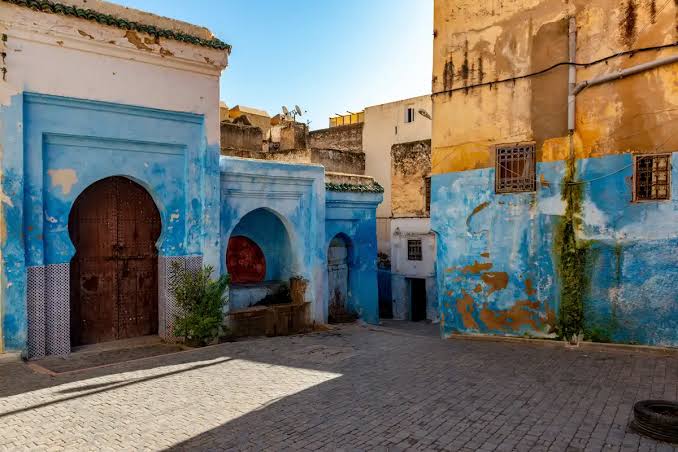
The Mellah of Fes is the oldest, and for most visitors the most resonant. Established in 1438, it lies adjacent to the royal palace — its proximity to the seat of power a reflection of the particular relationship between the Moroccan Jewish community and the ruling dynasty. The Sultan was simultaneously the guardian and, in important cases, the employer of the Jewish elite: court physicians, financial advisers, diplomatic translators and merchants whose international networks were of direct use to a sovereign conducting foreign policy across the Mediterranean. The physical closeness of the Mellah to the palace was an architectural expression of this political relationship.
The Mellah of Fes covers approximately three and a half hectares — a compact space that, at its demographic peak in the 19th century, housed a community estimated at between 8,000 and 10,000 people. This density produced the characteristic verticality of Mellah architecture: houses pushed upward when they could not expand outward, creating narrow canyons of stone and dark-painted wood. Today the quarter is largely inhabited by Muslim Moroccan families who moved in as Jewish residents emigrated through the 1950s, 60s and 70s, but the architectural character — the wooden balconies, the elaborate doorways, the synagogues and the cemetery — remains unmistakably distinct from the surrounding medina.
Enter the Fes Mellah from the Place des Alaouites, the grand square that separates the Mellah from the royal palace. Walk north through the main commercial street (Rue Sellarine) to the Ibn Danan Synagogue and then to the Jewish cemetery. The quarter is most atmospheric in the early morning, when light falls through the balconies and the commercial streets are just beginning to wake. A licensed local guide can explain the history of specific buildings and identify former synagogues and community institutions that are not marked. Allow two to three hours for a meaningful visit.
The Mellah is a living neighbourhood, not a heritage site. Dress modestly, walk quietly, and engage with the people who live there as you would in any residential area.
Marrakech — Where History Is Still Visible
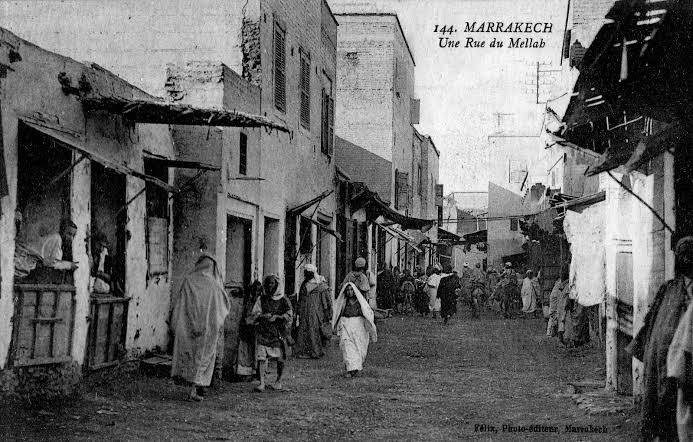
Early 20th-century postcard — Marrakech Mellah, circa 1910
The Mellah of Marrakech was established in 1558 by the Saadian Sultan Abdallah al-Ghalib, who relocated the Jewish community from their previous quarter near the Koutoubia to a new district adjacent to the Bahia Palace — following the Fes model of keeping the protected community close to the royal residence. Marrakech's Mellah developed into one of the most commercially dynamic in Morocco. Its position near the great souks of the medina gave Jewish merchants direct access to the trans-Saharan and Mediterranean trade networks that passed through the city, and the Mellah became known particularly for its jewellers, textile traders and commercial agents who handled business with European trading houses.
Today the Mellah of Marrakech is the most accessible of Morocco's historic Jewish quarters for visitors — a short walk from the Bahia Palace and the main souks, busy with a mix of commercial and residential activity, and home to the beautifully restored Lazama Synagogue. The quarter's main street, with its distinctive wooden balconies and ornate doorways, gives a vivid impression of the Mellah's former character even as the community it was built for is largely gone.
The Mellah of Marrakech is an easy addition to a walk through the southern medina. After visiting the Bahia Palace, turn north into the Mellah along the main commercial street. The Lazama Synagogue is open to visitors most mornings (a small donation is customary). The Jewish cemetery behind the Mellah is one of the most peaceful spaces in the city. From the Mellah, it is a ten-minute walk to the Djemaa el-Fna.
Essaouira — A City Built on Trade
Few Moroccan cities illustrate the specific economic role of the Jewish community as vividly as Essaouira. The city was founded in 1765 by the Alaouite Sultan Mohammed III specifically as an Atlantic trading port, and from the very beginning, Jewish merchants were central to its commercial identity. A group of specifically selected Jewish families — known as the tujjar al-sultan, the merchants of the king — were recruited by the Sultan to handle Essaouira's foreign trade, establishing commercial houses and correspondent relationships with trading firms in Marseille, Gibraltar, Amsterdam, London and Mogador (as Essaouira was then known internationally). At the height of this trading network in the mid-19th century, the Jewish community represented roughly a third of Essaouira's total population, and their commercial expertise made the city one of the most important trading ports on the Atlantic coast of Africa.
The Mellah of Essaouira retains a distinctive quality — its narrow streets, sea-bleached walls and the memory of a community that was simultaneously deeply Moroccan and internationally connected create an atmosphere unlike any other in Morocco. Walking through it today, visitors encounter traces of that remarkable commercial past in the architecture of former trading houses, the proportions of the lane network and the occasional Hebrew inscription above a doorway.
The Mellah of Essaouira is small and easy to explore on foot. Ask at your accommodation for directions to the former Jewish quarter, which lies north of the main medina. The Essaouira Jewish cemetery, outside the medina walls, is particularly well maintained and worth a visit. Combine the Mellah with the ramparts, the port and the Gnaoua music workshops for a day that covers multiple dimensions of the city's remarkable cultural history.
Meknes — The Imperial City's Hidden Quarter
The Mellah of Meknes, established during the reign of the great builder-sultan Moulay Ismail in the 17th century, reflects the imperial scale of that extraordinary ruler's ambitions. Meknes under Moulay Ismail was briefly the effective capital of Morocco, and its Jewish community — whose skills in commerce, translation, diplomacy and finance made them invaluable to a sultan who was simultaneously constructing palaces, negotiating with European powers and administering a vast empire — was among the most prosperous in the country. The Meknes Mellah is less visited than those of Fes and Marrakech but offers a quieter, more intimate encounter with this history, its synagogues and cemetery preserved and accessible.
Synagogues That Endure
Of the approximately 200 synagogues that once existed in Morocco's Mellahs, the majority closed after the emigration of their communities in the mid-20th century. A significant number have since been carefully restored — largely through the personal initiative of King Mohammed VI, whose commitment to preserving Morocco's Jewish heritage has been expressed in dozens of restoration projects funded by the Moroccan state. A handful of synagogues remain active places of worship for Morocco's small but enduring Jewish community; others function as heritage sites open to visitors; all of them stand as architectural and spiritual monuments to a tradition of religious practice maintained in Morocco across six centuries and more.
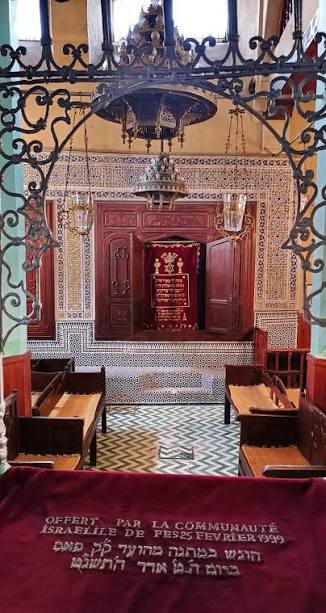
The synagogues of Morocco's Mellahs are among the most remarkable religious interiors in the country. They do not announce themselves from the outside — their entrances are often modest, set into the fabric of the Mellah streetscape with the same reserve that characterises Moroccan religious and domestic architecture generally. But the interior spaces they contain are frequently extraordinary: high-ceilinged halls whose columns, carved plaster walls and zellige tile wainscots place them squarely within the Andalusian-Moroccan decorative tradition, yet oriented and furnished according to the specific requirements of Jewish liturgical practice, with the Torah ark (aron ha-kodesh) at the eastern wall facing Jerusalem and the raised reading platform (bimah) at the centre of the hall.
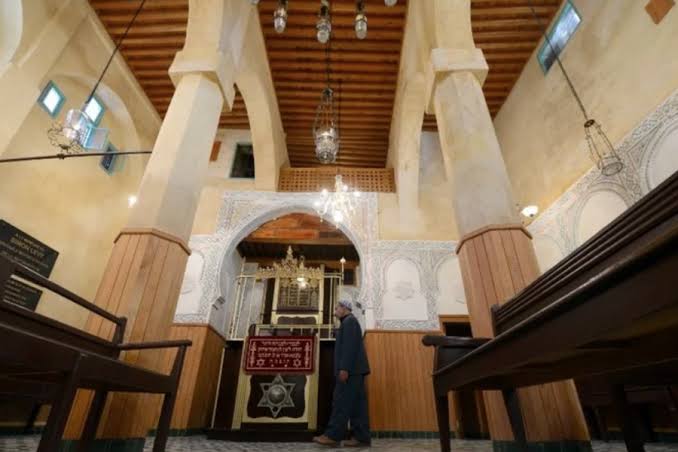
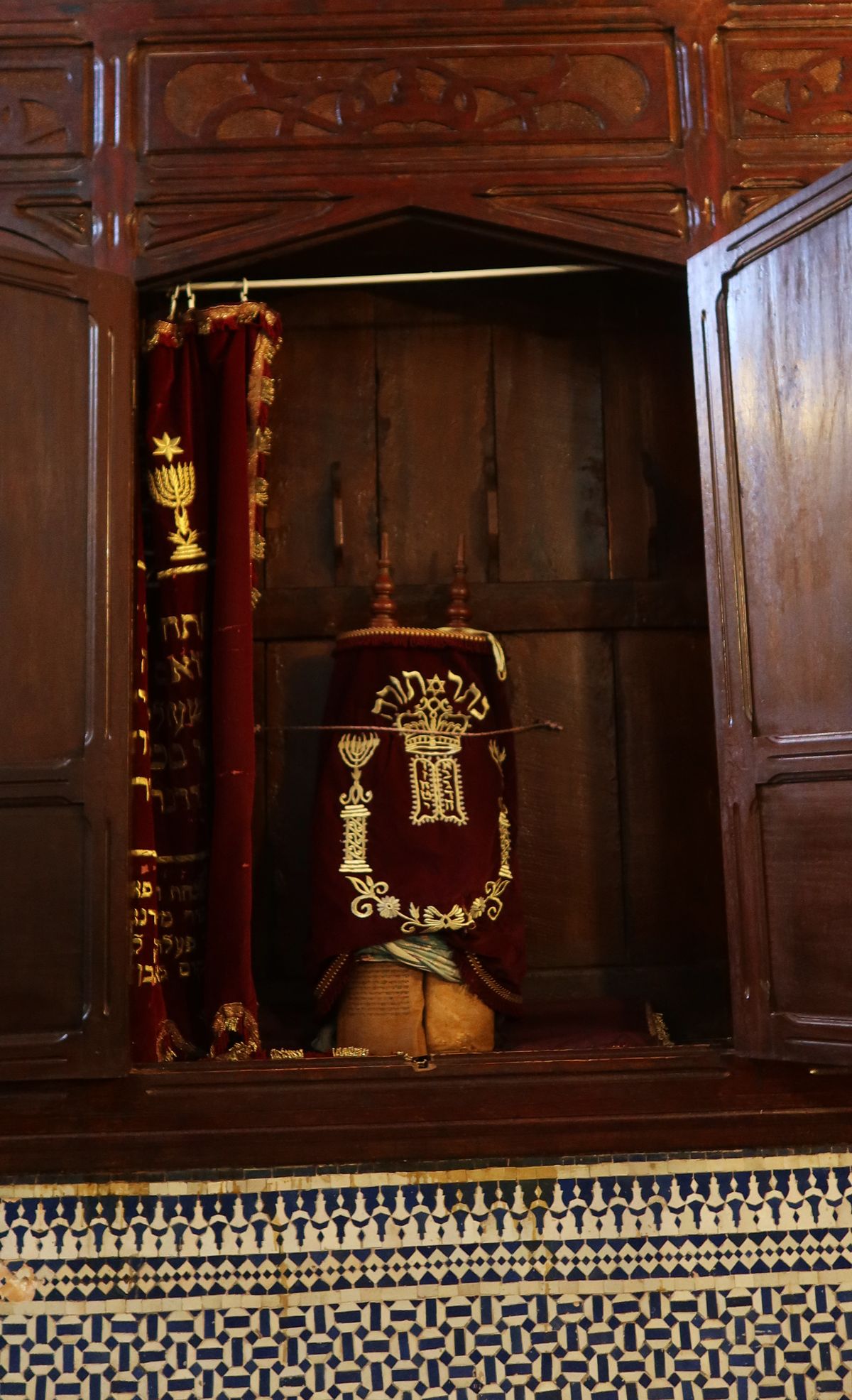
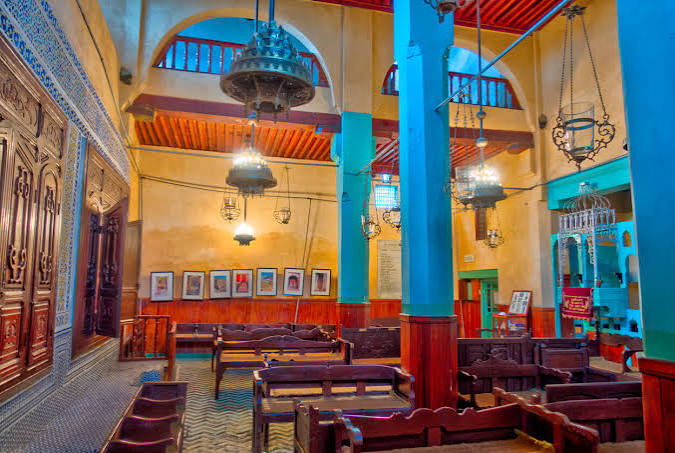
Ibn Danan Synagogue
17th century, beautifully restored in the 1990s. One of the finest examples of traditional Moroccan synagogue architecture, with zellige tilework, carved plaster and a women's gallery. Open to visitors — a modest donation is customary.
Slat Al Fassiyine
One of the oldest synagogues in Morocco, serving the community of Fes-born Jews — the "Fassiyine" — whose roots in the city predated the Andalusian arrivals. Its tall interior and cedar ceiling are outstanding. Currently undergoing further restoration.
Lazama Synagogue
Founded 1492 by Sephardic refugees from Andalusia. Its colourful interior — turquoise columns, layered lanterns, zellige floor — makes it the most visually striking Moroccan synagogue open to the public. Open most mornings.
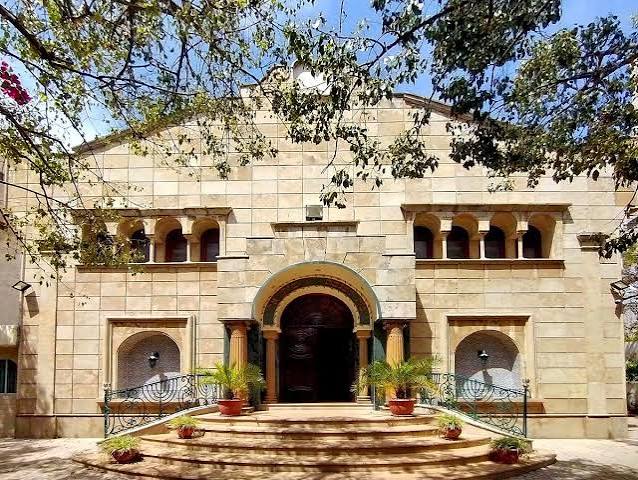
Beth El Synagogue
Morocco's most active Jewish community centre. Its modern exterior belies a functioning community of regular worshippers. Casablanca is also home to the Museum of Moroccan Judaism — the only Jewish museum in the Arab world.
The Sacred Ground
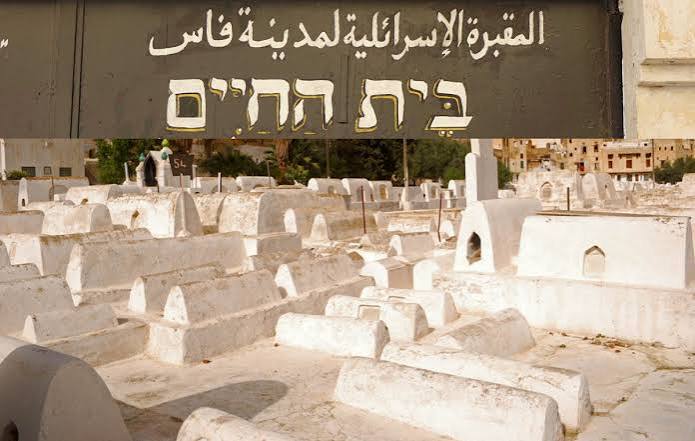
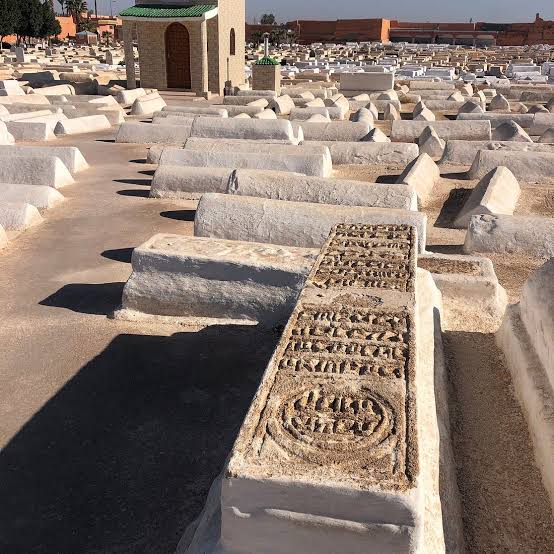
The Jewish cemeteries of Morocco are among the most moving spaces in the country — and among the most instructive for a visitor who wants to understand something about how Morocco has treated this heritage. Unlike the flowing lawns and upright monuments of European Jewish cemeteries, Moroccan Jewish graves are horizontal: white plaster tombs laid flat or nearly flat to the earth, their surfaces sometimes inscribed with Hebrew text, sometimes bearing a name and dates in French, sometimes marked only with a simple carved symbol. Arranged in dense, orderly rows across enclosed grounds, they create a landscape that is simultaneously austere and intimate, unlike anything else in a Moroccan city.
What is immediately striking about the most visited of these cemeteries — those of Fes, Marrakech and Essaouira — is that they are clean, well maintained and actively cared for. This is not a matter of institutional heritage management alone. It reflects a genuine local commitment to the maintenance of spaces that belong, in an important sense, to the shared history of the cities in which they stand. Muslim Moroccan families have lived alongside these cemeteries for generations; many have served as their custodians. The care they show is a quiet but eloquent expression of the coexistence that characterises Morocco's relationship with its Jewish heritage at its best.
"The Jewish cemeteries of Morocco are not places of absence. They are places of presence — carefully maintained, respectfully treated, a testimony to the care that Morocco continues to show for the communities that helped build it."
— MoroccoPassport EditorialAt the entrance to the Jewish cemetery of Fes, the bilingual sign is worth pausing over. In Arabic: al-maqbara al-isrā'īliyya li-madīnat Fās — the Israeli/Jewish Cemetery of the City of Fes. In Hebrew: בֵּית הַחַיִּים, Beit HaChaim — the House of the Living. The Hebrew name captures something that the Arabic does not: the Jewish tradition that death is not absence but a different mode of presence, and that a cemetery is therefore not a place of the dead but a place of the living — of those who visit, remember and maintain. The bilingual sign on the gate of the Fes cemetery, in two scripts and two languages that have coexisted in this city for six centuries, says this with extraordinary compression.
Craftsmanship, Commerce and Cultural Life
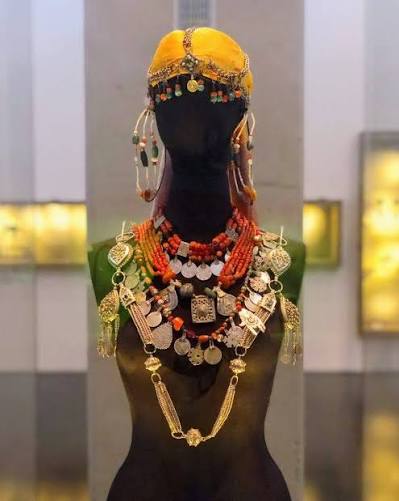
Among the many contributions of Moroccan Jewish communities to the country's cultural and economic life, perhaps none is more tangible — or more immediately visible to a visitor today — than the tradition of goldsmithing and silversmithing. Jewish craftsmen had been associated with precious metalwork in Morocco for centuries, producing jewellery whose technical sophistication and aesthetic originality placed it among the finest in the Islamic world. The tradition drew from multiple sources: Andalusian silversmithing techniques brought by Sephardic refugees after 1492, Amazigh ornamental traditions absorbed over centuries of shared life in the Atlas Mountains and the Souss Valley, and indigenous Moroccan Jewish decorative motifs that gave the work its distinctive hybrid character.
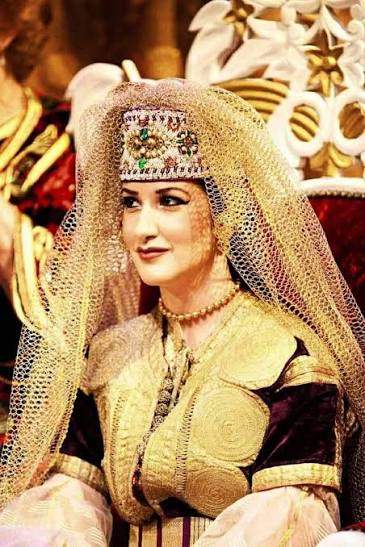
The filigree technique — the construction of jewellery from fine twisted wire rather than sheet metal, creating open, three-dimensional structures of extraordinary delicacy — was particularly associated with Jewish craftsmen in Morocco. The great parures worn by brides in traditional Moroccan Jewish weddings: elaborate assemblages of silver and gold, coral, amber, enamel and semi-precious stones that could weigh several kilograms and that represented a family's accumulated wealth displayed on the most important day of a daughter's life, were made by craftsmen whose skill was measured across generations. The techniques were transmitted through apprenticeship, father to son, master to student, in the same workshops of the Mellah that also produced domestic utensils, religious objects — Torah crowns, spice boxes, Hanukkah lamps — and the commercial metalwork that served a wider city clientele.
Beyond metalwork, the economic life of the Mellahs encompassed textile trade, leather goods, money-changing and finance (in a framework where Islamic law restricted Muslims from certain financial instruments that Jewish merchants could legally offer), international commerce and, in the most sophisticated communities, a significant involvement in diplomatic mediation. Jewish merchants who spoke Arabic, Hebrew, Spanish, French and sometimes Portuguese served as essential intermediaries between Morocco and the European powers throughout the 17th, 18th and 19th centuries, translating not merely language but the commercial and diplomatic cultures of worlds that had limited direct contact with each other.
The Moroccan-Jewish wedding tradition — with its specific music, elaborate ceremonial dress (including the distinctive keswa el kbira, the great dress), ritual foods and multi-day celebration structure — is recognised by UNESCO as an Intangible Cultural Heritage of Morocco. Though the community that created it has largely emigrated, the tradition continues to be practised and transmitted by Moroccan Jewish families in Morocco, France, Israel and North America — a living bridge between the Mellah world and the present.
A Heritage Actively Preserved
The story of Morocco's Jewish heritage in the present tense is, to a degree unusual in the broader region, a story of active institutional care and sustained political commitment. King Mohammed VI has made the preservation of Morocco's Jewish cultural sites a personal priority, commissioning and funding the restoration of synagogues, cemeteries and communal buildings in Fes, Marrakech, Meknes, Essaouira, Casablanca and other cities. Morocco's 2011 constitution explicitly recognised the Hebrew and Jewish dimensions of the country's national identity — a constitutional provision without parallel in any other Arab or Muslim-majority country. Morocco has also maintained diplomatic and cultural ties with Jewish communities in France, Israel and North America whose roots are Moroccan, creating a diaspora network that sends visitors, researchers, donors and, in some cases, returning residents back to the country of their families' origin.
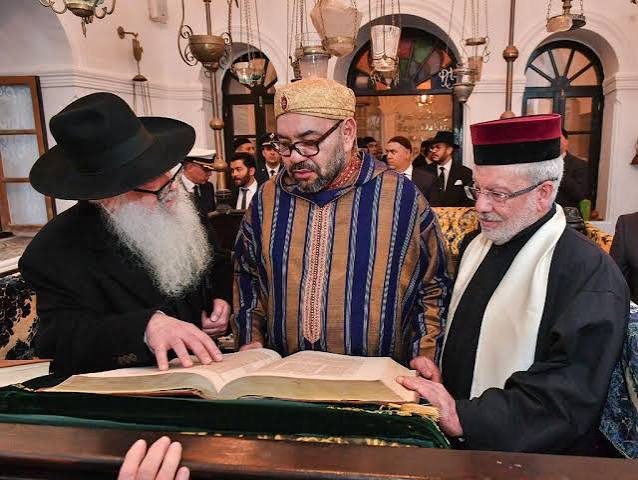
The Museum of Moroccan Judaism in Casablanca, founded in 1997 and expanded since, is the only museum dedicated to Jewish culture anywhere in the Arab world. Its collections encompass religious objects, manuscripts, textiles, photographs, domestic items and personal documents that trace the arc of Jewish life in Morocco from the ancient community through the emigration years and into the present. It is a place of scholarship and of memory — and increasingly of cultural reconnection, as younger generations of Moroccan Jews from France, Israel and North America visit to encounter, often for the first time, the material traces of the world their grandparents left.
This preservation effort is not without complexity. The great majority of the people who built the Mellahs, prayed in the synagogues and were buried in the cemeteries no longer live in Morocco. The streets they inhabited are now mostly home to other Moroccan families. The question of how to honour a heritage in the absence of most of the community that created it is one that Morocco is navigating with a degree of seriousness and political will that deserves recognition. What is preserved is not merely stone and plaster. It is an argument — made in architecture, in music, in craft tradition and in constitutional text — that Morocco's identity has always been plural, that its greatest cities were built by many hands, and that the communities whose names are now on cemeteries rather than doorways remain part of what Morocco is.
- Best time: Morning visits allow the best light in the Mellah streets and are generally quieter. Most synagogues that admit visitors are open in the morning only.
- Dress code: Men should cover their heads before entering a synagogue (a kippah may be provided at the entrance). Modest dress is appropriate throughout the Mellah.
- Guided tours: A licensed local guide who specialises in Jewish heritage will dramatically enrich the experience — identifying former community buildings, explaining the history of specific families and pointing out architectural details invisible to the uninformed eye.
- Photography: Ask permission before photographing inside synagogues and in the cemeteries. Most visitors are welcomed warmly, but courtesy is appropriate.
- Casablanca: The Museum of Moroccan Judaism (Musée du Judaïsme Marocain) is essential for any visitor interested in this heritage — allow two hours. It is located in the Oasis neighbourhood of Casablanca, a 15-minute taxi from the city centre.
Morocco's Mellahs invite a particular kind of attention — not the attention we give to palaces or panoramic views, but the attention we give to doorways. To thresholds worn smooth by generations of feet. To the marks that daily life leaves on stone over centuries. To wooden balconies whose carvings were made by craftsmen who are long gone but whose work is still standing, still filtering the same afternoon light into the same narrow lanes.
To understand a Mellah is to understand something about Morocco that no official history quite captures: that this country has been built by many hands, across many generations, by people of many traditions who found ways of living alongside each other that were sometimes imperfect, sometimes difficult, always more complex than simple narratives allow — but ultimately productive of a civilisation whose particular richness derives from its multiplicity. The wooden balconies, the restored synagogues, the bilingual signs above cemetery gates, and the commitment of a king to preserve buildings that his own community did not build — all of this is evidence not of a lost world but of a world that was genuinely shared. And a world that was genuinely shared leaves traces that are worth seeking out, worth walking to, worth the time it takes to stand in a quiet Mellah courtyard and let the history of the place do what history can do when given the opportunity: speak.
Together with the Amazigh civilisation, the Andalusian legacy and the many other cultural threads that have woven themselves into Moroccan identity across millennia, the Mellahs form one of the most meaningful chapters in one of the world's richest civilisational stories. They are there to be read, lane by lane, doorway by doorway, by anyone willing to look.
Continue Exploring
More from the Roots of Morocco collection — and the cities where this history comes alive.