In This Guide
In July 2022, FIFA awarded the 2030 FIFA World Cup to a historic tri-continental hosting bid: Morocco, Spain and Portugal in Europe and Africa, with the centenary celebration opening matches taking place in Argentina, Uruguay and Paraguay — the birthplace of the first World Cup in 1930. For Morocco, it is the culmination of a journey that began with failed bids in 1994, 1998, 2006 and 2010. The fifth time, the dream becomes reality.
Morocco's hosting preparation is the most ambitious infrastructure programme in the country's modern history. A new stadium is being built that will be the largest in the world. High-speed rail links are being extended. Five existing stadiums are being expanded and renovated to FIFA specifications. And the six host cities — Casablanca, Rabat, Marrakech, Fes, Tangier and Agadir — are each investing in their international visitor infrastructure with a scale and urgency not seen since Hassan II's reign.
Tournament Overview
2030 FIFA World Cup — Key Facts
Tournament: FIFA World Cup 2030 (23rd edition) · Host nations: Morocco, Spain, Portugal (main tournament) + Argentina, Uruguay, Paraguay (centenary matches) · Format: 48 teams, 104 matches · Moroccan venues: 6 stadiums across 6 cities · Final venue (expected): Grand Stade Hassan II, Casablanca
The 2030 tournament marks the centenary of the FIFA World Cup — the first was held in Uruguay in 1930. To honour this, FIFA awarded three matches to South America: one in Buenos Aires (Argentina), one in Montevideo (Uruguay) and one in Asunción (Paraguay). These three games precede the main tournament, which is then hosted across Morocco, Spain and Portugal.
Morocco is widely considered the frontrunner to host the tournament's Final at the Grand Stade Hassan II in Casablanca — a role that would reflect Morocco's central place in the joint bid. The country is set to host group stage matches, Round of 16 games, quarter-finals and potentially semi-finals, with the Final allocation to be confirmed by FIFA.
Morocco is building and renovating six stadiums for the 2030 FIFA World Cup
Grand Stade Hassan II — The World's Biggest Stadium
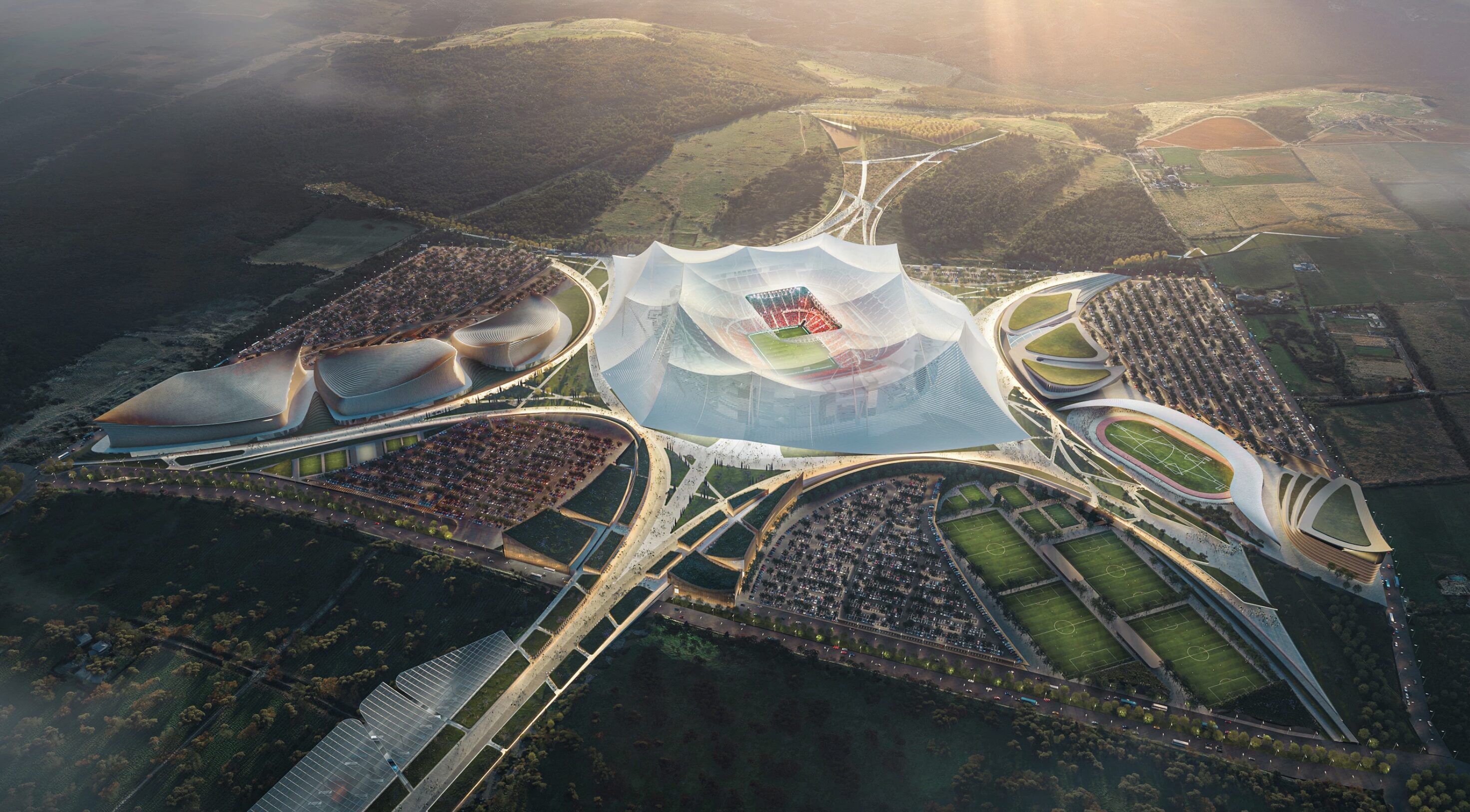
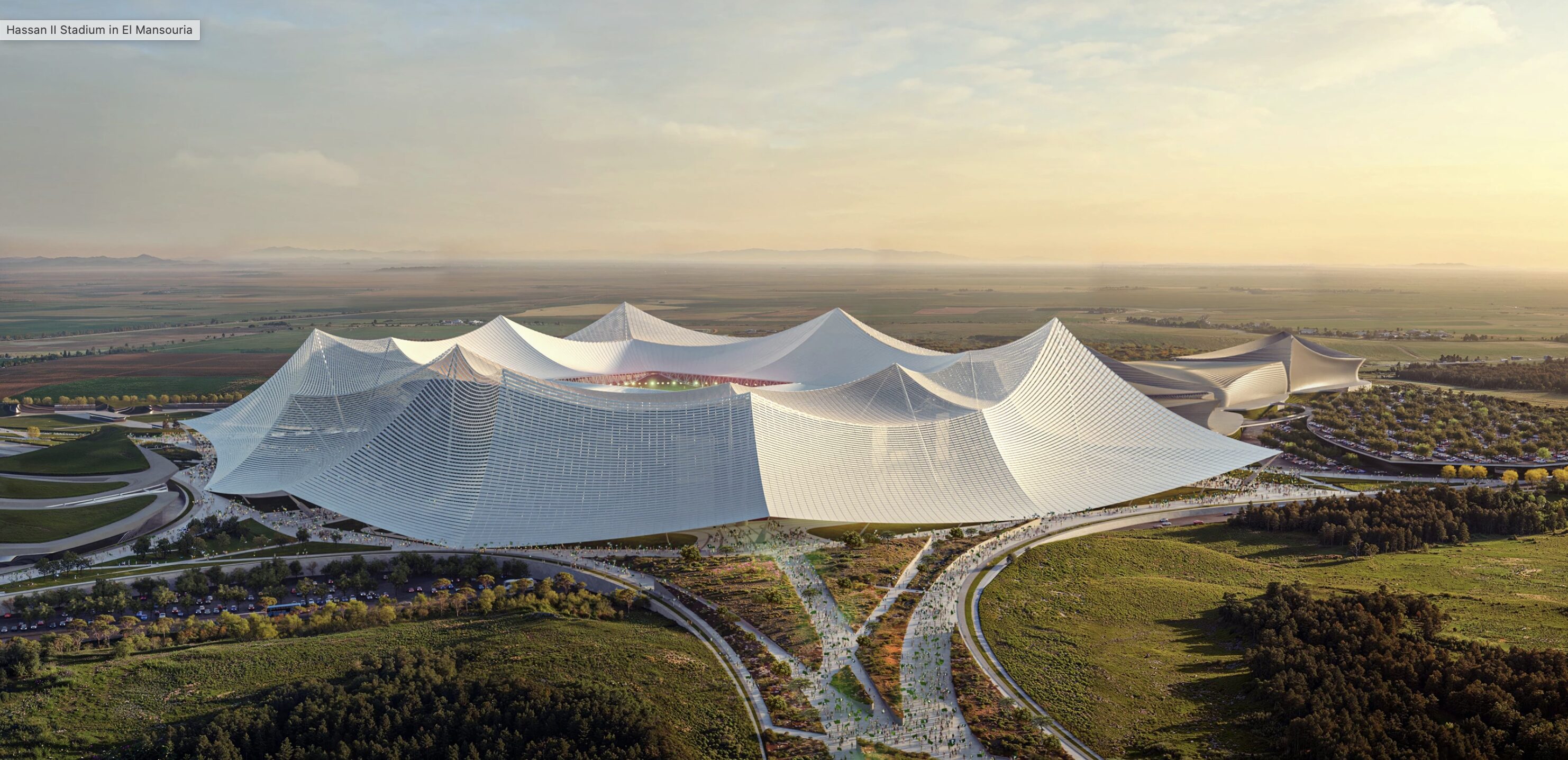
The centrepiece of Morocco's World Cup preparations is the Grand Stade Hassan II in Casablanca — a purpose-built arena that will surpass the Narendra Modi Stadium in India to become the largest football stadium in the world, with a planned capacity of approximately 115,000 spectators.
Location: Bouskoura, south of Casablanca city centre · Capacity: ~115,000 · Status: Under construction · Architect: Populous (UK) in partnership with Moroccan firms · Design inspiration: traditional Moroccan geometric patterns and zellige tilework · The stadium is widely expected to host the 2030 World Cup Final, pending official FIFA confirmation.
The stadium's design draws explicitly on Moroccan architectural heritage — the roof structure references the geometric complexity of Moroccan tilework and the muqarnas vaulting of imperial mosques. At full capacity, it will hold more people than any other football-specific stadium on earth. The site at Bouskoura was chosen for its transport connectivity — new roads and planned rail links will allow rapid movement of supporters to and from central Casablanca and the airport.
Beyond 2030, the Grand Stade Hassan II is designed to serve as a venue for the African Cup of Nations, Champions League finals, and other major international events, positioning Casablanca as Africa's premier sports event destination.
Morocco's Six 2030 World Cup Stadiums
Grand Stade Hassan II
The world's largest stadium — purpose-built for the 2030 Final in Bouskoura, south of Casablanca. Widely expected to host the Final, pending official FIFA confirmation.
Complexe Sportif Prince Moulay Abdellah
Rabat's national stadium, expanded and renovated to FIFA specifications. Located 5 km from the city centre, close to the Mohammed V Mausoleum and the UNESCO medina.
Grand Stade de Marrakech
Rebuilt on the site of the existing Marrakech stadium, this venue will bring World Cup action to Morocco's most visited tourist city — combining football with the magic of the Djemaa el-Fna.
Grand Stade de Fès
The ancient imperial city of Fes gets a world-class stadium to complement its UNESCO World Heritage medina. Visitors can experience a match and the world's oldest university within the same day.
Grand Stade de Tanger (Ibn Batouta)
Named after the great Moroccan medieval explorer, Tangier's stadium sits near the gateway to Africa from Europe — offering fans a unique dual-continent experience with Spain visible across the strait.
Complexe Sportif d'Agadir
Morocco's Atlantic beach city gets its World Cup moment. Fans can enjoy matches and spend their days on a 10 km Atlantic beach — making Agadir the most resort-friendly of Morocco's host cities.
Morocco's Six Host Cities
Morocco's six host cities span the length and breadth of the country, offering visitors a complete portrait of Moroccan civilisation — from the imperial medinas of Fes and Marrakech to the Atlantic beaches of Agadir, the strait-view kasbah of Tangier and the elegant capital of Rabat.
Casablanca
Final Venue (Expected) · Grand Stade Hassan IIMorocco's economic capital — home to the Hassan II Mosque, art deco heritage and the new Grand Stade Hassan II.
City Guide → 👑Rabat
Royal Capital · UNESCO MedinaThe royal capital with Hassan Tower, Kasbah des Oudaïas and Morocco's most underrated medina.
City Guide → 🌹Marrakech
Imperial City · Djemaa el-FnaThe Red City — souks, riads, the Djemaa el-Fna and the High Atlas mountains on the horizon.
City Guide → 📜Fes
Ancient Capital · Al-Qarawiyyin UniversityFes el-Bali — the world's largest car-free urban area and home to the oldest university on earth.
City Guide → ⚓Tangier
Gateway City · Strait of GibraltarWhere Africa and Europe face each other across the strait — kasbah, literary history and the ferry from Spain.
City Guide → 🏖Agadir
Atlantic Beach · Year-Round SunTen kilometres of Atlantic beach, world-class surf and Morocco's most resort-friendly atmosphere.
City Guide →Fan Travel Guide — Planning Your 2030 Trip
Visas for Morocco in 2030
Citizens of most European Union countries, the United Kingdom, the United States, Canada and Australia can currently enter Morocco visa-free for up to 90 days. This is expected to remain the case for the World Cup, with FIFA and Morocco working to ensure streamlined entry for all visiting supporters. Check the current visa requirements for your nationality well in advance — the situation may evolve as the tournament approaches. See our Morocco Visa Guide for full details.
When to Book
Hotel capacity in Morocco's six host cities will come under significant pressure during the tournament. Lessons from Qatar 2022 (where late bookers faced extreme shortages) apply: book accommodation as early as possible once official match schedules are released — ideally within days of announcement. Morocco's hotel infrastructure is expanding significantly in preparation, but demand from 48 competing nations' fans will be intense.
Tickets
FIFA ticket sales for the 2030 World Cup are expected to open through the official FIFA platform in 2028–2029. Only purchase tickets through official FIFA channels. Secondary market resale (tout) tickets carry significant risks of fraud and will be refused entry at venues. Sign up to FIFA's official newsletter for early notification of ticket sale phases.
✈️ Start Planning — Flights to Morocco
Casablanca's Mohammed V Airport (CMN) is Morocco's main international hub with connections to every major European city. Marrakech Menara (RAK) and Agadir Al Massira (AGA) also serve direct European routes.
Search Flights to Morocco → Powered by Skyscanner · We may earn a commission at no cost to youGetting Between Morocco's Host Cities
Al Boraq High-Speed Rail (TGV)
Morocco's Al Boraq TGV currently connects Tangier to Casablanca via Kenitra in approximately 2 hours 10 minutes — one of the fastest rail services in Africa. Extensions are planned or under construction for the World Cup period, including improved connectivity to Rabat and potentially towards Marrakech. This is the most comfortable and reliable way to travel between northern host cities.
ONCF Train Network
Morocco's conventional ONCF rail network connects Casablanca to Rabat (45 min), Casablanca to Marrakech (3 hrs), and Casablanca to Fes (4.5 hrs). The network is reliable, air-conditioned and significantly cheaper than rental cars or taxis for long distances. Advance booking is advisable during busy periods.
Domestic Flights
Royal Air Maroc, Air Arabia Maroc and Ryanair operate domestic routes between Moroccan cities. Agadir–Casablanca (1 hr) and Marrakech–Tangier are particularly useful connections given the road distances involved. Domestic flights will likely sell out quickly around match days.
Rental Car
Morocco has an excellent motorway network — the A1 (Tangier–Casablanca–Marrakech) and A2 (Casablanca–Fes) are fast, well-maintained and toll-operated. A rental car gives maximum flexibility between matches and is the best option for exploring Morocco beyond the host cities. See our Morocco Car Rental Guide for full advice.
🚗 Rent a Car in Morocco
Drive between host cities at your own pace and explore Morocco's extraordinary landscapes along the way.
Compare Car Rental in Morocco → Powered by Rentalcars.com · We may earn a commission at no cost to youWhere to Stay During the World Cup
Morocco's hotel stock ranges from international five-star chains (Four Seasons, Sofitel, Hyatt, Fairmont are all present in multiple cities) to hundreds of boutique riads in medinas. The riad experience — a private room around a tiled courtyard — is uniquely Moroccan and completely unlike hotel accommodation anywhere else in the world. Book riads directly where possible for the best rates and most authentic experience.
- Casablanca — Large hotel supply; book early given the Final venue status. Sidi Maarouf and the city centre have the best options.
- Rabat — Smaller hotel supply than Casablanca but easier to get around. The medina riads are excellent.
- Marrakech — Largest riad supply in Morocco; hundreds of options. Medina riads should be booked 18+ months ahead for peak World Cup dates.
- Fes — Medina riads in Fes el-Bali are the right choice. Several have been restored to extraordinary standards.
- Tangier — Growing boutique hotel scene in the Kasbah and Ville Nouvelle. Supply is smaller — book early.
- Agadir — Morocco's largest resort hotel supply; all-inclusives and beach hotels are available in volume. Easiest city for last-minute accommodation.
🏨 Find World Cup Accommodation
Compare hotels, riads and apartments across all six Moroccan host cities — and lock in your dates before they sell out.
Browse Morocco Hotels → Powered by Booking.com · We may earn a commission at no cost to you