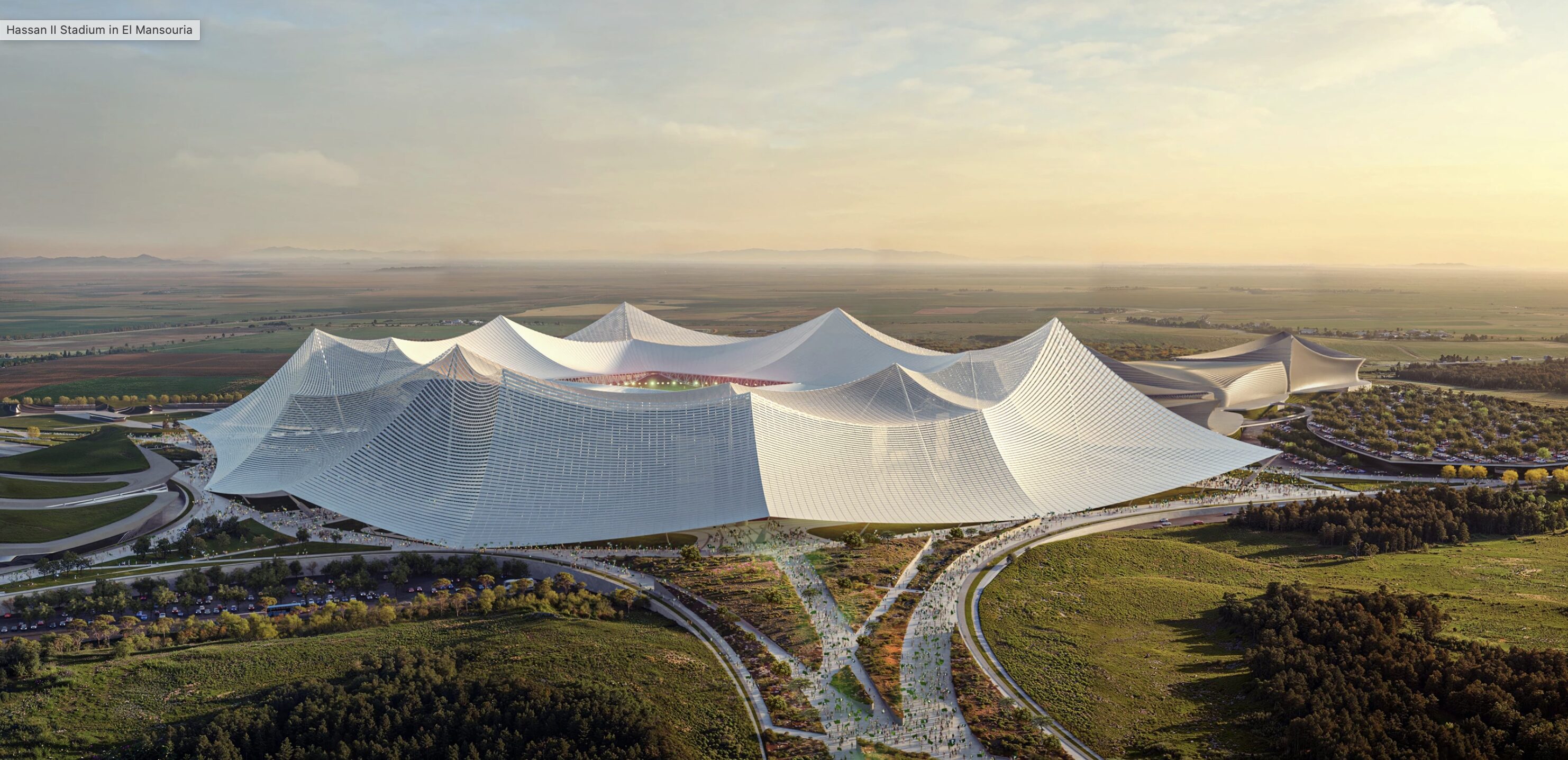
When Morocco submitted its joint bid for the 2030 World Cup, one project stood apart from the rest. Not a renovation of an existing ground. Not a modestly enlarged club stadium. A new arena, built on raw land in El Mansouria, Benslimane Province, approximately 38 kilometres north/northeast of central Casablanca, designed to seat approximately 115,000 people — one of the largest football stadiums proposed anywhere in the world.
The Grand Stade Hassan II does not yet exist in finished form. Its foundations are in the ground and its structural frame is taking shape, but much of what will define it remains in future tense: designed to become, planned to host, proposed to seat. That distinction — between what is under construction and what has been officially confirmed — runs through everything written about this stadium, and must continue to do so.
This article examines what is known, what is planned, what remains officially unconfirmed and what questions the stadium will need to answer in the years ahead.
A Stadium Born from a National Ambition
Morocco's relationship with the World Cup is long and, until recently, defined by absence. The Kingdom submitted unsuccessful bids for the right to host the tournament in 1994, 1998, 2006, 2010 and 2026. Five campaigns. Five rejections.
The joint bid with Portugal and Spain — which entered the bidding process as sole candidate in October 2023 — changed that history permanently. On December 11, 2024, the FIFA Congress formally appointed Morocco, Portugal and Spain as co-hosts of the 2030 edition. Centenary celebration matches were also confirmed in Argentina, Paraguay and Uruguay.
For Morocco, the confirmation did not arrive in isolation. It arrived alongside a national construction programme that had been developing for years: high-speed rail lines, airport expansions, urban transport upgrades, new hotels and — at the centre of it all — one of the most ambitious sporting infrastructure projects Morocco has undertaken.
The project reflects a longer Moroccan ambition to build a major stadium for Casablanca, while the 2030 World Cup accelerated its delivery and gave it an international deadline. That distinction matters when evaluating what this stadium is, and what it must become.
The Site: El Mansouria, Benslimane Province
The Grand Stade Hassan II is located in El Mansouria, Benslimane Province, approximately 38 kilometres north/northeast of central Casablanca. The location was chosen for reasons that are both practical and constraining.
On the practical side: scale. A stadium designed for 115,000 spectators, with the surrounding access roads, transport nodes, training facilities, parking infrastructure and operational zones that a venue of this size demands, cannot be inserted into an existing urban neighbourhood. The El Mansouria site provides the land footprint that Casablanca's developed districts cannot.
The stadium forms part of the proposed Morocco Sport City complex — a planned development that includes training pitches, athlete accommodation and supporting facilities. The project reflects a longer Moroccan ambition to build a major stadium for Casablanca, while the 2030 World Cup accelerated its delivery and gave it an international deadline.
The constraint is distance. Between El Mansouria and the established hotel districts, transport terminals and commercial zones of Casablanca lie approximately 38 kilometres of road and planned rail connections that thousands of supporters will need to traverse for every major match. The transport infrastructure connecting the city to the site is as critical a part of the project as the stadium itself — and it must be fully operational before the first match day.
The Design: The Moussem as Architecture
The Grand Stade Hassan II was designed by Oualalou + Choi in collaboration with Populous. Oualalou + Choi is the Paris-based architectural practice led by Moroccan architect Tarik Oualalou and Linna Choi, while Populous brings extensive international stadium expertise. Their consortium won the project's architectural design competition in 2024.
The stated design concept departs from the ornamental vocabulary most commonly associated with major regional stadium projects. Rather than drawing primarily on Islamic geometric tilework — the zellige tradition — or Andalusian architectural ornament, the architects described their inspiration as the moussem: Morocco's great seasonal gatherings, events at which tens of thousands of people assemble in open space to mark saints' days, equestrian traditions and community belonging.
The moussem is not an aesthetic reference. It is a social one — about congregation, movement, dispersal and return. As the conceptual anchor for a stadium, it points toward circulation, human scale and collective experience rather than surface decoration. A building organised around how people move together, not how its exterior looks from a distance.
How faithfully this concept translates into the completed structure remains to be seen. Architectural inspiration and executed detail are not always identical. But the concept, if honoured in the build, would produce a stadium defined by the quality of the crowd experience — which, for a venue expected to fill 115,000 seats at major events, is the appropriate priority.
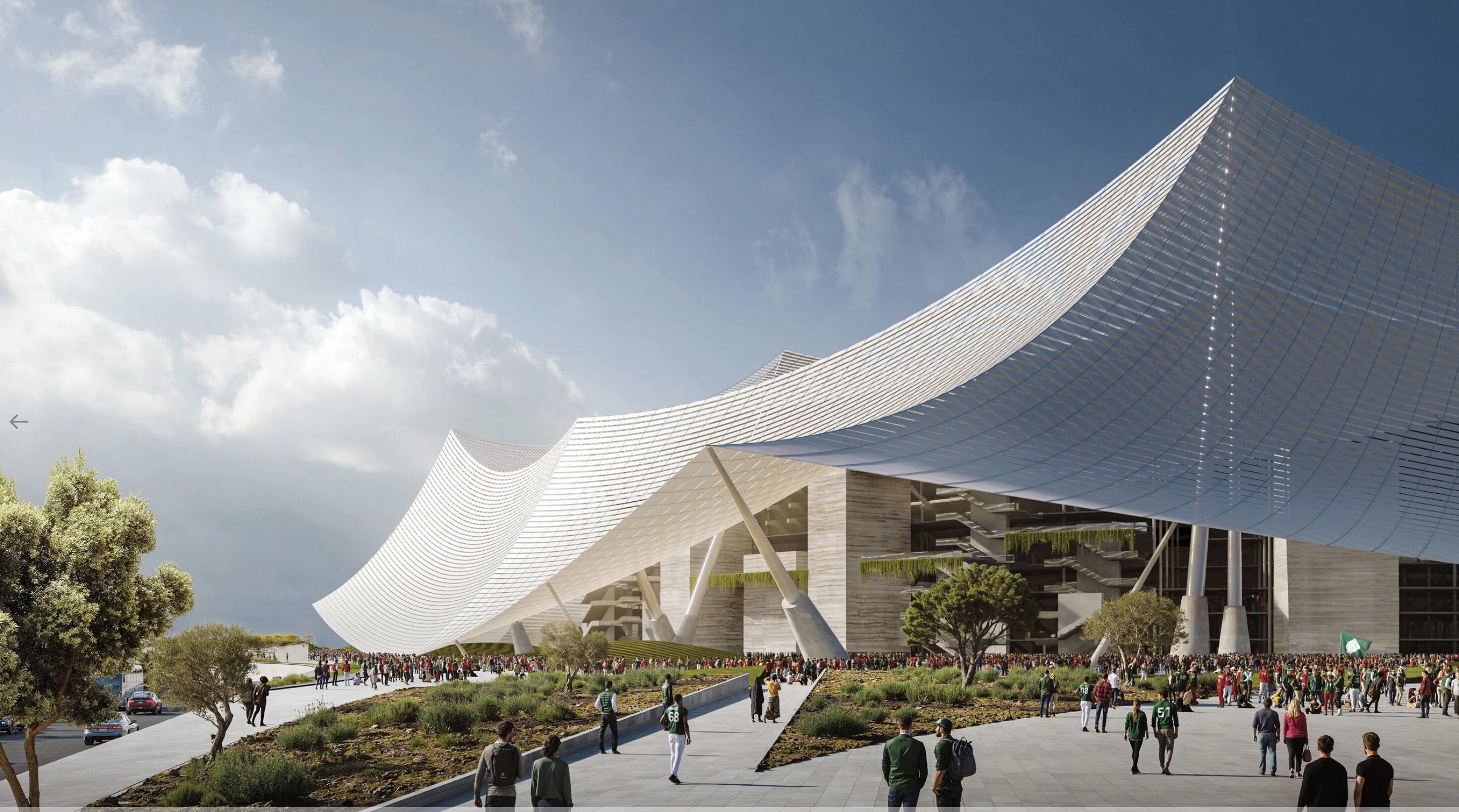
Interior bowl — architectural rendering. The proposed 115,000-seat configuration would make the Grand Stade Hassan II one of the world's largest football stadiums. Interior bowl design, roof structure and sight-line layout shown here represent the architectural concept as submitted. ⚠ Rendering — not a photograph of the completed venue.
Construction: Where Things Stand
Construction on the Grand Stade Hassan II is underway. During a May 2026 site visit, project official Yassir Soussi told Reuters that the stadium was approximately 30% complete, with around 40% of the tribunes constructed.
The official joint-bid documentation originally scheduled completion during 2028. In May 2026, a project official told Reuters that completion was being targeted for the end of 2027. The more recent target is now the working schedule, but it remains a construction objective rather than a guaranteed delivery date. If achieved, a 2027 completion would allow roughly three years for fitting-out, safety inspection and certification, operational testing and the staging of preliminary events before the tournament begins.
The Moroccan government has established a dedicated stadium project monitoring committee to track progress across all six bid venues. Morocco's six proposed stadium locations — Casablanca, Rabat, Tangier, Marrakech, Fez and Agadir — represent a range of new-build and renovation projects at different stages of development. The Hassan II project is the largest and most complex individual build in the programme.
Grand Stade Hassan II — Project Status
Updated July 2026 · May 2026 progress reported by a project official during a Reuters site visit| Main construction works | Under construction · ~30% complete May 2026 |
| Wider Morocco Sport City complex | Officially planned · delivery varies by component |
| Completion — current working target | End of 2027, reported May 2026 (Reuters) |
| Completion — original bid-book schedule | During 2028 (official bid documentation) |
| Transport links to El Mansouria site | Planning phase · specific links TBC |
| Wydad + Raja — home venue | Planned post-completion |
| 2030 World Cup Final allocation | Not yet decided by FIFA |
The Aerial View: Scale and Setting
Seen from above in the architectural renderings released through the bid documentation, the Grand Stade Hassan II is positioned within a wider landscape of training fields, approach roads and open space. The proposed Morocco Sport City complex it anchors is planned to include training facilities, accommodation and support infrastructure — while remaining connected to the wider Casablanca–Rabat corridor by road and planned rail links.
The scale visible from an aerial perspective also makes clear why existing urban sites could not accommodate a build of this size. The footprint of the stadium alone — the bowl, the concourses, the exterior circulation zones and the approach infrastructure — requires open land of a type simply unavailable within Casablanca's developed urban core.
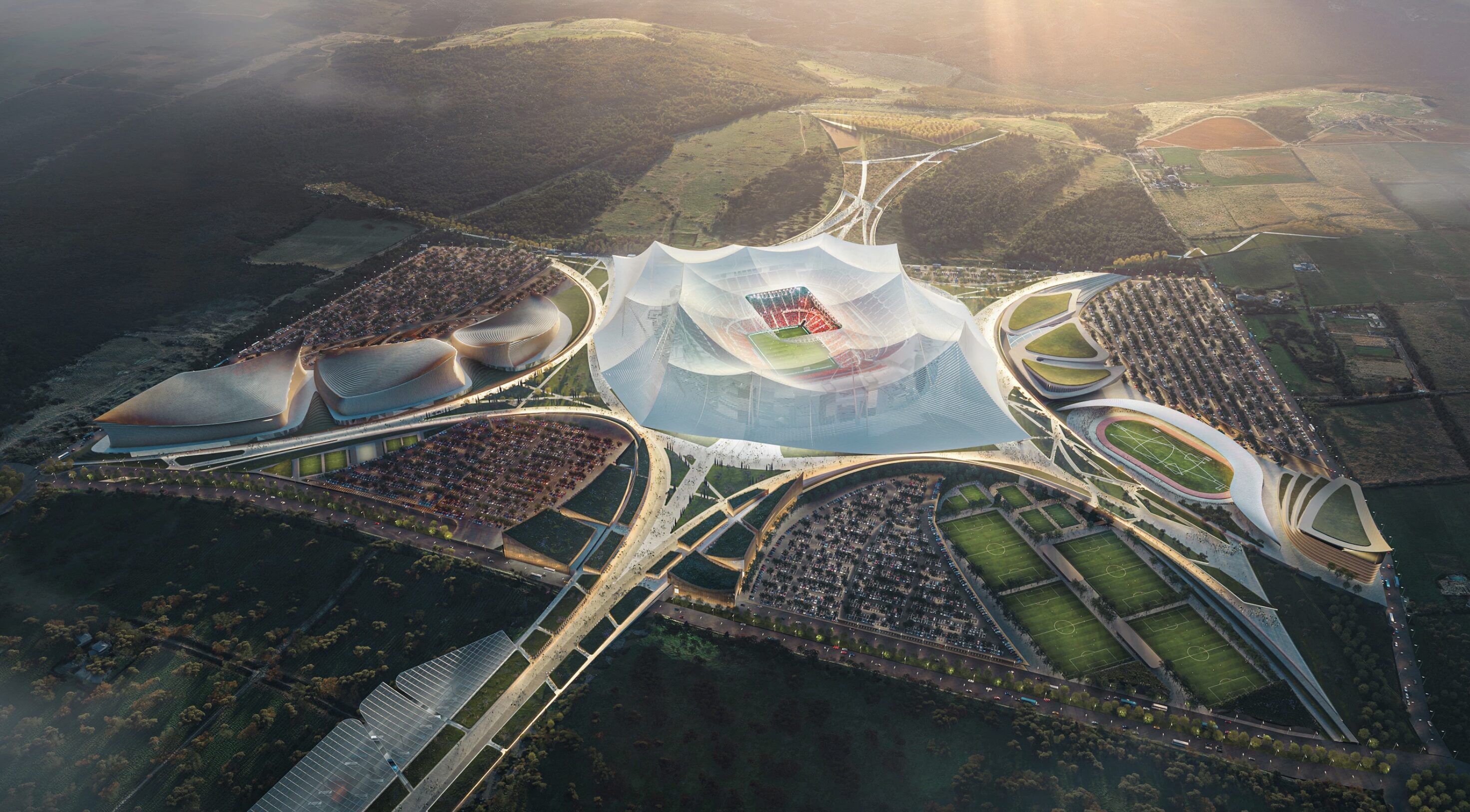
Aerial view — architectural rendering. The Grand Stade Hassan II sits within the proposed Morocco Sport City complex in El Mansouria, Benslimane Province. The surrounding development is officially planned; the delivery of individual components varies. ⚠ Rendering — not a photograph of the completed venue.
The Clubs: Wydad and Raja
The Grand Stade Hassan II is not being built as a tournament-only venue. Upon completion, it is planned to become the permanent home of two of Morocco's most historically significant football clubs: Wydad Athletic Club and Raja Club Athletic, both based in Casablanca and both with national and international followings that extend well beyond the city.
Wydad and Raja represent more than club football. The Casablanca derby between them is one of the most intensely followed fixtures on the African continent — a match that defines loyalties across generations, divides families, and draws emotional investment from Moroccans in Casablanca, across the country, and throughout the diaspora worldwide. Both clubs have competed at the top level of the CAF Champions League, Africa's flagship club competition. Both carry commercial weight that extends into broadcasting, merchandising and supporter culture.
A shared stadium of this scale raises questions that are standard for any multi-tenant modern venue: how scheduling, commercial revenue, branding and supporter experience are managed when two distinct clubs with distinct identities share a building that carries the name of neither. These challenges have been resolved successfully at other venues around the world. They require planning, clear contractual agreements and sustained management — and those arrangements are most effective when developed before the stadium opens, not after it.
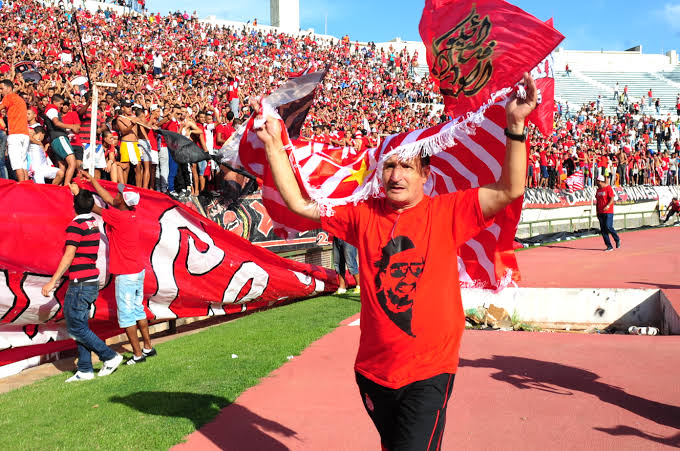
The Casablanca derby. Wydad AC and Raja CA — Morocco's two most supported clubs — are planned to share the Grand Stade Hassan II as their permanent home following completion. The derby between them is one of African football's most passionate fixtures.
Reaching the Stadium: The Transport Question
Moving 115,000 people to a venue approximately 38 kilometres north/northeast of Casablanca is a logistical undertaking that no stadium design can resolve on its own. The transport plan is as consequential as the architectural one — and, uniquely here, an official proposal already exists in the bid documentation.
The official joint-bid documentation proposes a station approximately one kilometre from the stadium, served by metropolitan rail from Casablanca and Rabat and by the expanded high-speed network. It presents target journey times of approximately 15 minutes from Casablanca, 20 minutes from Rabat and 20 minutes from Mohammed V International Airport. The bid also proposes match-day shuttle services. These are official plans, not currently operating stadium connections; their construction status, final service pattern and delivery schedule require continued verification.
The wider intercity network is already partly in place. The Al Boraq high-speed service connects Casablanca to Tangier via Kenitra and Rabat, and the expanded Kenitra–Marrakech line under construction will extend the high-speed footprint further. For supporters travelling from other host cities, these intercity connections are a genuine advantage. The critical question specific to the Grand Stade Hassan II is whether the station and last-mile services proposed in the bid book are built, tested and operational at the scale required before the first match day.
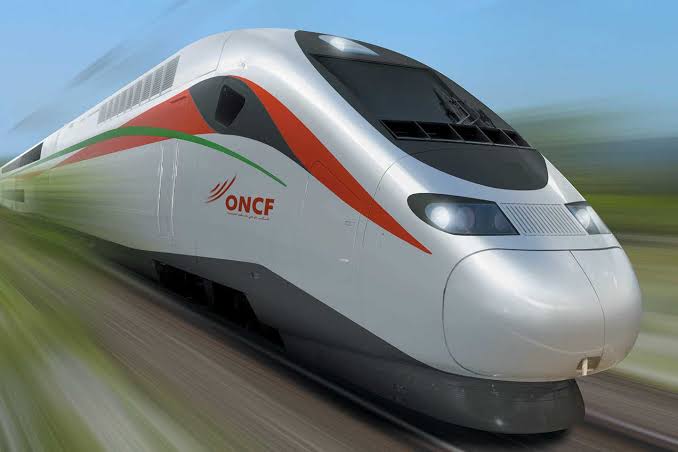
Al Boraq — Morocco's high-speed rail network. The Al Boraq service connects Casablanca to Tangier and Rabat. The official bid proposes regional and high-speed rail access close to the Grand Stade Hassan II with journey times of approximately 15 minutes from Casablanca and 20 minutes from Rabat. These stadium services are proposed in the bid documentation and must not yet be described as operational.
The Stadium Morocco Is Building and the Questions It Still Must Answer
The Grand Stade Hassan II is Morocco's most ambitious individual project in the 2030 programme — and the one where the gap between architectural ambition and construction evidence is still most visible. Approximately 30 per cent complete as of May 2026 is an active build. It is not a finished stadium. The 2027 completion target, if achieved, creates a three-year window for fitting-out, certification and operational testing — a workable buffer, but one that leaves little room for significant delay. The transport link to Benslimane Province, the stadium's post-tournament use case and the FIFA final allocation are three independent questions, each of which requires its own resolution. Progress on the building itself is the necessary first step. The other steps cannot wait until the building is complete to begin.
The Final Question: What FIFA Has Not Yet Decided
The Grand Stade Hassan II is widely described, including in Morocco's own bid documentation, as the proposed venue for the 2030 World Cup final. It is Morocco's largest planned stadium. It carries the most prominent position in the bid's narrative. It has received the highest-profile architectural investment. By any measure of scale and ambition, it is Morocco's centrepiece offering.
FIFA has not confirmed that the final will be held there.
Match allocations — including the most consequential match of the tournament — are subject to FIFA's internal assessment process. That assessment considers stadium readiness, transport infrastructure, accommodation capacity, broadcast logistics, security arrangements, pitch specifications, accessibility and factors that can only be evaluated once construction is sufficiently advanced. A stadium that has not yet been completed cannot receive a confirmed final allocation in the same way that a finished, certified venue can.
The final decision will be made by FIFA. Until it is formally announced, MoroccoMondial2030 will refer to the Grand Stade Hassan II as Morocco's proposed final venue — which it is, and which is a meaningful status — without presenting that allocation as settled or confirmed. Any source asserting otherwise is reporting an expectation, not an official decision.
Proposed Is Not Confirmed — and That Distinction Matters
The Grand Stade Hassan II is Morocco's proposed final venue for the 2030 World Cup. It is not FIFA's confirmed final venue. Any reporting that presents the allocation as decided is going beyond what FIFA has officially announced. This distinction will eventually be resolved — but the resolution must come from FIFA, not from the bid documentation. This publication will report the decision when it is made.
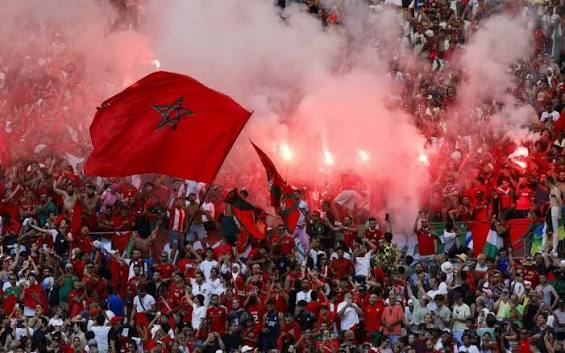
Morocco's supporters — a growing force in international football. Morocco's national team reached the quarter-final of the 2026 World Cup, extending a run of major tournament success. The Grand Stade Hassan II is designed to become the home of that national ambition — a venue whose scale reflects the country's standing in the global game.
After 2030: The Sustainability of Scale
A stadium designed for 115,000 spectators must remain operationally and financially viable even when ordinary events attract substantially smaller audiences. The question of how the Grand Stade Hassan II performs in the decades after 2030 — when the tournament has ended and ordinary Moroccan football resumes — is not a minor footnote. It is one of the most important questions about the project.
Morocco's Botola Pro, the country's top-flight professional football competition, draws attendances measured in thousands for most matches. Even Morocco's most supported clubs — Wydad and Raja, the two planned tenants of the Hassan II — attract their largest crowds for derby fixtures and continental competition, not for routine league play. A stadium of this capacity, hosting club matches at these attendance levels, carries significant operational costs against limited gate revenue.
The post-2030 case for the Grand Stade Hassan II will need to draw on multiple streams. Morocco's national team, commercially valuable following consecutive World Cup appearances and a 2022 semi-final, can fill large venues for international fixtures. CAF Champions League finals and continental showpieces could anchor annual major events. Concerts, athletics, corporate events and large-format cultural programmes are all viable uses at a venue of this size. Some modern stadiums have introduced variable capacity configurations, reducing active seating for club matches while retaining the ability to open fully for flagship events.
None of these are unfamiliar approaches. But they require planning that begins before the World Cup concludes — not after. The operational and commercial model for the Grand Stade Hassan II deserves as much scrutiny as its architectural concept.
The Measure of This Stadium Is Not the Final It Hosts
The Grand Stade Hassan II will be measured, ultimately, not by the match it hosts in 2030 but by the use it sustains in 2032, 2035 and beyond. A well-managed, financially sustainable, regularly used national stadium is a genuine legacy. An under-maintained, under-attended venue that requires ongoing public subsidy to survive is a different kind of monument. The plans for what happens after the tournament deserve the same transparency as the plans for what happens during it.
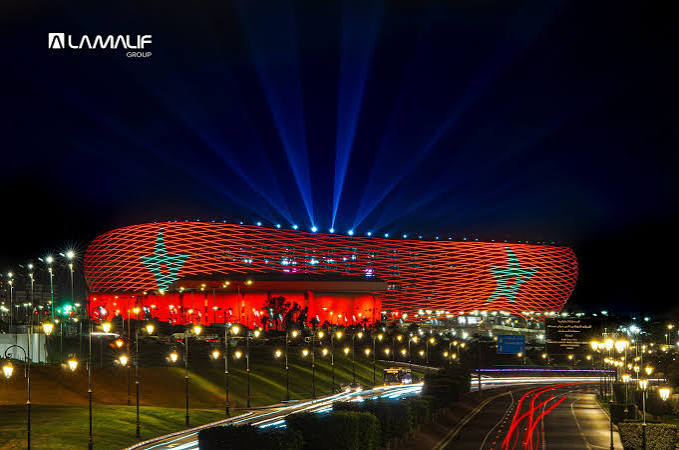
Night exterior — architectural rendering. The illuminated facade design as proposed in the bid documentation. The stadium's exterior appearance at night represents the architectural concept; the completed structure will be confirmed once construction is finished. ⚠ Rendering — not a photograph.
What This Stadium Must Prove
The Grand Stade Hassan II represents a genuine national commitment. Morocco is building something that has never existed before on African soil at this scale — a purpose-built, 115,000-capacity arena designed from the ground up for international football and intended to serve the country's sporting life for decades.
To fulfil that commitment, the stadium must do several things in sequence. It must be completed on schedule — the 2027 target is ambitious but achievable if current momentum is maintained. It must be certified, tested and operational well before 2030, not just technically ready. It must be connected to Casablanca and the wider region by transport infrastructure that can handle full-capacity crowds. And it must find a post-tournament purpose that keeps it active, maintained and worth the investment made in it.
These are not small tasks. They are the tasks that define whether this building becomes what Morocco intends it to be: not a stadium built for one tournament, but a venue that advances the country's standing in the global game for a generation.
The construction is underway. The proof must follow.
All Confirmed Developments — Independently Verified
As construction advances and official decisions are made, MoroccoMondial2030 will track every verified update to the Grand Stade Hassan II, Morocco's six host-city stadiums and all transport and infrastructure programmes.
Explore the Morocco 2030 Gateway →Sources and Official References
This analysis draws on the official 2030 joint-bid book, FIFA documents, SONARGES project communications, Populous design materials and Reuters construction reporting available through July 2026. Where projects remain in construction or planning phases, MoroccoMondial2030 applies the language used in official sources and does not present targets as confirmed outcomes.
- Official Morocco–Portugal–Spain 2030 bid book — Grand Stade Hassan II and Morocco Sport City specification
- FIFA — 2030 World Cup tournament documents and bid evaluation
- FIFA — Hosts appointed for the 2030 World Cup (December 2024)
- SONARGES — Grand Stade Hassan II and Morocco Sport City
- Populous — Stade Hassan II project profile
- Populous — Architectural design competition win (2024)
- Reuters — Morocco aims to complete stadium for World Cup final bid by end of 2027, official says (May 2026)
- Moroccan government — Stadium project monitoring committee