"Leadership is not measured only by what a man can command. It is measured, above all, by what he refuses — at cost to himself, in darkness, when no one is watching, and when the whole world seems to have decided that certain lives matter less than others."
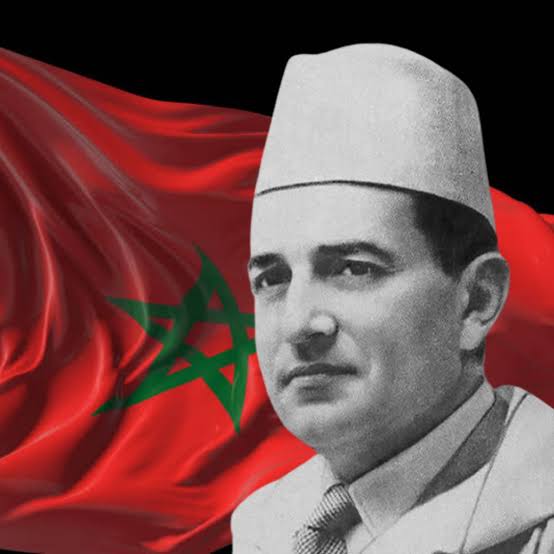
During one of history's darkest periods, Morocco's sovereign publicly affirmed that Jewish and Muslim citizens belonged to the same national family, even while the country remained under the constraints of the French Protectorate.
In the summer of 1940, the news reached Morocco in waves. France had fallen. The armistice was signed. The Vichy government — a French administration that had chosen collaboration with Nazi Germany — now held authority over the Moroccan Protectorate, the vast territory France had controlled since 1912. And in the autumn of that year, the Statut des Juifs — the Statute on Jews — was extended to apply across all French imperial possessions, including Morocco.
For Morocco's Jewish community — one of the oldest and largest in the world, numbering somewhere between 180,000 and 250,000 people at that time — the law was not merely a legal document. It was a declaration about what they were. Under Vichy doctrine, they were no longer simply Moroccan. They were Jews first, a separate and inferior category, to be stripped of professions, excluded from schools, and inventoried like property. It was the language of Europe's most dangerous ideology, arriving in a country where Jews had lived since antiquity — since before Islam, since before Arab settlement, since before the modern idea of Morocco itself had taken form.
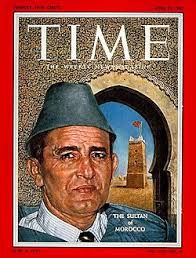
Sultan Mohammed V had watched the fall of France with sorrow. He had pledged Moroccan loyalty alongside France when war began in 1939 — a decision that now left his people under Vichy authority rather than the France he had trusted. He could not end the Protectorate. He could not repeal the statute. The French Resident-General, not the Sultan, held executive power over the territory. What Mohammed V did possess was something the statute could not quantify: the moral authority of a sovereign who defined his own nation, on his own terms, for his own people.
What he chose to do with that authority over the years that followed has become one of the defining chapters of modern Moroccan history — and one of the most studied acts of conscience in the story of the Second World War.
Morocco, the War and the Jewish Community: 1912–1956
| Date | Event |
|---|---|
| 1912 | Treaty of Fez — France establishes the French Protectorate of Morocco. The Sultan retains sovereignty in name; the French Resident-General assumes executive administrative authority. |
| 1860–1912 | The Alliance Israélite Universelle (AIU) establishes a network of schools across Morocco, educating tens of thousands of Jewish youth in French-language modern education. By 1940, the AIU network in Morocco is one of the largest anywhere in the world. |
| September 1939 | Second World War begins. France declares war on Germany. Morocco, as a French Protectorate, enters the conflict. Sultan Mohammed V pledges Moroccan loyalty alongside France. |
| June 1940 | France falls. The armistice is signed. The collaborationist Vichy government under Marshal Pétain assumes authority over the French empire, including Morocco. General Charles Noguès remains Resident-General in Rabat. |
| October 1940 | Statut des Juifs enacted. Vichy's anti-Jewish statute is applied across all French territories including Morocco. Jewish Moroccans are excluded from public employment, restricted in the professions and subjected to educational quotas, property inventories and — in some cities — forced relocation to the historic mellahs. |
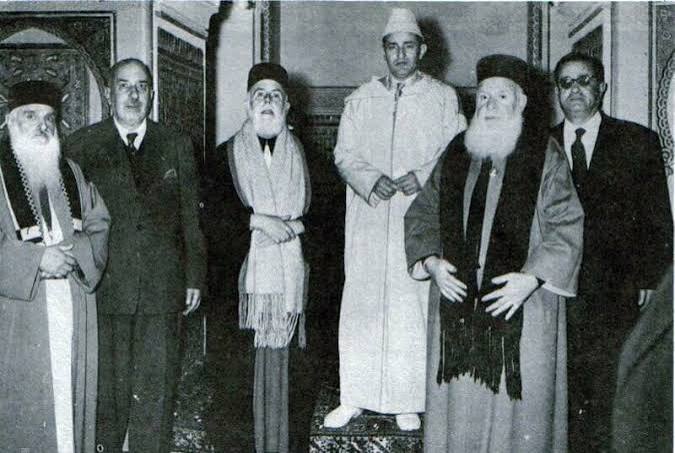
| 1941 | Throne Day, Rabat. At the most important official ceremony of the Moroccan calendar, Mohammed V publicly includes prominent Jewish community leaders alongside him — a deliberate symbolic statement made in full view of the French Protectorate administration and Moroccan notables. He continues throughout this period to receive Jewish representatives in private audience. |
| January 1942 | Wannsee Conference, Berlin — the Nazi leadership formalises the "Final Solution to the Jewish Question." The genocide of European Jewry is organised as policy. Morocco remains under Vichy law but is not implicated in deportation planning. |
| November 1942 | Operation Torch. Allied forces (US and British) land simultaneously at Casablanca, Oran and Algiers. After three days of fighting, French North Africa switches to the Allied side. Vichy authority collapses. Anti-Jewish legislation begins to be repealed. |
| January 1943 | Casablanca Conference (Codename: Symbol) — President Franklin D. Roosevelt and Prime Minister Winston Churchill meet at the Anfa Hotel, Casablanca, to plan the next phase of the Allied war effort. On January 22, FDR hosts a dinner for Sultan Mohammed V — a historically significant meeting at which the Sultan's aspirations for Moroccan independence are reportedly discussed. |
| March 1943 | Full restoration of rights for Jewish Moroccans, following a transition period after the Torch landings and Allied pressure on the Free French authorities. |
| 1948 | Creation of the State of Israel. The first significant waves of emigration of Moroccan Jews to Israel begin. The community, which numbered between 250,000 and 300,000 at its peak, begins its long demographic transition. |
| 1956 | Moroccan independence. Mohammed V becomes King Mohammed V of independent Morocco. He articulates a vision of the new Moroccan state that includes the Jewish community in the national identity. Mass emigration accelerates through the 1960s. |
| Today | Morocco's 2011 Constitution explicitly recognises the Hebrew (hébraïque) tributary as one of the sources of Moroccan national identity. Between 2,000 and 3,500 Jews remain in Morocco. Tens of thousands return annually for the Hiloulot pilgrimages. Synagogues, cemeteries and mellahs are preserved with state support. |
Morocco Under the French Protectorate
.jpeg)
The first thing to understand about Mohammed V's actions during the Vichy period is what they cost — and what they could not achieve. The French Protectorate, established by the Treaty of Fez in 1912, created a political arrangement deliberately designed to keep the Sultan in his ceremonial role while the French administered the actual machinery of the state. The Resident-General controlled the civil service, the police, the courts, the military and the legislative apparatus. He governed. The Sultan reigned.
When France surrendered in June 1940 and the Vichy government assumed control of the Protectorate, this structure did not change — only the ideology directing it did. General Charles Noguès, Resident-General in Rabat, was now answerable to a government whose policies included the systematic persecution of Jews. The Statut des Juifs, when it arrived in October 1940, was an act of the French Protectorate administration. It did not require the Sultan's signature. It was not issued in his name. He had no legal mechanism to veto it.
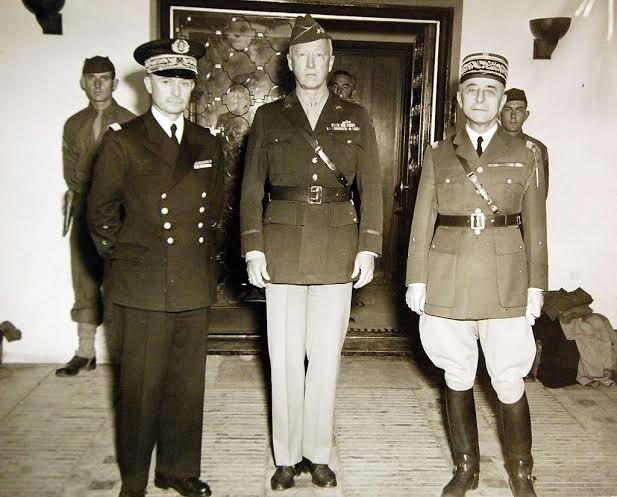
This matters because it defines the exact terms of Mohammed V's courage. He was not a free monarch who chose, from a position of full sovereignty, to protect his Jewish subjects. He was a sovereign constrained by colonial law who used every non-legal tool available to him — his personal relationships, his ceremonial authority, his symbolic choices, his private communications and his public conduct — to refuse the ideology that Vichy was attempting to install as the basis for Moroccan society.
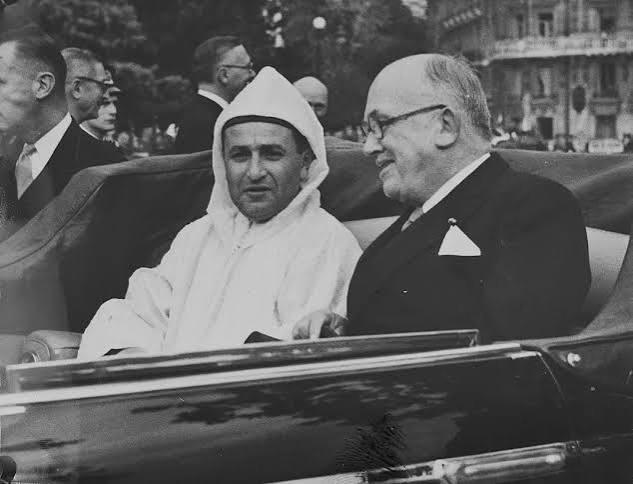
Those tools were real. Symbolic authority in a society where symbolism carries genuine weight is not nothing. A sultan who publicly includes Jewish leaders in the highest ceremony of the Moroccan year is communicating something that no administrative statute can silence. A sovereign who receives Jewish community representatives in private audience and assures them of his protection is exercising a form of authority that the French had not yet found a way to legislate away. Mohammed V understood this. And he used it, deliberately and consistently, for as long as Vichy held Morocco.
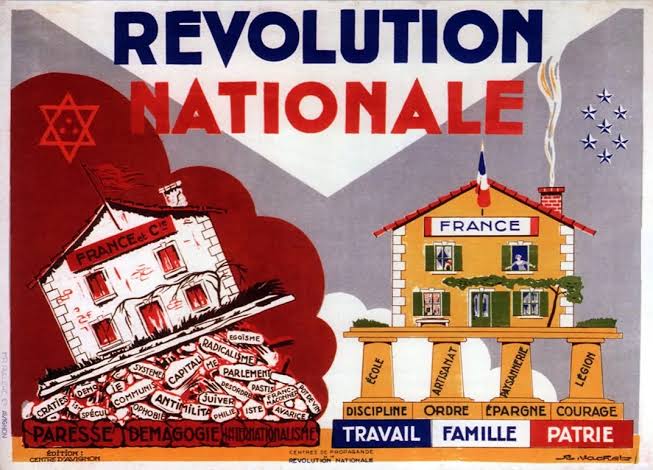
The Statut des Juifs was promulgated by the Vichy government on October 3, 1940, and applied to Morocco by a Protectorate dahir of October 31, 1940. It was an act of the French colonial administration. It did not require — and was not issued in the name of — Sultan Mohammed V. The following are its key provisions, extracted from the official text.
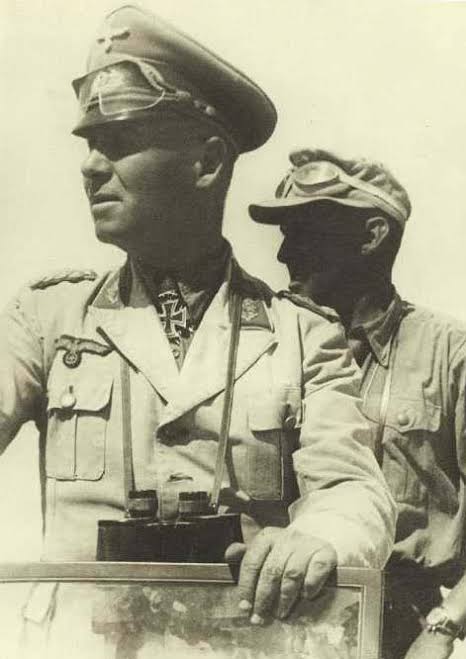
The ideological stakes of this period were not abstract. By 1942, German forces were advancing across North Africa. The question of whether the Final Solution — the systematic extermination of European Jews — would extend to North Africa was not, at that moment in history, resolved. The proximity of the Nazi military to Moroccan soil gave the question of how the Vichy administration treated Morocco's Jewish population a dimension of genuine existential risk that hindsight can obscure. What Mohammed V was refusing — the racial classification of his Jewish subjects — was the exact ideological framework through which the Holocaust was being administered just across the Mediterranean.
Morocco was never the site of mass deportations or exterminations. But the Allied landings in November 1942 are part of the reason that sentence can be written. What would have happened to Morocco's Jewish community had Vichy rule continued indefinitely, had the Allies not landed, had the war unfolded differently — belongs to the realm of historical contingency, not settled fact. What is not contingent is what Mohammed V chose to do with his authority while that outcome was still uncertain.
"They Are All My Subjects"
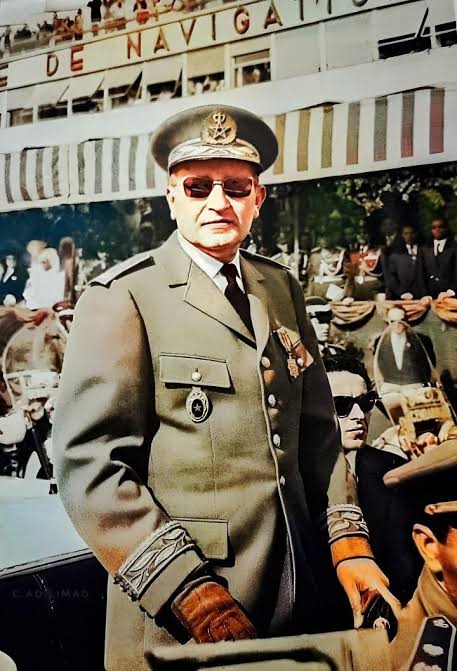
The sentence most often quoted in accounts of Mohammed V and Morocco's Jewish community has acquired, over the decades, the quality of a proverb:
"There are no Jews in Morocco. There are only Moroccan subjects."
Attributed to Sultan Mohammed V — exact source and context debated by historiansHistorians who have examined the primary sources with greatest care — including Mohammed Kenbib and Robert Assaraf, whose archival research on this period is foundational — caution that this precise formulation does not appear in contemporaneous official records in exactly this form. The quote may have taken on its current wording in the retelling and remembering of the decades that followed. This is not unusual for moments that carry enormous moral weight; the words that capture a principle often crystallize after the fact, shaped by the community whose survival they seem to protect.
But here is what that scholarly caution does not mean: it does not mean Mohammed V never said this, in some form, to someone. And it does not mean the principle the statement expresses was not consistently and genuinely his. On the contrary — multiple accounts from Jewish community leaders who lived through the Vichy period, and who had direct contact with the Sultan, attest in consistent terms to precisely this principle: he regarded Moroccan Jews as loyal subjects of the kingdom, communicated that to them directly and repeatedly, and acted on it publicly in ways visible to all of Moroccan society.
The documented evidence for Mohammed V's position is not a single disputed sentence. It is a pattern of conduct maintained across several years under considerable political pressure. And it is that pattern — not the exact wording of one famous line — that constitutes the real historical story.
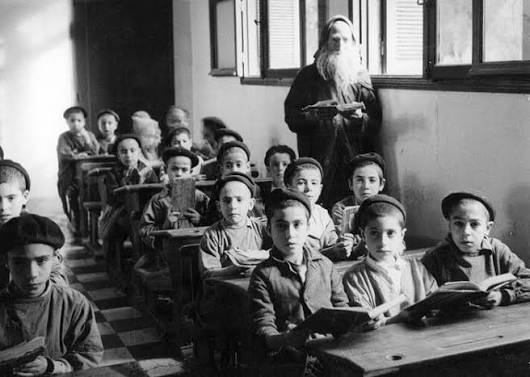
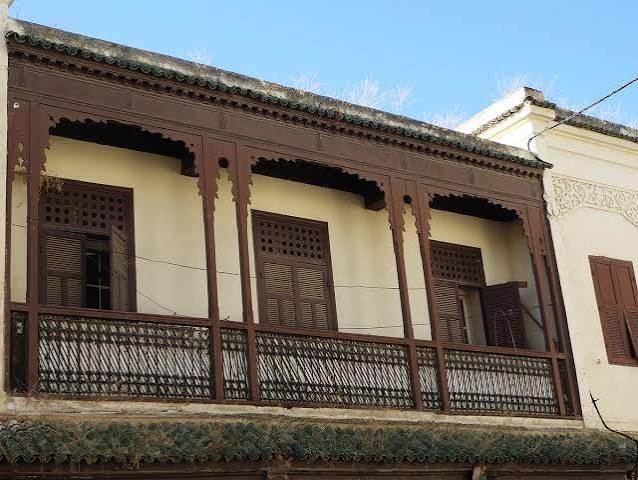
The Vichy statute did not arrive in Morocco as an abstraction. It arrived in people's lives. Jewish lawyers and doctors were struck from professional registers. Civil servants were dismissed. The numerus clausus — the educational quota system — limited Jewish children's enrolment in public schools, placing severe pressure on the Alliance Israélite Universelle's network of schools, which had educated generations of Moroccan Jewish youth since the 1860s. In certain cities, Jewish families who had established themselves in European-settled neighbourhoods were required by local administrative order to return to the historic mellahs. The statute was not enforced identically across every corner of Morocco — local administrators varied in their zeal — but its effects were real, widespread and demeaning.
The wartime experience of Morocco's Jewish community remains the subject of historical research because it illustrates the complexity of leadership under colonial rule. Unlike an independent head of state, Sultan Mohammed V governed within the constraints of the French Protectorate, where the Vichy administration retained broad executive powers. Yet he consistently affirmed that Morocco's Jewish community formed part of the nation and opposed attempts to define his subjects according to imported racial ideology. For historians, this episode is significant not because it offers a simple story of absolute power or complete resistance, but because it demonstrates how moral authority could still influence public life even when political authority was limited. Today, it remains one of the most studied examples of Jewish-Muslim relations during the Second World War.
Courage Within Constraints
Consider what it meant, in 1941, for the Sultan of Morocco to invite prominent Jewish community leaders to stand beside him at the Throne Day ceremony in Rabat.
Throne Day was not a private occasion. It was the highest official event in the Moroccan calendar — the annual celebration of the Sultan's accession, attended by the most important figures in Moroccan society and observed by the French Protectorate administration. Inviting Jewish leaders to stand at this ceremony, in a position of visible honour, was not an act of social courtesy. It was a political statement, issued in front of every relevant authority in the country, about who belonged to Morocco and what Morocco meant.
In the context of 1941 — when Jewish citizens across Vichy-controlled territories were being stripped of their rights, their property, their professional status and, in occupied France itself, their lives — this was an act of conspicuous moral courage. It was the opposite of what Vichy required. It was the opposite of what the logic of collaboration demanded. And it was carried out at precisely the moment when the ideological current was running strongest against it.
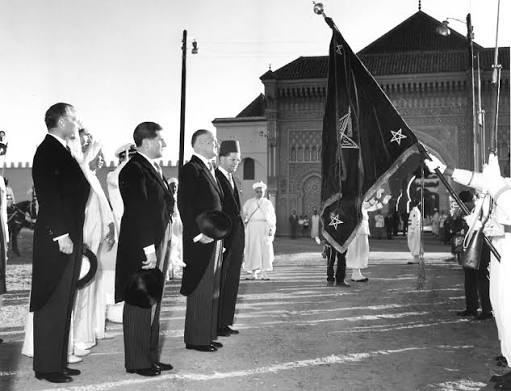
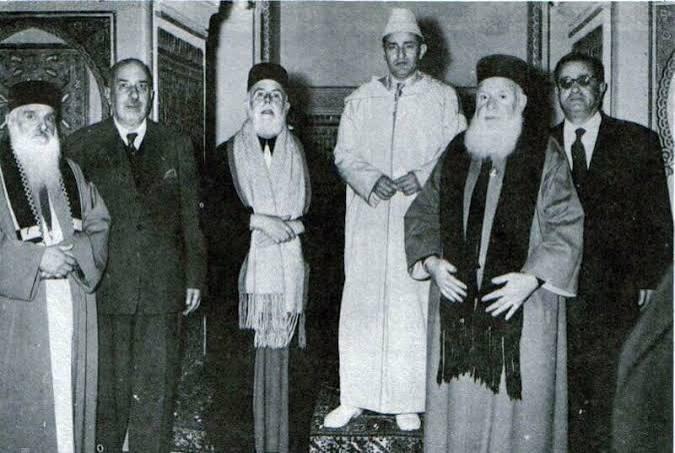
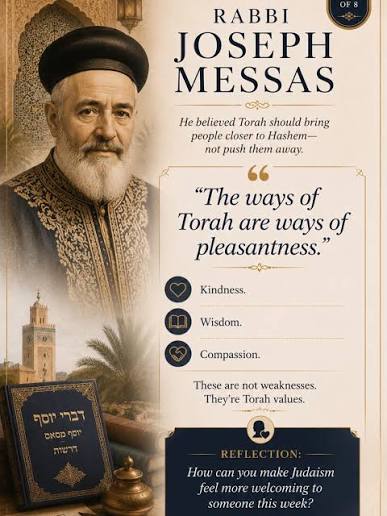
He also acted in more intimate registers. Accounts from the period describe Jewish community leaders — rabbis, civic figures, representatives of the organized communities of Casablanca, Fez, Marrakech — being received by the Sultan in private audience. His message to them, described consistently across multiple testimonies, was the same: you are Moroccan. You are my subjects. My position has not changed. He could not protect them from every consequence of Vichy law. He could not guarantee that a local French administrator would treat them fairly. But he could communicate, through every channel available to him, that he did not accept the premise on which those laws were built.
"There is a kind of leadership that announces itself with decrees. And there is a kind of leadership that consists entirely of refusing — quietly, consistently, at personal cost — to define one's people the way an occupying ideology demands. Mohammed V practiced the second kind."
— MoroccoPassport EditorialHe also reportedly communicated his expectation that local officials exercise restraint in applying discriminatory measures. Whether these interventions reached the level of formal policy modification is a matter historians continue to examine. What is clear is that the Sultan made his position known — to the Jewish community, to Moroccan society, and to the French administration — in terms that no one could misinterpret. He was not a neutral observer to what was happening in his country. He was a sovereign who had chosen a side, using the tools available to him in the constrained space between what he was permitted to command and what he refused to permit to define him.
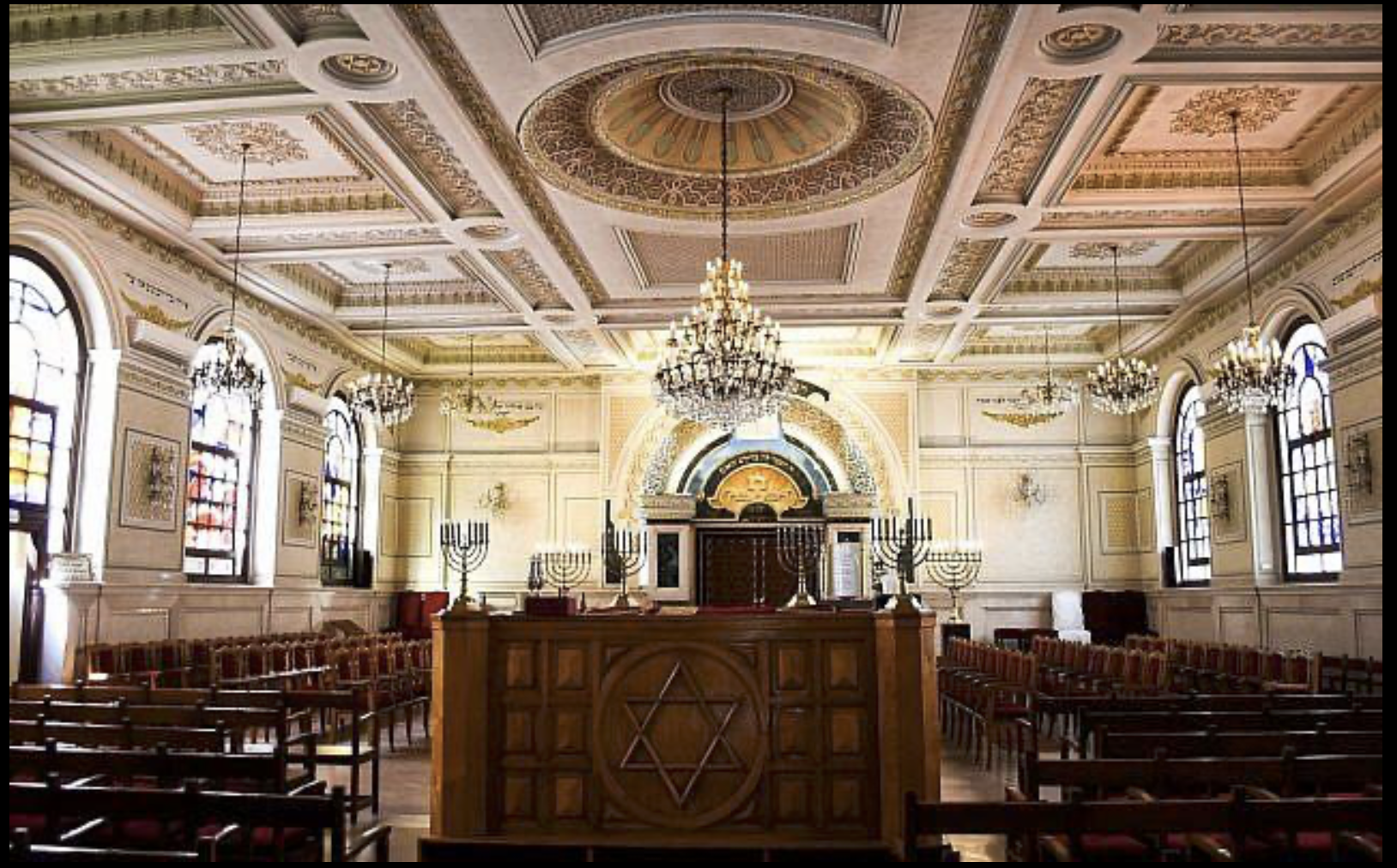
The Scholarly Record
History of this kind — morally significant, politically contested, transmitted across generations — attracts both careful scholarship and the gradual accretion of legend. The episode of Mohammed V and Morocco's Jewish community is no exception. It has been studied by some of the most rigorous historians of modern Morocco and the Jewish world, and their conclusions deserve to be heard directly.
"Mohammed V consistently refused to apply Vichy's racial categories to his Jewish subjects. The documentation makes clear that he communicated this position — through his public conduct, through private audiences with Jewish community leaders, and through the symbolic choices he made at official ceremonies — throughout the Vichy period. This does not mean he possessed the legal power to overturn the statute. It means he used every non-legal tool available to him to refuse its underlying premise."
"The significance of Mohammed V's conduct lies not in a single declaration but in a pattern of behaviour maintained across several years. Assaraf's archival research establishes that the Sultan received Jewish community representatives, communicated his continued regard for their place within the Moroccan nation, and made deliberate public gestures — above all the Throne Day of 1941 — whose meaning was unmistakable to everyone present, including the French Protectorate officials who witnessed them."
 Summary of scholarly findings — Robert Assaraf, Mohammed V et les Juifs du Maroc à l'époque de Vichy (Paris: Plon, 1997)
"The history of North African Jewry under Vichy cannot be told without attending carefully to what was different about Morocco — and what was the same. The anti-Jewish statutes caused real harm across the region. But the relationship between the Moroccan sultan and his Jewish subjects introduced a dimension of symbolic and moral counterweight that has no direct parallel in Tunisia or Algeria, where no equivalent royal authority existed."
Voices of History
A reference work on this subject is not complete if it confines itself to one editorial voice. What follows is a gathering — the Sultan's attributed words, the testimony of the community he regarded as his own, the documented position of the administration that imposed the statutes, and the assessments of scholars and contemporary figures who have spent years examining what happened here. When independent voices converge on the same historical conclusion, that convergence is itself a form of evidence.
"There are no Jews in Morocco. There are only Moroccan subjects."
"When I entered the Sultan's presence during those years, I did not feel like a man whose government had classified him as less than human. I felt like a Moroccan. He never let us feel abandoned. Whatever the French decreed, he made clear where he stood."
"The Sultan continues to express reservations about the racial classification of his subjects. He does not regard the new legislation as his own. We are proceeding with the implementation of the statute as directed from Vichy, but his position is a complicating factor for the local administration."
"The story of North African Jews under the Second World War is the story of a people who survived not because they were saved, but because the particular circumstances of their geography, the character of their rulers, and the accident of Allied liberation came together before the worst could arrive. Morocco is the most instructive case, because the variable of the Sultan's conduct is the most documented."
"My family is Moroccan. That is not a sentiment — it is a historical fact that Mohammed V understood and that his successors have honoured. The Jewish heritage of Morocco is not a foreign heritage that was welcomed. It is a Moroccan heritage, rooted in the same soil, belonging to the same national story."
"Morocco did not become a place where Jews were protected from Vichy law. It became a place where the highest authority in the land refused to accept that Vichy law had redefined who belonged to Morocco. That distinction seems subtle on paper and is enormous in lived experience."
What the Historians Tell Us
Any account of Mohammed V and Morocco's Jewish community that claims more certainty than the evidence warrants does a disservice to both. The story has attracted, over the decades, a layer of legend that the documented history does not always support — and an honest engagement with this episode requires distinguishing between what we know, what we believe, and what has been added over time.
The scholarly record on this period is substantial. Historians including Mohammed Kenbib, Michel Abitbol and Robert Assaraf have each examined the primary sources with considerable rigour. Their conclusions offer both clarity and appropriate caution.
- Mohammed V consistently expressed opposition to antisemitic discrimination through his conduct, his private communications and his public ceremonies.
- He regarded Moroccan Jews as loyal subjects of the kingdom — a position he communicated directly to Jewish community representatives on multiple documented occasions.
- The 1941 Throne Day inclusion of Jewish leaders was a historically significant public gesture, experienced by the community as an act of solidarity and protection.
- Jewish Moroccans suffered real hardship under Vichy restrictions: professional exclusions, educational quotas, economic losses, and in some cases forced relocation.
- Morocco was never a site of mass deportations to Nazi extermination camps — distinguishing the Moroccan experience from Jews in occupied France.
- The Sultan's political authority under the Protectorate was ceremonial and symbolic; he lacked executive power to unilaterally repeal French administrative legislation.
- The exact wording and documented context of the declaration "There are no Jews in Morocco" — it does not appear in contemporaneous official records in precisely this form.
- The precise degree to which Mohammed V's personal interventions modified specific applications of Vichy law at the local administrative level.
- The yellow star: there is no historical evidence that Jewish Moroccans were ordered to wear the yellow Star of David. This claim appears in popular accounts but is not supported by the documentary record.
- The deportation plans: claims that Vichy specifically planned to deport Morocco's Jewish community to Nazi extermination camps are not supported by available evidence.
- The relationship between Mohammed V's wartime solidarity and Moroccan government policies on Jewish emigration in the 1950s–60s, which were sometimes restrictive.
These distinctions matter — not because they diminish Mohammed V's significance, but because the real story, told accurately, is more interesting than the legend. A sultan who used ceremonial authority and personal relationships to affirm the dignity of a persecuted community — while lacking the power to change the laws they were subjected to — presents a moral example that is human, specific and genuine. That example does not require exaggeration to be admirable. Examining it with honesty is the highest form of respect both for the history and for the man.
Morocco in Historical Context: A Comparative View
The significance of Mohammed V's conduct becomes clearest when set alongside what was happening elsewhere under Vichy rule. The table below presents documented historical distinctions — not to minimize the real harm that Vichy legislation caused in Morocco, but to establish the specific and measurable ways in which Morocco's experience differed.
| Dimension | Elsewhere Under Vichy Rule | Morocco Under the Protectorate |
|---|---|---|
| Anti-Jewish legislation | Statut des Juifs implemented; in occupied France, enforced under direct German supervision and used as a prelude to deportation | Statut des Juifs introduced by Protectorate dahir, October 1940; applied by the French colonial administration without the Sultan's signature or assent |
| Sovereign's stated position | Vichy France: Pétain signed and championed the legislation; in Tunisia and Algeria, no equivalent sovereign institution existed | Mohammed V consistently communicated his continued regard for Jewish subjects as Moroccan; refused to accept racial categorisation as defining his people |
| Public symbolic gestures toward Jewish community | Progressive exclusion of Jewish citizens from official public life; removal of civil identity markers | Jewish community leaders continued to appear at Throne Day ceremonies in positions of honour; Sultan maintained visible public solidarity |
| Yellow star requirement | Imposed across occupied France and other Nazi-controlled territories from June 1942 | No documented evidence that Jewish Moroccans were required to wear the yellow star; this claim in popular accounts is not supported by the historical record |
| Deportations to Nazi extermination camps | Occupied France: 75,000+ deported, majority murdered; Tunisia under German occupation (1942–43): direct Nazi persecution and forced labour | No documented deportations from Morocco to extermination camps; Allied landings (November 1942) ended Vichy rule before this scenario developed |
| Post-war relationship between community and the state | Jewish populations in occupied Europe largely destroyed through murder and displacement; Vichy France faced decades of reckoning with state complicity | Moroccan Jewish diaspora maintains active connection to Morocco through annual Hiloulot pilgrimages, heritage restoration, and diplomatic ties; 2020 Abraham Accords normalised Morocco-Israel relations |
Note: Morocco was not immune from the harm Vichy legislation caused. Jewish Moroccans experienced real professional exclusion, educational restriction, and civic degradation. The distinctions above reflect differences in degree, sovereign conduct, and historical outcome — not an absence of harm.
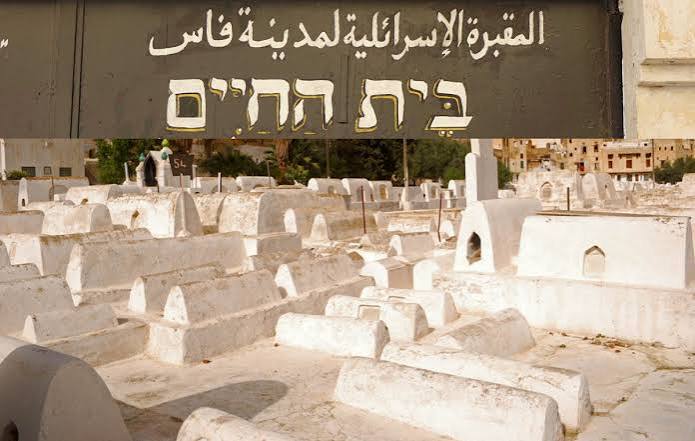
Operation Torch, the Casablanca Conference and Liberation
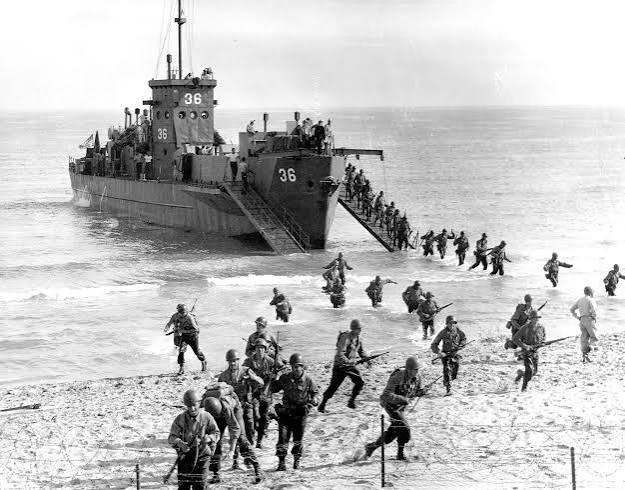
On the night of November 8, 1942, Allied forces — American and British — landed simultaneously at Casablanca, Oran and Algiers. The operation, codenamed Torch, was the largest amphibious landing in history to that point. After several days of fighting, French North Africa switched to the Allied side. General Noguès capitulated. The Vichy administration that had imposed racial legislation on Morocco's Jewish community for more than two years collapsed virtually overnight.
The repeal of anti-Jewish legislation did not happen instantaneously — the process of restoration took until March 1943 under Free French authority, complicated by competing political pressures and the resistance of some colonial administrators. But the moral arc had shifted. The racial classification of Jewish Moroccans as inferior subjects was over. The community's rights began to be restored.
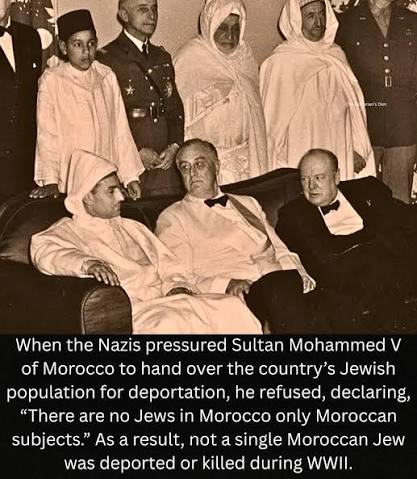
Two months after the landings, in January 1943, Casablanca became the site of one of the most important Allied strategic meetings of the war. President Franklin D. Roosevelt and Prime Minister Winston Churchill gathered at the Anfa Hotel — on Moroccan soil — for the Casablanca Conference (Codename: Symbol), at which they planned the next phase of the Allied offensive and issued the famous "unconditional surrender" declaration regarding the Axis powers.
On January 22, 1943, President Roosevelt hosted a private dinner for Sultan Mohammed V at the Anfa Hotel. This meeting — documented in the memoirs of several American diplomats present — was historically significant beyond its immediate context. FDR expressed support for the principle of national self-determination, an implicit reference to Moroccan independence aspirations that reportedly alarmed Churchill, mindful of the potential effect on British colonial territories. Mohammed V understood the significance of the encounter. A sultan who had spent two years maintaining his own definition of Moroccan identity against a collaborationist colonial administration was now receiving the President of the United States on his own territory, discussing Morocco's future as a sovereign nation.
The arc from the Throne Day of 1941 to the Anfa Hotel dinner of 1943 is one of the most compressed and remarkable sequences in modern Moroccan history. In twenty-four months, the same man went from using symbolic authority to resist racial ideology under Vichy control to sitting at a table with the leader of the free world as a future head of an independent state. The story of Mohammed V and Morocco's Jews is not separate from this larger story. It is part of the same continuous act of leadership.
A Legacy Beyond the War
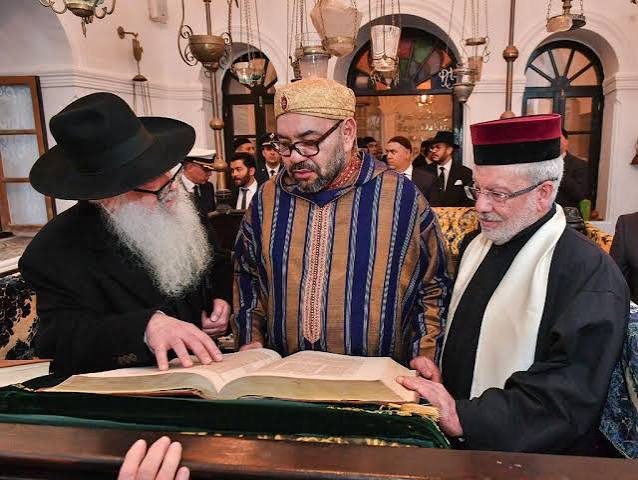
The mass emigration of Moroccan Jews — to Israel, to France, to Canada and beyond — occurred primarily between 1948 and the early 1970s. At its peak, Morocco's Jewish population had reached somewhere between 250,000 and 300,000. Today, perhaps 2,000 to 3,500 remain. By the most straightforward arithmetic, the community is almost gone from the country its ancestors helped build.
And yet the relationship between Moroccan Jews and Morocco has not ended. It has changed in form — from habitation to memory, from residence to return — but it has not broken. Each year, tens of thousands of Moroccan Jews from Israel and France and North America travel back to Morocco for the annual Hiloulot: pilgrimages to the tomb sites of revered rabbis, festivals that combine prayer and family reunion and the particular joy of people who know they are standing on the earth their grandparents walked on. They do not come back as tourists. They come back as Moroccans.
That relationship did not happen by accident. It was built over centuries of shared history — and during the years when it was most in danger of being severed, it was preserved in part by a sultan who refused to let Vichy France define what Morocco was. The memory of that refusal lives on in the families who carry it, passed down across generations, across oceans, across the long distance between the country of origin and the country of settlement.
"The Jews are under my protection, and I reject any distinction between my subjects."
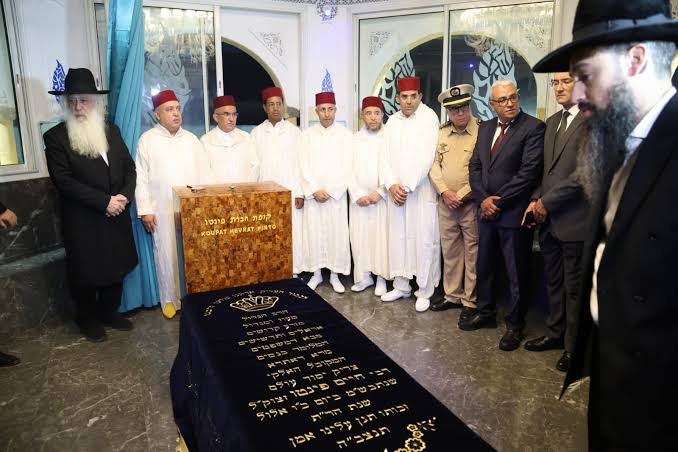
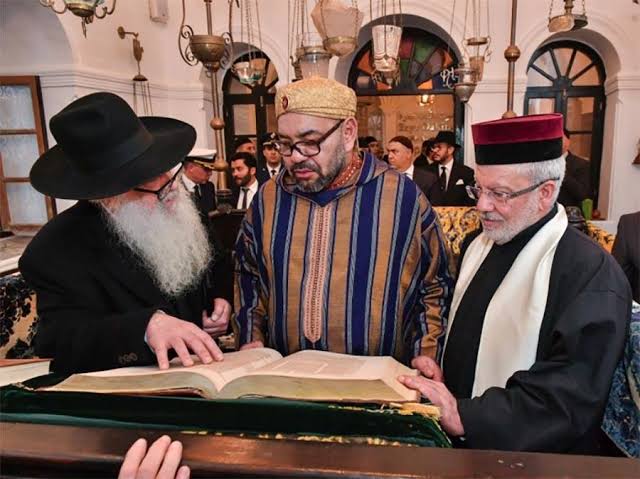
Sultan Mohammed V — post-war statement. Historians note that the exact wording preserved in later accounts varies between sources; multiple independent testimonies record this consistent principle, which is wholly in keeping with his documented conduct throughout the Vichy years and after.Today, Morocco's Alaouite monarchy continues and deepens that legacy. The Moroccan Constitution explicitly acknowledges the Hebrew component of Moroccan cultural identity. King Mohammed VI has supported — often personally — the restoration of synagogues, Jewish cemeteries and historic mellahs across the Kingdom. The Museum of Moroccan Judaism in Casablanca, the cultural centre of Bayt Dakira in Essaouira, and the growing programme of heritage preservation across the imperial cities all express, in concrete institutional form, the principle that Mohammed V expressed through personal courage in the wartime years: that this is not the history of a minority that once passed through. It is the history of Morocco.
"A sovereign Muslim State, attached to its national unity and to the preservation of the harmonious convergence of its components: Arabo-Islamic, Amazigh and Saharo-Hassanic, enriched and nourished by its African, Andalusian, Hebrew and Mediterranean tributaries."
Morocco's 2011 Constitution explicitly names the Hebrew (hébraïque) component as one of the tributaries of Moroccan national identity — the only Arab constitution to do so. This is not a diplomatic formulation. It is a constitutional recognition, embedded in the founding law of the Moroccan state, that the country's Jewish heritage is not a foreign chapter in the national story but one of its living sources. The principle that Mohammed V defended through his personal conduct during the Vichy years — that Jewish Moroccans are Moroccan — now has constitutional standing.
Why This Chapter Still Matters
The history of Mohammed V and Morocco's Jewish community is not important because it tells us that Morocco was perfect. It is important because it shows how moral leadership can exist even under foreign domination and severe political constraints. The Sultan could not repeal Vichy law. He had no army capable of resisting France. He operated within the architecture of a colonial Protectorate that was itself operating under the architecture of a collaborationist regime. None of those constraints are minimised by naming them clearly. What is significant is that within them, choices were still possible — and that Mohammed V made a particular set of choices, consistently, over the full duration of the Vichy period.
Few episodes in World War II illustrate the relationship between a Muslim sovereign and his Jewish subjects as powerfully as the conduct of Sultan Mohammed V during the Vichy years. This is not a sentimental claim. It is a defensible historical observation, grounded in a documented pattern of behaviour that runs from his refusal to apply racial categories at Throne Day in 1941 through his private representations against specific Vichy measures, to the speed with which rights were restored after Allied liberation in 1942–43. The pattern, not any single act, is the record.
This matters beyond Morocco's borders because of what it says about the structure of moral choice in conditions of constraint. In 1940–1942, across occupied and collaborationist Europe and North Africa, the question of what to do when racial ideology arrived with the force of colonial law was asked of many leaders. The answers given determined, in some cases, whether communities survived. Mohammed V's answer — you are Moroccan as you have always been, and no imported statute changes that — is part of the historical record of how that question was answered. His example belongs not only to Moroccan history but to the broader record of conscience under pressure: evidence that the choice to refuse complicity was available, and that someone in authority, facing real costs, took it.
This is why the chapter deserves rigorous telling, without embellishment and without diminishment. The undocumented legends — the yellow star, the planned deportations — weaken the historical case rather than strengthening it. The documented story is extraordinary enough to stand without invention. And it is precisely because it can withstand scrutiny that it will outlast the versions that cannot.
Morocco did not save its Jewish community from Vichy legislation. The laws came; they caused real harm; they lasted two years before Allied liberation removed them. But Morocco did something that no legislation can mandate and no colonial power can command: it kept the door open. The door through which Jewish Moroccans could still hear, from the highest authority in the kingdom, that they were Moroccan — that their centuries on this soil had not been cancelled, that the definition of the nation had not changed. It was not a legal protection. It was something older and, in the long run, more durable: a declaration of who we are and who we refuse to say we are not. Decades later, in the cemeteries of Fez and on the pilgrimage roads to Ouezzane and in the family stories told in apartments in Tel Aviv and Paris and Montreal, that declaration is still being heard. It is still being passed on. That is what it means for a moral act to outlive its moment — and to channel history, as it was always meant to be channelled, toward the generations that follow.
The true importance of Mohammed V's wartime position extends beyond Morocco itself. In an age when governments across Europe and North Africa were asked to classify, separate, and discriminate against people because of their religion, Morocco's sovereign chose instead to affirm a different principle: that the bonds of citizenship and shared history were stronger than imported ideologies of racial division. Whether viewed through the lens of Moroccan history, Jewish history, or the history of World War II, this episode remains a reminder that leadership is measured not only by power, but by the values a leader refuses to abandon.
This article exists because we believe MoroccoPassport has a responsibility that goes beyond travel advice and practical guides. There are chapters of this country's history that deserve to be told in full — not for the benefit of tourism, not to make Morocco look good, but because the truth of what happened here during the Second World War is genuinely important to the broader human story. Mohammed V and Morocco's Jews is one of those chapters.
We have tried to tell it the way it deserves to be told: without embellishment and without diminishment. We have acknowledged where historians agree and where they continue to debate. We have corrected claims — the yellow star, the planned deportations — that have entered popular circulation without documentary support, because the undocumented legend actually weakens the historical case rather than strengthening it. The documented story is extraordinary enough to stand without invention.
What strikes us most, returning to this history, is the quality of the choice Mohammed V made. He could not stop the Vichy machine. He could not end colonial law. He could not physically shield a single Jewish Moroccan from the professional exclusions or educational quotas that the statute imposed. What he could do — and what he consistently did, across the years of the Protectorate's darkest chapter — was refuse to tell his own people that they were less than Moroccan. In a world that was running low on that kind of refusal, it was not nothing. It was, in fact, a great deal. And it is still here, still felt, still being passed on.
That is the story we wanted to tell. We hope we have done it justice.
"There are no Jews in Morocco. There are only Moroccan subjects."
"He received us. He told us: nothing has changed. You are Moroccan. Whatever laws they impose from outside, you are Moroccan, and that does not change."
"The Sultan continues to resist the racial classification of his subjects. He does not regard this legislation as his own. He is a complicating factor in the orderly administration of the statute."
"The significance of what Mohammed V did cannot be measured only in what he prevented. It must be measured also in what he refused to become."
"In Morocco, the Sultan's refusal to accept the racial premises of Vichy legislation as applicable to his own people constituted a form of moral resistance that has no equivalent in any other French territory in North Africa."
Statut des Juifs — October 3, 1940
"Is considered Jewish... any person descending from at least three grandparents of the Jewish race... Jews may not exercise any function in public service... any liberal profession... any function connected with banking, the press, radio, cinema or theatre."
— Journal Officiel de l'État Français, Oct. 18, 1940. Applied to Morocco: Protectorate dahir, Oct. 31, 1940. Sultan's signature: absent.
The following sources form the scholarly and archival foundation of this article. Begin with Assaraf (1997) for the biographical focus on Mohammed V, Kenbib (1994) for the broad sweep of Muslim-Jewish relations in Morocco, and Satloff (2006) for the English-language comparative perspective across North Africa.
The most focused scholarly treatment of Mohammed V's conduct during the Vichy period. Assaraf draws on French, Moroccan and Israeli archival sources to document the Sultan's pattern of behaviour, his private communications, and the political constraints under which he operated. The primary reference for any serious engagement with this subject.
The foundational study of Muslim-Jewish coexistence and tension in Morocco across a critical century. Kenbib situates the Vichy period within the longer arc of Moroccan inter-communal relations, providing the essential historical context for understanding Mohammed V's conduct.
The essential comparative study of Jewish communities across Morocco, Algeria and Tunisia under Vichy rule. Abitbol's regional analysis identifies what was genuinely distinctive about Morocco's experience — and what was the same.
The most authoritative English-language survey of modern Moroccan history. Miller's attention to the intersection of colonial politics and Moroccan sovereignty provides indispensable context for understanding the limits and possibilities of the Sultan's position.
A comprehensive social and political history of the Jewish communities of North Africa. Essential for understanding the community's own experience during the Vichy years and the emigration waves that followed independence.
A rigorous and accessible account of Jewish communities across the Arab world under Vichy and Nazi rule. Satloff's comparative work is particularly valuable for establishing what was common to the North African experience and what was specific to Morocco.
Provides the broader African colonial and post-colonial context within which the Moroccan Protectorate's history sits, useful for understanding the structural dynamics of French colonial authority during and after the Vichy period.
The primary French colonial archive. Holds the administrative correspondence of the Moroccan Protectorate, including records relating to the implementation of the Statut des Juifs, communications between the Resident-General and Vichy authorities, and documentation of the Sultan's interventions. The foundational archive for any primary-source research on this period.
Holds the official records of the Vichy government, including the original text of the Statut des Juifs and related decrees. Essential for researchers seeking to compare the metropolitan statute with its colonial application in Morocco.
The archive of the French Ministry of Foreign Affairs, holding diplomatic correspondence relating to North Africa during the Vichy period and the wartime conduct of the Protectorate administration.
American diplomatic and military records from the wartime period, including documentation of the Casablanca Conference (January 1943) and the Anfa Hotel dinner at which President Roosevelt met Sultan Mohammed V.
The USHMM's Holocaust Encyclopedia is the most authoritative online reference for documentation of Jewish communities under Vichy rule across North Africa. The USHMM Digital Collections also holds oral testimonies from Moroccan Jewish survivors.
The world's principal institution dedicated to Holocaust documentation and remembrance. Yad Vashem's encyclopedic entries on Moroccan Jewry document Vichy legislation, community composition, and the conduct of Moroccan authorities during the war years.
The only Jewish museum in the Arab world. Founded by Simon Lévy (1934–2011), the museum holds the most comprehensive collection of material and documentary evidence of Moroccan Jewish history, including objects, photographs, and oral testimonies from the Vichy period. A living institution and the primary custodian of community memory inside Morocco.
A cultural centre dedicated to the Jewish heritage of Essaouira, established by royal initiative and housing an archive, permanent exhibition, and ongoing cultural programme. A model of how the Moroccan state has institutionalised the memory of the Jewish community.
The oral testimony record is a critical complement to the archival documentary record. Many of the most direct accounts of what Mohammed V communicated to Jewish community leaders — including descriptions of private audiences — survive through community oral history, preserved in collections like these.
Yad Vashem's testimony collections provide first-person accounts that complement the written documentary record, particularly for understanding how Vichy legislation was experienced at the community and individual level.
This article distinguishes between documented historical evidence, contemporary testimony, and later oral traditions. Where historians disagree, those debates are acknowledged rather than presented as settled fact. Readers are encouraged to consult the primary and scholarly sources listed above for further study.
Continue Exploring
Dedicated to the memory of all Moroccan Jews and Muslims who preserved the bonds of citizenship, dignity, and shared humanity during one of the darkest chapters of the twentieth century.