
For years, Morocco's World Cup ambitions were discussed in the future tense. New stadiums would be built. Existing arenas would be modernized. Transport networks would expand. Host cities would prepare for the world's largest football tournament.
AFCON changed that conversation.
When the continental championship began, Morocco was no longer presenting only plans. It was operating a major tournament across six cities and nine stadiums, under the attention of international teams, broadcasters, supporters and officials. Five of the six venues at the centre of Morocco's proposed 2030 stadium plan were used during the competition. The exception was the still-unfinished Grand Stade Hassan II near Casablanca.
That distinction matters. AFCON did not make every 2030 project complete, and it did not reproduce the full scale of a World Cup. What it provided was evidence: Morocco could bring stadiums, transport, tourism and multi-city organization together under real pressure.
What AFCON demonstrated
- Nine stadiums in tournament operation across six cities
- Five of Morocco's six proposed 2030 venues tested in competition conditions
- Multi-city coordination under sustained international scrutiny
- Reuters reported no major organizational hitch across a 24-team continental tournament
- International praise for playing surfaces, transport links and tourism infrastructure
- Prince Moulay Abdellah Stadium, Rabat, delivered the final to international standard
- Grand Stade de Tanger operated as a functional northern flagship
What still remains
- Grand Stade Hassan II: under construction, not yet tested
- Further renovation phases at Marrakech, Fez and Agadir before 2030
- Airport and rail expansions still in progress
- Cross-border coordination with Spain and Portugal not replicable by AFCON
- FIFA final match allocations not yet confirmed
- Larger World Cup commercial and technical requirements unfilled
- Long-term legacy questions about public value beyond tournament performance
Morocco Was Asked to Prove It
The most persistent question surrounding Morocco's preparations was never simply whether it could build impressive structures. The harder question was whether the country could make an entire tournament system work.
A stadium is only one part of that system. Teams need training sites, secure transfers and reliable hotels. Supporters need clear routes, public transport, information and crowd management. Broadcasters need power, connectivity and working positions. Playing surfaces must survive repeated matches. Cities must coordinate police, medical services, volunteers, tourism operators and venue staff — often on the same day.
Those capabilities cannot be judged from architectural renderings. They become visible when the gates open.
AFCON Delivered an Answer
Reuters' post-tournament assessment was direct: the 24-team competition concluded without a major organizational hitch. Its report highlighted impressive stadiums, easy transport links, established tourism infrastructure and world-class playing surfaces.
That does not mean every spectator experienced a perfect journey or that every operational decision escaped criticism. No event of this scale is frictionless. It means the overall host system held together across multiple cities for the duration of a high-pressure international tournament.
This is the central lesson for 2030. Morocco's advantage is not limited to the physical assets visible from the stands. It includes the less visible network that allows those assets to function together.
The Stadiums Were Ready When Competition Began
Before AFCON, scepticism focused heavily on delivery. Could the principal stadiums be operational in time, and would their quality match Morocco's presentation of itself as a future World Cup host?
When competition began, nine stadiums across Rabat, Casablanca, Tangier, Marrakech, Agadir and Fez were available to the tournament. The rebuilt Prince Moulay Abdellah Stadium in Rabat and the transformed Grand Stade de Tanger had entered operation before AFCON, creating time for matches and live-event testing rather than opening for the first time on the tournament's first night.
It is tempting to describe every project as having been completed "ahead of schedule." The public evidence does not establish that every venue beat an original contractual deadline. The stronger and more defensible conclusion is also the more important one: the stadium network required for AFCON was functioning when the tournament needed it, and the leading venues presented a level of finish that drew international praise.
Rabat and Tangier: The Clearest Evidence

Grand Stade de Tanger — Morocco's expanded northern flagship, operating at 72,644 seats and one of five proposed 2030 venues that experienced tournament conditions during AFCON. Stadium readiness tracker →
Prince Moulay Abdellah Stadium became the symbolic centre of the tournament. It hosted the final and demonstrated what a modern Moroccan flagship venue could look and feel like under maximum attention. Its value for 2030 is not only its architecture or capacity. AFCON tested how the stadium receives crowds, supports teams and media, manages security and connects with a host city's wider services.
Tangier offered a second powerful example. The expanded Grand Stade de Tanger brought a major northern venue into operation in a city with direct geographic and transport relevance to the Iberian co-hosts. Its scale, setting and proximity to Spain make it central to the cross-Mediterranean story of 2030.
Together, Rabat and Tangier moved the national conversation from promise to performance. They were not models waiting to be built; they were working stadiums receiving international competition.
Five Proposed 2030 Venues Tested Under Pressure
The significance of AFCON extends beyond two flagships. Stadiums in Marrakech, Agadir and Fez were also used, meaning five of Morocco's six principal proposed World Cup venues experienced tournament conditions.
That operational record must still be described accurately. These venues being ready for AFCON does not mean their 2030 programmes are finished. Marrakech, Agadir and Fez are expected to undergo further work for the World Cup cycle. Capacity, structure, hospitality, circulation and technical requirements can differ between a continental competition and FIFA's final World Cup specifications.
AFCON therefore served as both proof and diagnosis. It confirmed that the venues could operate at international level while giving organizers real information about what should be refined before 2030. For the latest venue-by-venue distinction between operating, under construction and planned work, see the MoroccoMondial2030 stadium tracker.
The Systems Behind the Stadiums

Grand Stade de Tanger during a live evening fixture — illustrating the operational standard Morocco's host venues demonstrated across AFCON. A working stadium requires not only a roof and seats, but crowd management, broadcast infrastructure, transport connections and tested procedures.
The strongest host countries are often judged by what spectators do not notice: a team bus arriving on time, a crowd flowing without panic, a broadcast continuing without interruption, a pitch remaining consistent and a visitor moving between an airport, hotel, city and stadium without confusion.
AFCON placed these systems under sustained pressure. Morocco had to coordinate six host cities rather than stage a showcase match in a single location. Each additional city multiplied the operational relationships: municipal authorities, venue teams, transport operators, security services, accommodation providers, volunteers and local businesses.
The tournament showed that Morocco possesses a national coordination capacity, not merely a collection of stadiums. That capacity may be the most transferable asset on the road to 2030.
An On-Field Controversy Is Not an Infrastructure Failure
The Final and the Host Operation Are Separate Assessments
The final was clouded by an extraordinary sporting controversy. Senegal's players temporarily left the field after a late penalty was awarded to Morocco; the match resumed, the penalty was missed, and Senegal won after extra time. Any serious review should acknowledge the incident: it shaped the final's global coverage and raised questions belonging to sporting conduct and competition governance. It should not, however, be confused with the separate assessment of Morocco's stadiums, transport or host-city operations. A controversial match can take place inside a well-run tournament. Recognizing that distinction is not an attempt to minimize the episode — it is necessary analytical discipline.
Morocco's Experience with FIFA
AFCON did not arrive in a country unfamiliar with international football delivery. Morocco hosted the FIFA Club World Cup in 2013 and 2014, then staged the official 2022 edition in February 2023. Those tournaments brought clubs, supporters, broadcasters and football officials from several confederations into Moroccan venues.
Morocco also received the right to host the FIFA U-17 Women's World Cup annually from 2025 through 2029. FIFA described the country as the first African host of the tournament and connected the multi-year format to the creation of reusable organizational foundations — including transport, accommodation, broadcast systems and football technology.
Repeated delivery matters. A single successful event can depend on a temporary surge of effort. A sequence of events gives institutions the opportunity to retain knowledge, train personnel, improve procedures and test the same systems again.
Beyond Football: A Kingdom That Regularly Hosts the World
Morocco's event experience is broader than football, and that breadth is relevant to a World Cup.
The Meeting International Mohammed VI in Rabat forms part of the Diamond League athletics calendar, demanding elite technical standards, international athlete services and broadcast coordination. The Hassan II Golf Trophy represents a long tradition of international sporting hospitality. These events do not match a World Cup's scale, but they strengthen specialized skills that a global tournament also needs.
Other gatherings test different parts of the national system. COP22 brought international climate diplomacy to Marrakech in 2016. In 2023, the city hosted the Annual Meetings of the World Bank Group and International Monetary Fund, receiving ministers, central bankers, executives, civil-society representatives, academics and global media. Those meetings demanded protocol, security, interpretation, accommodation and high-level delegation logistics.
GITEX Africa has made Marrakech a gathering point for technology companies, governments, investors and entrepreneurs. Its organizers promoted attendance by more than 55,000 technology leaders for the 2026 edition. The operational challenge differs from football, but the underlying disciplines — accreditation, exhibition infrastructure, connectivity, hospitality and international arrivals — are highly transferable.
What Major Festivals Teach About Crowds
Morocco's cultural calendar adds another layer of practical experience. Mawazine reported more than 3.75 million visits over nine days in 2025. The Gnaoua and World Music Festival brings large audiences into Essaouira, a smaller historic city with different spatial and tourism pressures from Rabat or Casablanca. The Marrakech International Film Festival combines global media attention, public screenings, invited talent and premium hospitality.
Festival attendance should not be treated as directly equivalent to ticketed stadium attendance. The counting methods, security environments and movement patterns are different. But these gatherings teach cities how to manage public space, transport peaks, temporary infrastructure, visitors, communications and simultaneous venues.
This is why Morocco's wider event culture belongs in the 2030 analysis. The World Cup will not take place only inside stadiums. It will unfold in airports, railway stations, public squares, hotels, restaurants, fan areas and historic centres. Countries learn to manage those environments through repeated use.
What AFCON Could Not Test
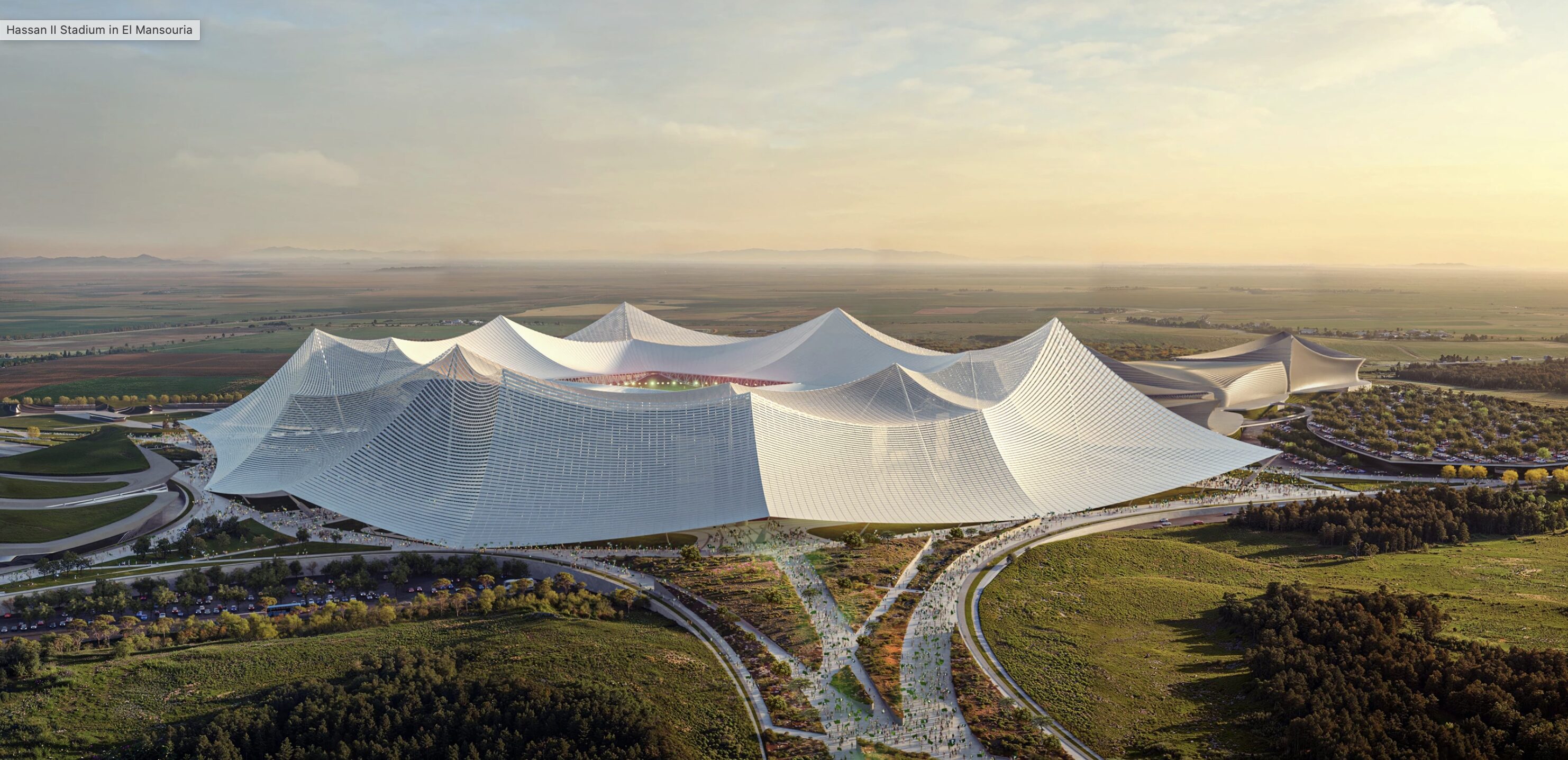
⚠ Rendering — not a photograph of the completed venue. Grand Stade Hassan II exterior design by Oualalou + Choi and Populous. The 115,000-seat venue remains under construction in El Mansouria, Benslimane Province. It was the only one of Morocco's six proposed 2030 venues not used during AFCON. Grand Stade Hassan II in detail →
Confidence should not eliminate scale from the analysis. A World Cup is a much larger and more commercially complex operation than AFCON. It brings more teams, supporters, media, sponsors, technical facilities and official sites. It also creates longer and more varied travel patterns.
Morocco will not operate 2030 alone. The tournament is shared with Spain and Portugal, while centenary celebration matches are planned in South America. Cross-border coordination will affect scheduling, aviation, security, supporter information and team movement in ways that a domestic AFCON could not reproduce.
AFCON also could not test the Grand Stade Hassan II, because the 115,000-seat project remained under construction. Nor could it validate infrastructure that has not yet entered service, including planned airport capacity and rail expansion. Announcements and construction progress are not the same as completed operations.
Finally, the competition did not settle every question about how public investment should be balanced with social priorities. Delivering stadiums successfully does not make debates about healthcare, education, housing or access illegitimate. A credible 2030 legacy will be judged not only by tournament performance, but by whether the wider transformation creates durable public value.
The Remaining Work Toward 2030
The next phase is therefore not a victory lap. It is a transition from continental proof to World Cup preparation.
Grand Stade Hassan II must progress from construction site to tested venue. Later phases at Marrakech, Fez and Agadir must be completed and verified against the final requirements applied to them. Airport and rail projects must move from plans and worksites into reliable passenger service. Host cities must turn AFCON observations into improved crowd routes, accessibility, signage, training and contingency procedures.
Morocco must also preserve the people behind the performance. Venue managers, volunteers, transport teams, grounds crews, security personnel and technical specialists carry operational knowledge that buildings cannot store. Retaining and developing that human network through repeated events may prove as important as any new structure. For the wider infrastructure picture, see Morocco's 2030 Transformation.
Demonstrated Capability — Not a Completed Programme
This article distinguishes between what AFCON demonstrated and what remains to be done. "Demonstrated" means the evidence exists in the public record. "Remains" means the work is planned, announced or partially complete but has not yet been delivered and independently verified. MoroccoMondial2030 does not treat announcements as achievements.
The Verdict: Capability Proven, Work Continuing
Morocco's strongest argument for 2030 is no longer only what it promises to build. It is what it has already demonstrated it can organize.
AFCON showed modern stadiums operating across several cities. It showed transport and tourism systems supporting a major international competition. It showed that years of hosting football, sport, diplomacy, technology gatherings and mass cultural events have produced institutional experience.
The evidence should neither be understated nor exaggerated. AFCON was not a World Cup, and it did not complete Morocco's 2030 programme. It was a successful major test that replaced one form of uncertainty with a stronger conclusion: Morocco has the capacity to deliver under international pressure.
The challenge ahead is larger. But Morocco will approach it with evidence of performance — not merely confidence.
The Question Has Changed
Before AFCON, the question was whether Morocco could deliver. After AFCON, the question is whether Morocco can scale. That is a harder question in some ways and a simpler one in others: the organizational machinery exists. The task now is to extend it — to a sixth venue still under construction, to a substantially larger and more complex 48-team tournament, and to a shared operation that crosses international borders. Morocco has earned a different level of scrutiny. That is what demonstrated capability looks like.
More from MoroccoMondial2030 Editorial
Six Stadiums, One Deadline: Morocco's Race to 2030
Venue-by-venue readiness levels, current capacities and what remains before the tournament.
Read the Tracker → Stadium Deep DiveGrand Stade Hassan II: Inside Morocco's 115,000-Seat Vision
Construction, design, location, capacity and the questions the project must still answer.
Inside the Project → InfrastructureMorocco's 2030 Transformation: Beyond the Stadiums
The airports, rail lines, hotels and transport systems being built alongside the venues.
The Wider Picture →Sources and Methodology
This analysis draws on Reuters' post-tournament reporting, FIFA official communications, and institutional records of events hosted in Morocco. Where claims about operational performance are made, this article cites independent news sources rather than organizer communications alone. "Demonstrated" language is applied only where evidence appears in the cited sources; "proposed," "planned" and "expected" are used for items that remain incomplete.
- Reuters — Morocco banish doubts about ability to host 2030 World Cup (January 2026)
- FIFA — Morocco hosted the Club World Cup for the third time
- FIFA — U-17 Women's World Cup: Morocco awarded multi-year hosting rights (2025–2029)
- FIFA — World Cup 2030: tournament organisation and host nations
- IMF/World Bank — Annual Meetings 2023, Marrakech
- UNFCCC — COP22 event record, Marrakech 2016
- World Athletics — Diamond League Rabat: Meeting Mohammed VI
- GITEX Africa — Official website
- Maroc.ma — Mawazine 2025: 3.75 million attendees (official record)
- Gnaoua and World Music Festival — Official website, Essaouira
- Marrakech International Film Festival — The Festival
Independence notice. MoroccoMondial2030 is an independent editorial project of MoroccoPassport. It is not affiliated with or endorsed by FIFA, CAF, the 2030 World Cup organizers, the FRMF or any government authority. Project status and event information may change; official bodies remain the authoritative sources.