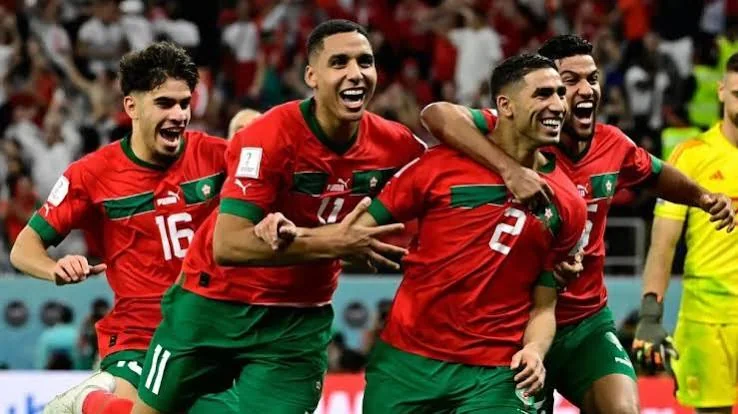
Introduction
How a Kingdom Built a World Football Power
For much of modern football history, Morocco possessed talent without sustained international results. The country produced celebrated players, powerful clubs and unforgettable national-team moments. Morocco became the first African nation to advance from a FIFA World Cup group in 1986. It won the Africa Cup of Nations in 1976. Raja Casablanca, Wydad Athletic Club and FAR Rabat carried Moroccan identity into continental competition.
But talent alone did not create continuity. World Cup qualification was inconsistent. Youth development varied between clubs and regions. Many gifted players emerged through individual opportunity rather than a unified national system. Morocco could surprise the football world, but it had not yet built the structure required to remain among its leading nations.
That changed.
Over approximately a decade, Morocco moved from outside the world's top 50 to seventh in the FIFA men's ranking — the highest position in its history. The senior team reached the semifinal of the 2022 World Cup and the quarter-final again in 2026. The Olympic team won bronze in Paris. The U-20s became world champions. Moroccan teams collected African titles in youth football, domestic-player competition and futsal. Women's football reached stages that had once seemed distant.
This was not one exceptional generation appearing by chance. It was the visible result of a national football project developed under King Mohammed VI, implemented through the Royal Moroccan Football Federation, and completed by a diaspora whose best players increasingly chose Morocco.
Morocco's football rise is not one team's story. It is the story of a system learning how to produce belief, opportunity and results across generations.
FIFA World Ranking — MoroccoPassport Analysis
From Outsider to Established Power
This graphic is independently produced by MoroccoPassport from verified official ranking data. It is not affiliated with or derived from FIFA's own graphics.
2016
Outside Top 50
Morocco ranked below the world's leading fifty nations
2022
11th in world
Post-Qatar World Cup — first African semifinal
2025–26
Entered Top 10
Established among the world's leading ten nations
June 2026
7th — Highest ever
Morocco's historic peak ranking
FIFA rankings change periodically. Position shown reflects the official ranking available in June 2026.
A Decade of Results
The Atlas Lions Achievement Record
Key verified milestones, 2018–2026
2018
CHAN champions — Morocco wins the African Nations Championship for the first time, reserved for domestic-league players
African Title2020
CHAN champions again — a second consecutive domestic-player continental title confirms the domestic league's growing strength
African Title2022
Men's World Cup semifinal — First African and Arab nation to reach the last four at a FIFA World Cup. Morocco finishes fourth, its best-ever senior result
World Cup Historic2022
Women's AFCON finalist — Morocco hosts and reaches the first Women's Africa Cup of Nations final in its history
Women's Football2023
U-23 African champions — Morocco wins its first U-23 Africa Cup of Nations, defeating Egypt 2–1 in the final, and qualifies for the Paris Olympics
Youth Title2023
Women reach World Cup Round of 16 — Atlas Lionesses defeat South Korea and Colombia at their first Women's World Cup
Women's Football2024
Men's Olympic bronze — Morocco defeats Egypt 6–0 in the Paris bronze-medal match, the country's first Olympic football medal
Olympic Medal2024
Men's Futsal AFCON champions — 5–1 victory over Angola in Rabat, record-equalling third continental futsal title
Futsal2025
U-17 African champions — Morocco wins its first U-17 Africa Cup of Nations, beating Mali on penalties after a goalless final
Youth Title2025
CHAN champions — a record third title, 3–2 over Madagascar. Lamlaoui top scorer
African TitleOct 2025
FIFA U-20 world champions — 2–0 over Argentina in the final. First global football title in Morocco's history. Maamma: Golden Ball. Zabiri: Silver Ball
WORLD CHAMPIONDec 2025
FIFA Arab Cup champions — 3–2 over Jordan in Qatar. Hamdallah scores twice including extra-time winner
Regional Title2025
Inaugural Women's Futsal AFCON champions — Morocco comes from 2–0 down to win 3–2 against Tanzania in the final
Women's FutsalMarch 2026
Officially declared AFCON 2025 champion by CAF — Appeal Board rules Senegal forfeit. CAS appeal pending as of August 2026
Senior TitleJuly 2026
Second consecutive World Cup quarter-final — first African nation in history to reach the last eight at back-to-back men's World Cups
World Cup HistoricThe Foundation
A Royal Vision Becomes an Institution
The football transformation developed within the broader modernization undertaken during the reign of King Mohammed VI. The most important decision was not the appointment of one senior coach or the recruitment of one talented player. It was the decision to build permanent institutions capable of developing players long before they entered the national team.
The Mohammed VI Football Academy, inaugurated in 2009, became the central symbol of that strategy. Located in the Salé region near Rabat, the academy was designed to combine elite football training with education, accommodation, medical support and personal development. Its objective was not simply to find technically gifted children. It was to build complete players prepared for professional football and life beyond it.

Youth development at the Mohammed VI Football Academy combines football training, education, medical preparation and personal formation. The academy does not claim to have produced every Moroccan international — its contribution is institutional as much as individual. Image supplied to MoroccoPassport by the editorial team; original publisher attribution retained where visible.
The academy helped establish a standard that extended beyond its own graduates. Youth development could no longer depend only on the resources or traditions of individual clubs. It became a matter of national planning. FIFA's own analysis of Morocco's rise has connected the U-20 world championship and wider progress to the long-term development project that began more than a decade earlier.
King Mohammed VI's contribution should therefore be understood not merely through ceremonial appearances, but through sustained backing for the structures that made later victories possible.

Where Every National Team Begins
A Child, a Shirt and the First Club That Captures an Imagination
Morocco's historic clubs remain essential to its football culture. Wydad Athletic Club, Raja Club Athletic and FAR Rabat are not simply professional teams. They are social institutions carrying identities rooted in Casablanca, Rabat and communities far beyond. Their academies and football schools give children their first structured relationship with the game.
The young player in the Wydad Football School photograph represents the beginning of that relationship: a child, a club shirt and the possibility of belonging. The national development system did not replace club identity. It gave that identity a more complete pathway — from the local football school to the academy, the professional game and, for a select few, the national team.
From the Editor
Wydad Athletic Club was my team when I was that boy's age. Like millions of Moroccans, my relationship with football began not with rankings or trophies, but with a club, a shirt and the first team that captured my imagination. That childhood attachment never disappears.
— Rachid Echahly, Editor-in-Chief

Morocco arrived at the 2022 World Cup with talent, but not with the status of a tournament favorite. Its group contained Belgium, Croatia and Canada. Belgium had finished third at the previous World Cup. Croatia had reached the final. Morocco was expected to compete honorably, not redefine African football.
Instead, the Atlas Lions won the group. They eliminated Spain in the Round of 16 after a disciplined defensive performance and a penalty shootout remembered for Achraf Hakimi's decisive kick. They defeated Portugal 1–0 in the quarter-final through Youssef En-Nesyri's header.
The achievement resonated across Morocco, Africa, the Arab world and Moroccan communities abroad. For the first time, an African national team stood among the final four at a men's World Cup.
France ended the run in the semifinal, and Croatia won the third-place match. Morocco officially finished fourth. But fourth place did not feel like failure. It had expanded the imaginable.

Royal Recognition
King Mohammed VI Receives the Atlas Lions and Their Mothers
"The Royal Palace reception following the tournament made the cultural meaning visible. King Mohammed VI received the players with their mothers, recognizing not only elite athletes but the families behind their journeys."
King Mohammed VI receives members of the Atlas Lions and their mothers following Morocco's historic 2022 World Cup campaign — a ceremony connecting national achievement, family and public recognition. Image supplied to MoroccoPassport by the editorial team; original publisher attribution retained where visible. For official photography, consult MAP (Maghreb Arabe Presse) — Morocco's national news agency and primary distributor of Royal Palace imagery.
The Global Morocco
The Diaspora Was Not an Addition — It Was Part of the Plan
Morocco's development model differs from that of countries relying exclusively on domestic academies. A significant number of Moroccan internationals were born or developed abroad — particularly in France, Belgium, the Netherlands and Spain. The FRMF treated diaspora recruitment as long-term relationship building rather than last-minute talent searches.
Achraf Hakimi developed at Real Madrid. Yassine Bounou built his career through Spanish football. Sofyan Amrabat grew through Dutch football. Others followed different paths. Academy graduates, Moroccan club products and diaspora players did not compete for ownership of the project. They became parts of the same national system.
Players needed to believe that choosing Morocco would not mean accepting inferior preparation or reduced ambition. Modern facilities, competitive coaching and a serious national project made that choice more convincing.
2023 — 2024
Competitive Depth Across Generations

2023: Africa's Best Under-23 Team
Morocco hosted the 2023 U-23 Africa Cup of Nations and completed the competition undefeated. The team defeated Egypt 2–1 after extra time in the final in Rabat, winning Morocco's first title at that age level. The championship also secured Olympic qualification. Players were no longer arriving at the senior level without experience of high-pressure knockout matches and continental finals. A competitive pathway was forming.
Paris 2024: Morocco's First Olympic Football Medal
At Paris 2024, Morocco's men reached the Olympic semifinals before losing to Spain. The response in the bronze-medal match was emphatic. Morocco defeated Egypt 6–0 in Nantes — one of the most decisive medal performances in Olympic football history. Soufiane Rahimi scored twice, while Ezzalzouli, El Khannouss, Nakach and Hakimi also found the net.
The bronze was Morocco's first Olympic football medal. Just two years after Qatar, the result demonstrated that Morocco's competitiveness was reaching a second generation. The country was no longer dependent on one senior squad.
Morocco vs Egypt · Olympic Bronze Medal · Paris 2024
The Year the System Delivered
2025: Five Titles in One Year
If Qatar 2022 announced Morocco's arrival, 2025 revealed the depth behind it.

Morocco's record third CHAN title, 2025. Image supplied to MoroccoPassport by the editorial team.

Morocco's women's futsal squad before the inaugural AFCON final, 2025. Image supplied to MoroccoPassport by the editorial team.
April 2025
U-17 African Champions
First U-17 AFCON title. Mali beaten on penalties 4–2 after goalless final. Goalkeeper Zakaria Alaoui saves two. Morocco conceded one goal in the tournament.
2025
CHAN Champions — Record Third
3–2 over Madagascar. Lamlaoui scores twice, finishes as top scorer. First nation to win CHAN three times. Proves domestic league strength.
October 2025
FIFA U-20 World Champions
2–0 over Argentina in Chile. Zabiri scores twice. Defeats Spain, Brazil, France, USA and Argentina. First global football title in Morocco's history.

2025
Inaugural Women's Futsal AFCON
Morocco trails Tanzania 2–0 and wins 3–2. The inaugural women's futsal continental title goes to Morocco in a dramatic final comeback.
The Defining Moment
World Champions at Under-20 Level
The defining youth achievement came in Chile. Morocco's U-20 team defeated Spain and Brazil during the group stage, advanced through the knockout rounds and overcame France on penalties in the semifinal. Argentina awaited in the final — a nation that had won the competition a record six times. Morocco had never previously reached the final.

Zabiri celebrates his second goal. Full time: Argentina 0–2 Morocco. Source credit: Photo: FIFAWorldCup (watermark visible in original).

CAF official champions graphic following Morocco's U-20 World Cup victory, Chile 2025. Source: CAF/aseanfootballnews watermarks visible.
Yassir Zabiri scored twice in the first half, and Morocco won 2–0. On 19 October 2025, Morocco became FIFA U-20 world champion — the first global football title in the country's history and only the second U-20 World Cup victory by an African nation after Ghana in 2009.
The journey mattered as much as the final. Morocco had defeated or survived Spain, Brazil, the United States, France and Argentina. This was not a title produced by avoiding the strongest teams. It was the clearest evidence yet that Morocco's football system could develop players capable of winning against the world's traditional powers.
Othmane Maamma received the tournament's Golden Ball, while Yassir Zabiri received the Silver Ball after scoring twice in the final. Their different development paths illustrate the breadth of Morocco's model. Zabiri spent nine formative years at the Mohammed VI Football Academy before entering professional football through Union Touarga; Maamma developed through the French club system. Morocco's success came from bringing academy graduates, domestic-club products and diaspora-developed players into one coherent national project.
Why the AFCON 2025 Record Requires Explanation
The senior Africa Cup of Nations, officially designated AFCON Morocco 2025, concluded in January 2026. Morocco reached its first AFCON final since 2004 after defeating Nigeria in a semifinal penalty shootout. The final against Senegal took place on 18 January at the Prince Moulay Abdellah Stadium in Rabat.
Late in regulation time, with the match goalless, Morocco received a penalty following a VAR review. Senegal's players left the field in protest. They returned after an interruption of approximately 17 minutes. Brahim Díaz's penalty was saved, and Pape Gueye later scored for Senegal in extra time. On the field that evening, Senegal finished 1–0.
On 17 March 2026, the CAF Appeal Board upheld an appeal by the Royal Moroccan Football Federation. It ruled that Senegal had violated Article 82 by leaving the field without the referee's authorization. Article 84 therefore applied: Senegal was declared to have forfeited. CAF recorded the final as a 3–0 victory for Morocco and officially declared Morocco AFCON 2025 champion.
Senegal appealed to the Court of Arbitration for Sport. As of this article's August 2026 review, that appeal had not overturned CAF's decision. Morocco therefore remains the officially recognized African champion — its second senior continental title after 1976. This requires precise reporting: Morocco's title is official under the governing confederation's ruling, while the unusual route to that title and pending legal appeal remain part of the historical record.
Status reviewed: August 2026 — CAS proceedings ongoing
Crown Prince Moulay El Hassan performs the ceremonial kick before the AFCON 2025 final at the Prince Moulay Abdellah Stadium, January 2026. Source: Canal+/Mediatude (watermark visible in original). Image supplied to MoroccoPassport by the editorial team; original publisher attribution retained.

Crown Prince Moulay El Hassan with members of the Atlas Lions during the rain-soaked ceremony following the AFCON 2025 final. Image supplied to MoroccoPassport by the editorial team; original publisher attribution retained where visible.
AFCON Morocco 2025
Crown Prince Moulay El Hassan and the AFCON Final
Crown Prince Moulay El Hassan was present at the Prince Moulay Abdellah Stadium in Rabat for the AFCON 2025 final. He performed the ceremonial kick before kick-off. The subsequent image of the Crown Prince standing with players in the rain became one of the tournament's defining visual memories — royal engagement made visible through weather, ceremony and shared presence on the field.
The photographs from this event carry broadcaster and publisher watermarks which remain intact. They are presented here in the context of the historical record, not as celebration of the CAF ruling that arrived two months later. Both images were supplied to MoroccoPassport by the editorial team; we continue to seek the definitive original source attribution from MAP or Royal Palace communications.
July 2026
2026: A World Cup Breakthrough Becomes Continuity

Morocco entered the 2026 World Cup carrying expectations entirely different from those of 2022. The Atlas Lions were no longer outsiders. They were an established top-ten nation expected to advance. Morocco reached the knockout rounds and defeated Canada 3–0 in the Round of 16 — the first time an African nation had scored three goals in a men's World Cup knockout match.
France again ended Morocco's campaign, winning the quarter-final 2–0 in Boston. The result did not repeat the semifinal of Qatar, but it established a different record: Morocco became the first African national team to reach the quarter-finals of consecutive men's World Cups.
That consistency may ultimately prove more significant than a single extraordinary tournament. Surprise can happen once. Remaining among the leading nations requires organization.
A Changing Landscape
Women's Football Changes the Meaning of the National Project
Morocco's transformation cannot be measured only through the men's teams.
2022
Women's AFCON Final
Morocco hosts and reaches its first Women's AFCON final. Loss 2–1 to South Africa, but the tournament transforms visibility at home.

Ongoing
Domestic Growth
Moroccan clubs become serious CAF Women's Champions League competitors. Federation investment expands coaching and competitive opportunities.
2025
Futsal Champions
Morocco wins the inaugural Women's Futsal AFCON — coming from 2–0 down to defeat Tanzania 3–2 in the final. A new chapter opens.
The progress has not been perfectly linear, and the infrastructure remains less developed than the men's game. But women's football has moved from the margins of the national conversation into major stadiums and global tournaments.
An Overlooked Power
Futsal: Morocco's Other Football Dimension

Morocco's futsal achievements are sometimes treated as a secondary story. They should not be. The men's national futsal team won three consecutive African championships, including the 2024 title with a 5–1 victory over Angola in Rabat. Morocco also became a leading World Cup competitor, demonstrating technical quality against elite opposition.
Morocco's men's futsal squad celebrate their record-equalling third Futsal AFCON title, Rabat 2024. Image supplied to MoroccoPassport by the editorial team.
In 2025, Morocco won the inaugural Women's Futsal Africa Cup of Nations, coming from two goals behind to defeat Tanzania 3–2 in the final. Futsal matters to the wider system because it develops close control, speed of thought and decision-making in restricted spaces. A country competing successfully across men's football, women's football, youth tournaments, domestic-player competition and futsal possesses a football ecosystem rather than a single fortunate team.
Analysis
What Actually Created the Transformation?
It is tempting to reduce Morocco's rise to one academy, one federation president or one remarkable generation. The evidence points to a combination.
Long-term Royal Support
King Mohammed VI provided the sustained national backing that allowed football development to be treated as a strategic project rather than a sequence of short-term reactions.
Federation Implementation
Under Fouzi Lekjaa, the FRMF strengthened training infrastructure, coaching, youth competition, international recruitment and Morocco's ability to host major events.
The Mohammed VI Academy
The academy established an elite development model combining football, education and personal formation — its greatest contribution may be institutional rather than individual.
Club Traditions
Wydad, Raja, FAR and other Moroccan clubs remained essential sources of players, coaches, supporters and football identity that no federation strategy could replace.
Diaspora Integration
Morocco built a credible project capable of convincing dual-national players that representing the Kingdom could match the highest professional ambitions.
Multiple Pathways
Youth teams, women's football, futsal and domestic-player competition were developed as connected parts of the project — not isolated successes.
No single element explains Morocco's rise. Their alignment does.
Looking Forward
Why This Matters for 2030
Morocco's role in the 2030 World Cup is often discussed through stadiums, airports, railways and accommodation. Those preparations matter. But Morocco is not approaching 2030 merely as a capable host. It is approaching as a football nation that has earned competitive legitimacy.
The Record
What Morocco Brings to 2030
The stadiums will show what Morocco has built. The national teams show why it was built.
The Child in the Red Shirt
Morocco's Football Future Is Already Training Somewhere
Perhaps in Salé, Casablanca, Rabat, Tangier, Agadir or a smaller community far from the national spotlight.
Perhaps that child is entering the Mohammed VI Football Academy. Perhaps she is joining a girls' team for the first time. Perhaps he is registering with a local football school, putting on Morocco's red shirt and imagining a future inside a stadium filled with Moroccan flags.
Morocco's football revolution is visible in trophies and rankings. Its future is visible in every child putting on the shirt.

Morocco's football future begins with the next child who puts on the red shirt. Image supplied to MoroccoPassport by the editorial team; original publisher attribution retained where visible.