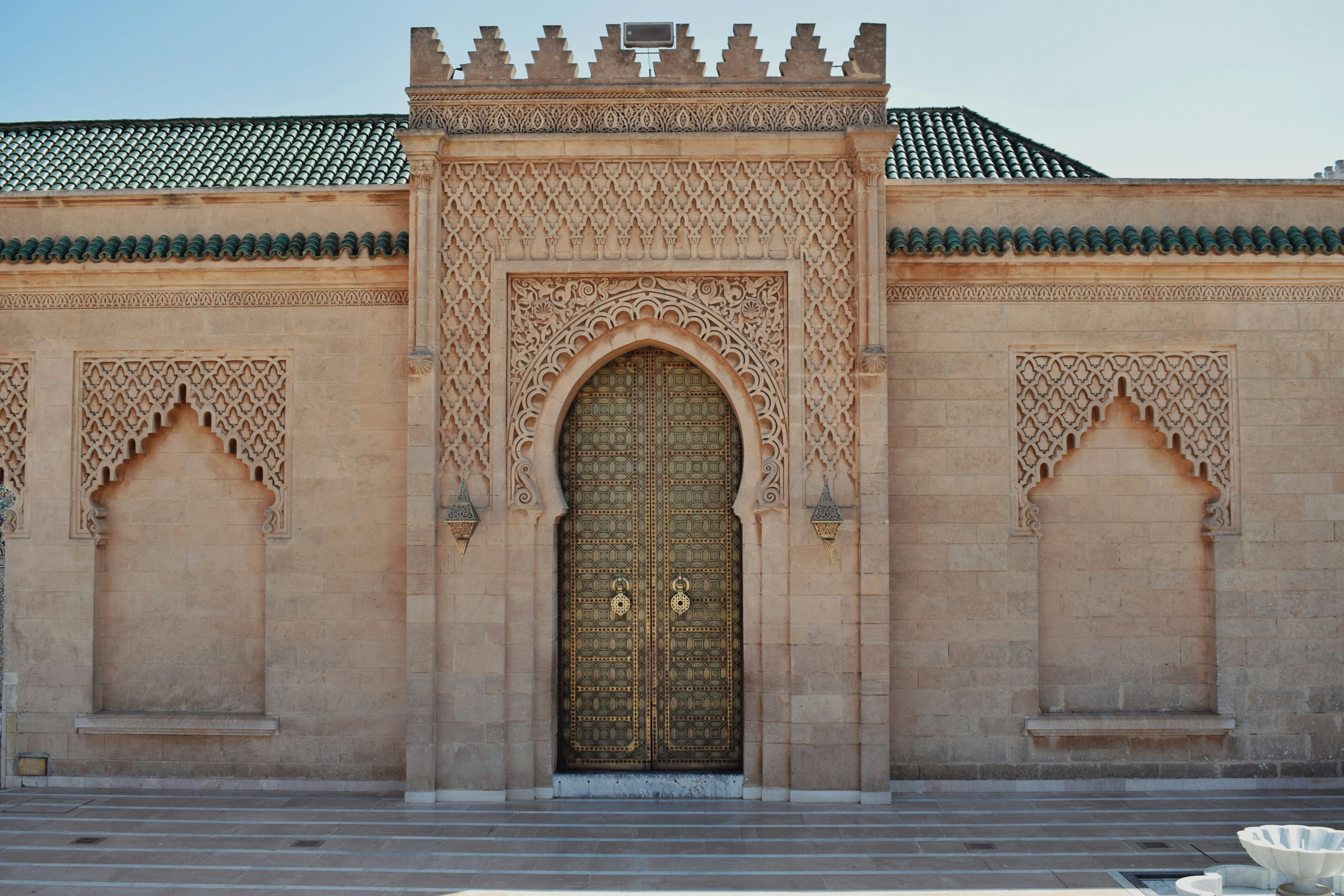
From the palaces of Granada to the medinas of Fes — eight centuries of Al-Andalus live on in Morocco's architecture, music, craftsmanship and daily life. A journey through the world's most beautiful act of cultural transmission.
There is a particular quality of light in the courtyard of the Bou Inania Madrasa in Fes. It falls through carved cedar screens onto walls of geometric zellige tile — cobalt, ochre, white — and reflects off a small central fountain in patterns that have not changed in six centuries. You might sit here for a long time without being able to explain precisely why the space feels the way it does: not merely beautiful, not merely ancient, but profoundly familiar in a way that resists rational analysis. What you are sensing is a memory fixed in stone, tile and water. A memory of a civilisation built on the other side of a narrow sea — in Córdoba, in Seville, in Granada — that found in Morocco not an ending but a continuation.
That civilisation was Al-Andalus: the Arabic name for the culture that flourished on the Iberian Peninsula for nearly eight centuries, from the crossing of the Moorish armies in 711 CE to the surrender of the Nasrid Emirate of Granada on the morning of 2 January 1492. For the greater part of that period, Al-Andalus was not merely a presence on the southern edge of Europe. It was among the most sophisticated urban civilisations in the medieval world — a place of libraries, observatories, irrigated gardens, philosophical discourse, poetry, music, architectural innovation and religious coexistence whose influence reached deep into what would become the European Renaissance. When it ended, it did not end quietly.
The story of what happened next — of the scholars, musicians, architects, physicians, poets and craftsmen who crossed the Strait of Gibraltar and rebuilt their world in Morocco — is one of the most significant acts of cultural transmission in recorded history. Its consequences are visible in every carved cedar doorway in the Fes medina, audible in the stately classical suites of Al-Ala music, tasteable in the sweet and savory complexity of a slow-cooked bastilla. This is a journey through that legacy — not through history books, but through the places, sounds and materials in which it still lives today.
"The crossing of Al-Andalus to Morocco was not merely the flight of refugees. It was the deliberate rescue of a civilisation — carried not in books alone, but in the hands of architects, musicians, craftsmen and gardeners who intended to rebuild everything they had lost."
— MoroccoPassport Editorial- Historical period: 711–1492 CE (Al-Andalus), with major migrations to Morocco continuing through 1610
- Best cities to experience it: Fes, Tetouan, Rabat, Salé, Chefchaouen
- Known for: Riad courtyards, zellige tilework, Andalusian music (Al-Ala), Andalusian gardens, traditional craftsmanship, and a distinctive cuisine built on sweet-savory combinations
- Ideal for: History enthusiasts, architecture lovers, photographers, cultural travellers, and anyone who wants to understand Morocco at its deepest level
A Journey Across the Strait
The history of Al-Andalus and Morocco is not the story of two separate civilisations that happened to exchange ideas across a stretch of water. It is, more accurately, the story of a single cultural world divided by geography — and eventually reunited by catastrophe. From the very beginning of the Moorish presence in Iberia, the Strait of Gibraltar was a corridor rather than a border. Moroccan dynasties ruled both shores simultaneously: the Almoravids, who founded Marrakech in 1062, crossed into Iberia in 1086 at the request of Muslim rulers threatened by the Christian Reconquista and governed an empire that stretched from sub-Saharan West Africa to the Spanish plateau. The Almohads, who built the Koutoubia Mosque in Marrakech and the Hassan Tower in Rabat, erected the Giralda in Seville from the same architectural blueprint. The same craftsmen, the same geometric vocabulary, the same vision of paradise — on both sides of the water.
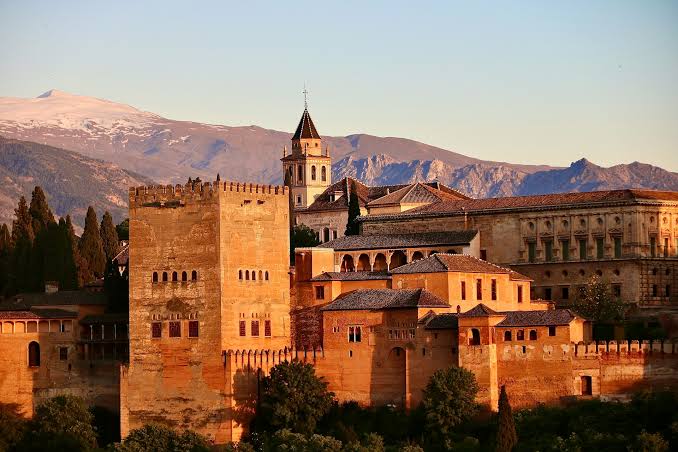
The Reconquista — the centuries-long Christian military campaign to retake the Iberian Peninsula — shifted the balance of power gradually and then irreversibly. Toledo fell in 1085. Seville in 1248. By the middle of the 13th century, only the Emirate of Granada in the far south of the peninsula remained under Moorish rule. The Nasrid emirs who governed Granada did so in extraordinary splendour, building the Alhambra palace complex — the most refined expression of Moorish architectural achievement — while knowing that their territory grew smaller with each generation.
When Granada fell on 2 January 1492, the consequences were immediate and lasting. The subsequent expulsion edicts — targeting first the Jewish community of Spain in that same year, then the Muslim population in 1502 (given the choice to convert or leave), and finally the remaining Moriscos in 1609 — drove successive waves of Andalusian refugees across the strait. They came in their hundreds of thousands: scholars carrying manuscripts, architects with drawings, musicians with instruments and scores memorised by heart, craftsmen with the tools of their trade. They came to a Morocco that was, in many cases, already familiar to them — because the cultural world of Al-Andalus and Morocco had never been entirely separate.
The Moorish refugees who settled in Rabat after 1610 — expelled from the Andalusian city of Hornachos — founded a semi-independent republic known as the Bou Regreg Republic on the banks of the river between Rabat and Salé. They built the fortifications of the Kasbah des Oudaias and the walls of Salé that visitors see today. Rabat's Andalusian identity is not merely cultural — it is written into the very walls of the city.
What the Andalusian exodus brought to Morocco was not simply the desperate remnant of a defeated culture. It was the full flowering of a civilisation at the peak of its intellectual and artistic development — and Morocco, which had political stability, existing cultural sophistication, and deep historical ties to Al-Andalus, was uniquely positioned to receive and absorb it. The result was not merely a transfer of cultural elements but a genuine synthesis: the creation of a distinctly Moroccan-Andalusian identity that, in its architecture, music, craftsmanship and cuisine, is still the defining character of Morocco's imperial cities today.
The Architecture of Paradise
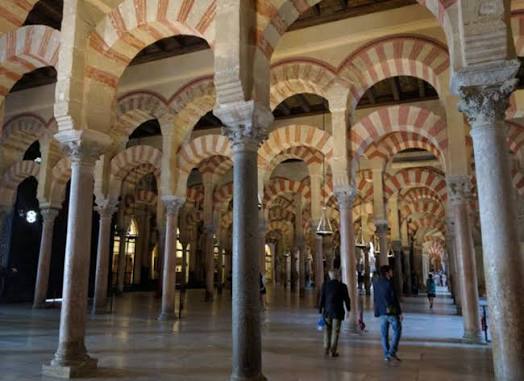
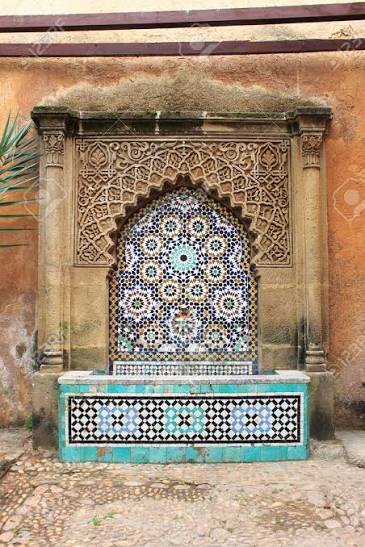
To understand Moroccan architecture is to understand a vocabulary invented, refined and perfected in Al-Andalus across eight centuries, then carried across the strait and given a new home in the medinas of Fes, Tetouan and Marrakech. The vocabulary is precise: the horseshoe arch, its proportions governed by exact mathematical ratios; the muqarnas, those honeycomb vaults of carved plaster that dissolve ceiling mass into a shimmer of geometric light; the zellige, the hand-cut ceramic tilework whose patterns are built from a module of small tiles arranged in configurations of almost infinite complexity; the alicatado, carved plaster walls reading as a continuous surface of interlocking geometry; and the cedar ceiling, with its carved and painted coffering whose colour — gold, lapis, vermilion — endures for centuries without fading. These elements are not decorative choices. They are a cosmology.
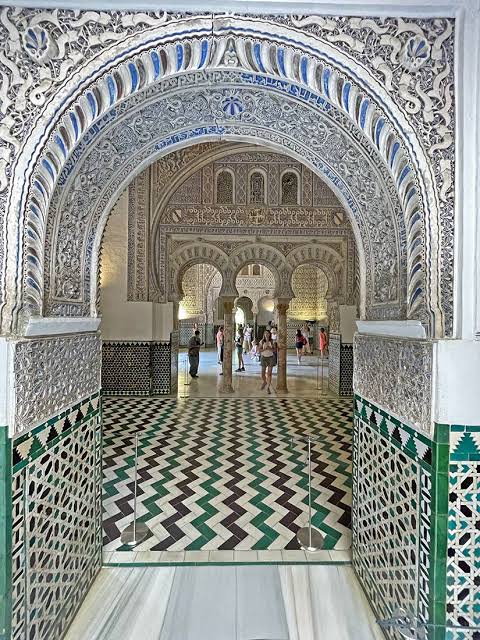
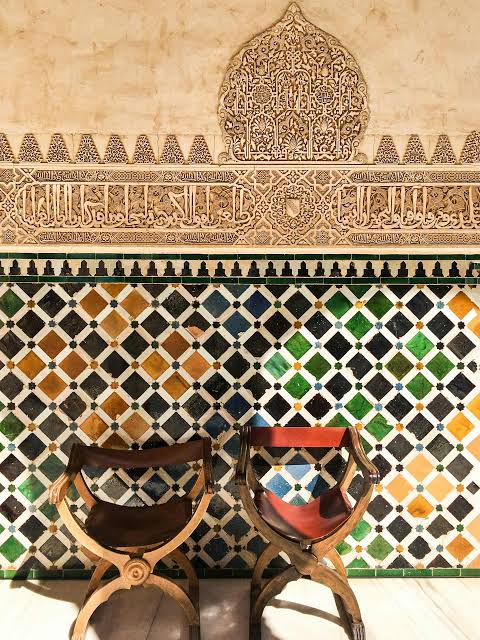
The central organising idea of Andalusian architecture is the translation of paradise into built form. The Quranic description of paradise — janna, literally a garden — as a place of flowing water, shade, fragrance, geometric order and spiritual light gave architects a programme: not to imitate paradise literally, but to create spaces that evoke its qualities. The riad courtyard — the fundamental spatial unit of domestic architecture in Moroccan cities — is the direct heir of this tradition. A square or rectangular space, enclosed and inward-facing, with a central fountain, four planting beds, perhaps a lemon tree or an orange tree, and the sound of water: all of it is an architectural argument that paradise can be recreated on earth, within four walls, accessible in daily life.
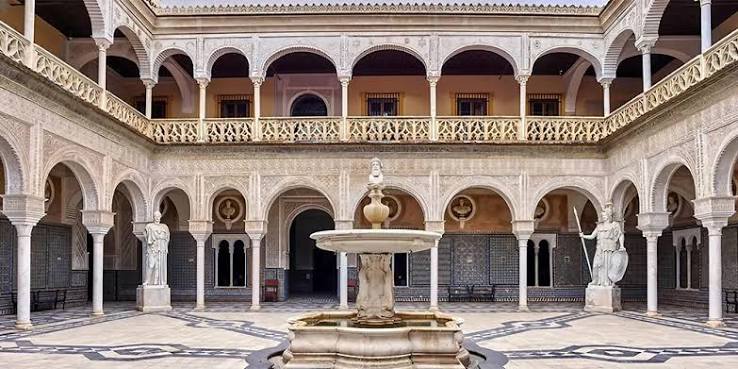
The riad as it exists in Morocco today is not a simplified version of the Andalusian original. It is, in many cases, its equal — the product of the same craft traditions, the same mathematical principles and the same understanding of how architecture should interact with light, water and the human body across the arc of a day. In the great riads of Fes — places such as Dar Batha, Riad Fes or the interiors of the madrasas that have been converted to museums — the quality of the work is indistinguishable from the finest interiors of Granada or Seville. This is not coincidence. It is the result of a direct and unbroken transmission of knowledge carried across the water by the craftsmen themselves.
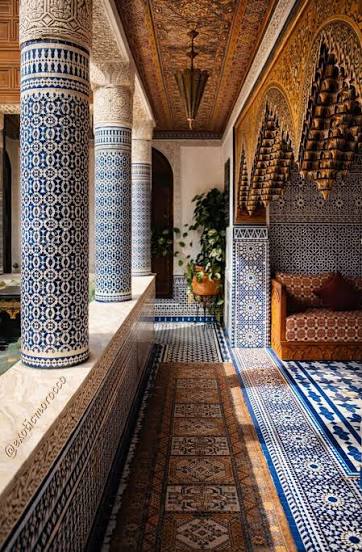
Among the most remarkable of these transmitted crafts is the work of the cedar carvers — the naqqachine of the Fes medina, whose workshops line the narrow streets of the artisan quarter and whose chisels and gouges have changed little in five hundred years. Cedar from the Middle Atlas Mountains is the preferred material: it is aromatic, resistant to insects and moisture, and accepts carving with a smoothness that allows the craftsman to achieve depths of detail that would be impossible in harder wood. The patterns they carve — geometric interlacings, arabesques, calligraphic bands — derive from a vocabulary that was fully developed in Al-Andalus by the 12th century and has been elaborated rather than fundamentally changed in the centuries since.
Cities Where It Lives
The Andalusian legacy in Morocco is not spread uniformly across the country. It is concentrated in specific cities that absorbed the largest waves of refugees and that have maintained, through their medinas and their craft traditions, the most direct continuity with the world of Al-Andalus. To travel between these cities is to follow the trail of the crossing itself — to move from the places where the refugee communities settled to the places where their descendants still live, work and practise crafts that connect them directly to a world that ended in Granada more than five centuries ago.
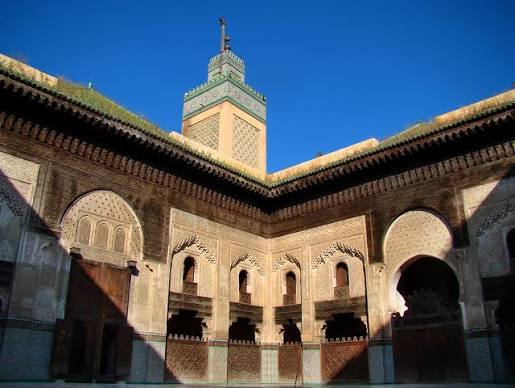
Fes — The Capital of Moroccan-Andalusian Civilisation
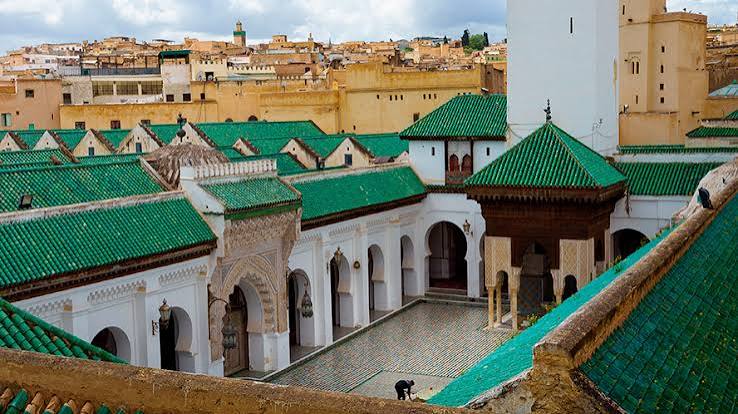
Fes is the primary repository of the Andalusian legacy in Morocco, and its credentials are extraordinary. The city received its first major wave of Andalusian settlers as early as the 9th century, when refugees from a revolt in Córdoba established the Adoua al-Andalus — the Andalusian quarter — on the west bank of the Fes river. The founding of Al-Qarawiyyin mosque and university in 859 CE by Fatima al-Fihri, the daughter of an Andalusian merchant family, established Fes as an intellectual centre whose reputation would eventually attract scholars from across the Islamic world. When the great exodus of 1492 came, Fes was the natural destination: it already had the infrastructure, the tradition of hospitality to Andalusian settlers, and the cultural sophistication to absorb an influx of poets, architects, physicians and musicians without losing its equilibrium.
The physical fabric of Fes el-Bali — the old medina, now a UNESCO World Heritage Site and the largest functioning medieval city in the world — is the most complete surviving embodiment of the Andalusian-Moroccan architectural synthesis. The Bou Inania Madrasa, completed in 1357, prefigures the architecture that the 1492 refugees would bring and refine: the proportional courtyard, the zellige wainscot, the carved stucco walls, the cedar screen. The Attarine Madrasa, adjacent to Al-Qarawiyyin, is another masterwork of the same tradition. And in the domestic architecture of the medina's private riads — most of them invisible from the street, their splendour concentrated entirely inward — the aesthetic of Al-Andalus has been maintained in daily life in a way that no museum could replicate.
Fes el-Bali
The largest medieval medina in the world and the most complete embodiment of the Andalusian-Moroccan synthesis. UNESCO World Heritage. The Bou Inania and Attarine madrasas, Al-Qarawiyyin, and hundreds of private riads invisible from the street.
Tetouan
Founded in the 15th century almost entirely by Moorish refugees, Tetouan is the most Andalusian city in Morocco. Its UNESCO medina was built by the exiles themselves and its architecture, dialect and musical tradition are the most directly descended from Al-Andalus of any Moroccan city.
Rabat & Salé
The Moriscos expelled in 1609 from Hornachos in Extremadura built the Kasbah des Oudaias and the great walls of Salé. Their Andalusian Bou Regreg Republic left an indelible architectural and cultural imprint on Morocco's capital.
Chefchaouen
Founded in 1471 by Moulay Ali ibn Rashid partly to receive Andalusian Muslim refugees. Its medina retains a distinct Andalusian character: whitewashed arches, tiled fountains, a central plaza that recalls the plazas of southern Spain rather than the labyrinthine souks of Fes.
Marrakech
Though more Amazigh and sub-Saharan in its foundational character, Marrakech received Andalusian craftsmen who built the Bahia Palace, the Saadian Tombs and many of the great riads of the medina. Its finest interiors are impossible without the Andalusian contribution.
Tangier
The closest Moroccan city to Iberia and one of the first receiving points for Andalusian refugees. Tangier's Casbah, its mosques and its distinctive urban character all bear the Andalusian imprint, filtered through centuries of Mediterranean cultural exchange.
If you want the single most concentrated encounter with the Andalusian legacy in Morocco, spend a morning in the Bou Inania Madrasa in Fes when the light falls into the courtyard at a low angle — ideally in the hour after opening. Then walk through the Andalusian quarter of Fes el-Bali (north of Al-Qarawiyyin) and listen for music coming from private houses. In the afternoon, take the 45-minute drive to Tetouan, whose medina is far less visited than Fes but in many ways more immediately Andalusian in its atmosphere, its people and its architecture.
The Music of Al-Andalus
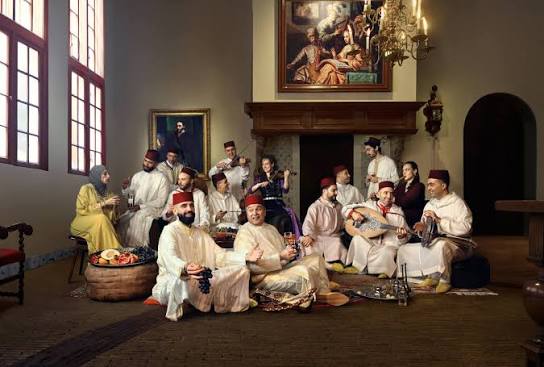
Of all the cultural inheritances that crossed the strait from Al-Andalus to Morocco, none is more haunting, and perhaps none more improbable in its survival, than the classical music tradition known as Al-Ala — also called Gharnati (from Granada) or simply Moroccan Andalusian music. It is one of the great classical music traditions of the world, comparable in its sophistication and historical depth to the art music traditions of India, Persia or the European Baroque, and it is today almost entirely preserved in Morocco — because in its country of origin, it no longer exists.
Al-Ala is organised into a system of twenty-four musical suites called nuubat (singular: nuba), each associated with a particular mode, a particular emotional quality and a particular time of day. The suites move from slow, meditative introductions through progressively faster and more exuberant movements, reaching a point of rhythmic intensity before coming to a close — a structure that has remained essentially unchanged since it was codified in Al-Andalus between the 9th and 15th centuries. Each nuba takes several hours to perform in its entirety, and the full cycle of twenty-four nuubat would take, if performed consecutively, the equivalent of several days. In practice, orchestras perform selected movements within suites, but the overall architecture of the tradition remains intact.
The instruments of Al-Ala are themselves a living museum of Andalusian musical practice: the oud (lute), the rabab (bowed instrument), the kamanjah (a form of violin held vertically), the qanun (zither), the derbouka and various hand percussion instruments. The singing that accompanies the orchestra draws on a repertoire of classical Arabic and Moroccan Arabic poetry, some of it composed by poets who lived and died in Al-Andalus and whose works crossed the strait in the memory of the musicians who carried them.
Al-Ala music is listed by UNESCO as part of Morocco's Intangible Cultural Heritage. Morocco's conservatories of Andalusian music — in Fes, Tetouan, Rabat and Chefchaouen — hold the most complete surviving archive of this tradition anywhere in the world. The Fes Sacred Music Festival each June, and the Tanjazz Festival in Tangier each September, both programme Al-Ala concerts that represent some of the most extraordinary musical experiences available anywhere on the Mediterranean. You can also see our Morocco Music Festivals guide for more.
In the cities of northern Morocco — Tetouan above all, but also Fes, Chefchaouen and Tangier — Al-Ala remains a living social practice, not merely a preserved cultural artefact. Amateur orchestras practise in private homes; families gather to hear performances in the reception rooms of historic riads; conservatories train new generations of musicians in the full technical demands of the tradition. The repertoire includes poems written by Andalusian poets who died before 1492, songs that describe the landscape of a Spain most of the current performers have never visited, laments for cities that no longer exist in the form they were described. There is something in this that goes beyond musicology: it is an act of cultural memory so precise and so sustained across five centuries that it challenges ordinary conceptions of what a tradition can carry, and how far it can travel.
The Craftsman's Art
In the workshop districts of the Fes medina — the haouma districts where each craft has its traditional street, its hammering and chiselling and the smell of cedar sawdust in the air — the most significant thing is not what you see but what you hear: the sound of craft being transmitted. A master craftsman working on a piece of zellige. An apprentice watching, then attempting, then watching again. A cedar carver explaining to a younger colleague the precise sequence of cuts that produces a particular form of arabesque without losing the connection between its interlocking elements. This is how the knowledge of Al-Andalus has survived in Morocco: not primarily in books or archives, but in the relationship between a hand that knows and a hand that is learning to know.
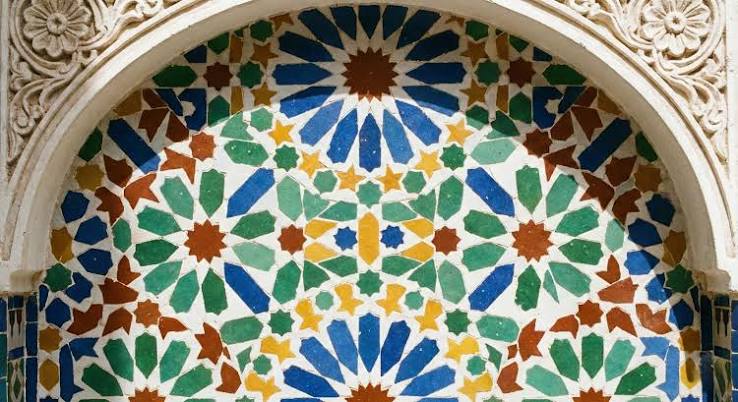
The zellige tradition is perhaps the most immediately visible of the Andalusian craft inheritances in Morocco. Zellige — the art of creating geometric tile mosaics from hand-cut fragments of fired and glazed ceramic — reached its fullest development in Al-Andalus between the 10th and 15th centuries, where it decorated the floors and walls of mosques, palaces and private houses with patterns of almost mathematical complexity. When the craftsmen who made it came to Morocco, they brought their tools and their knowledge of the base module: the small white tile from which all colours are cut, using a small hammer and a pointed chisel, into the specific shapes — triangles, stars, hexagons, elongated diamonds — that form the elements of the larger pattern. The Fes medina is today the primary centre of zellige production in the world, and the tools used in its workshops are essentially unchanged from those described in medieval Andalusian craft texts.
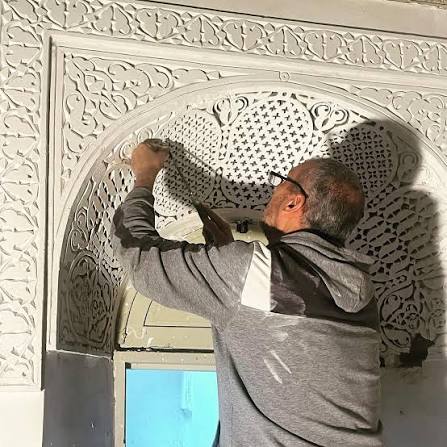
The plaster carvers — the jibs artists who create the carved stucco walls of Morocco's madrasas and riads — work in a tradition of equal antiquity and equal sophistication. Wet plaster is applied to a wall and, before it sets completely, the craftsman works with a series of combs, chisels and modelling tools to draw and then cut the surface into patterns of extraordinary fineness. The technique requires the craftsman to hold the entire pattern in his mind — because he is cutting into a surface that will be visible as a composition, not as a series of isolated elements — and to work at a pace governed by the setting time of the plaster. Corrections are difficult; perfect judgment of timing and proportion is essential. The finest examples of this craft in Morocco — in the Bou Inania, in the Bahia Palace in Marrakech, in the great riads of Fes — represent human achievement at a level that most visitors, confronted with it for the first time, find genuinely difficult to comprehend.
- Fes el-Bali Artisan Quarter: The streets around the Attarine souk and the Chouara tannery district contain active workshops producing zellige, carved cedar and stucco work. Visitors can observe craftsmen at work without obligation to purchase.
- Dar Batha Museum, Fes: Morocco's finest collection of Andalusian-influenced decorative arts, housed in a 19th-century Andalusian palace. Essential for understanding the craft tradition in its historical context.
- The Madrasa Circuit: Bou Inania and Attarine madrasas in Fes; Ali Ben Youssef Madrasa in Marrakech. These are the finest surviving showcases of the craft at its historical peak.
- Tetouan Artisan School: The École des Arts et Métiers de Tétouan is one of the few institutions specifically dedicated to preserving the Andalusian craft tradition in a formal educational context.
Gardens of the Imagination
The Andalusian garden is one of the most influential garden traditions in world history, and Morocco is its primary living embodiment. The tradition draws from multiple sources — Persian garden design, Quranic descriptions of paradise, Roman hydraulic engineering, and the agricultural innovations of Arab scientists in Spain who transformed irrigation across the entire Iberian Peninsula — but its defining principle is straightforward: the garden is a translation of paradise into physical space. Water is the defining element. Without water — flowing water, reflected water, the sound of water — the garden cannot function as a spiritual and sensory environment. The four-part division of the garden (the chahar bagh, or fourfold garden) derives from Quranic descriptions of the four rivers of paradise, and the geometric organisation of planting beds, water channels and paths around a central fountain creates a spatial grammar of extraordinary power.
In Morocco, the Andalusian garden tradition is encountered in two forms: the grand royal garden, designed for a scale of hundreds of acres, and the intimate riad courtyard, designed for a household. The Agdal gardens of Marrakech, established in the 12th century by the Almohads on the model of Andalusian royal gardens, cover 400 hectares of olive and citrus groves irrigated by an ancient hydraulic system still in operation today. The Menara gardens, also in Marrakech, date from the same period and remain a functioning agricultural garden as well as one of the most serene public spaces in the city.
For most visitors, however, the encounter with the Andalusian garden tradition comes in the riad: the private courtyard house of the Moroccan medina, whose central courtyard — typically no more than fifteen or twenty metres square — contains in microcosm every element of the grand tradition. The fountain at the centre: always present, always flowing. The lemon or orange tree: its fragrance changing with the season. The zellige-tiled channels that carry water from the fountain to the planting beds: precisely levelled to produce the barely-visible movement of water across the surface. Sitting in a well-made riad courtyard in the early morning, with the light falling at an angle through the open sky above and the sound of the fountain the only sound in the space, is one of the most complete sensory experiences that Morocco offers. It is also, unmistakably, Al-Andalus — rebuilt, five hundred years later, in a different country.
"The riad courtyard is not a decorative choice. It is an argument — made in marble, water, zellige tile and the fragrance of orange blossom — that paradise can be recreated on earth, within four walls, accessible in daily life."
— MoroccoPassport EditorialThe Tastes of Al-Andalus
Moroccan cuisine is widely recognised as among the finest in the world, and its defining characteristics — the balance of sweet and savory, the sophisticated use of spice, the complexity of layered flavour built from simple ingredients over long, slow cooking — are Andalusian inheritances as much as indigenous Moroccan ones. The cuisine of Al-Andalus, which incorporated Persian, Arab, Amazigh and Roman elements into a distinctive synthesis developed over centuries of practice in the kitchens of Córdoba, Seville and Granada, crossed the strait with the refugee community and was absorbed into the existing Moroccan food culture to produce something genuinely greater than either of its sources.
The most celebrated emblem of the Andalusian-Moroccan culinary tradition is the bastilla — called pastilla in some regions — a pie of extraordinary complexity and cultural resonance. Its shell is made of warqa, tissue-thin pastry sheets that require years of practice to produce with the necessary transparency; its filling is a combination of pigeon or chicken braised with onions and saffron, eggs scrambled into the braising liquid, and almonds toasted and spiced with cinnamon and sugar. The final presentation, dusted with icing sugar and cinnamon in geometric patterns, is then baked until the pastry is shatteringly crisp. The combination of savoury, sweet and deeply aromatic is precisely the flavour register of medieval Andalusian cooking, documented in recipes that survive in Arabic manuscripts from 13th-century Al-Andalus and that match the dish as it is made in Fes today with a fidelity that is either remarkable or entirely expected — depending on whether you have absorbed the fact that the cooks who created the tradition and the cooks who preserved it are connected by five centuries of uninterrupted practice.
Beyond bastilla, the Andalusian imprint on Moroccan cooking is pervasive: the use of cinnamon and saffron in savoury tagines; the combination of dried fruits — dates, prunes, apricots — with meat; the almond-based pastry tradition of the south; the use of orange flower water and rose water in desserts and pastries; the Moroccan tradition of afternoon mint tea served with small sweet pastries, which mirrors practices documented in Andalusian domestic literature. In the markets of Fes and Tetouan, in the bakeries of the Chefchaouen medina, in the dessert platters of fine riad restaurants — Al-Andalus is tasting as much as it is visible and audible.
For bastilla: Dar Roumana (Fes) and Dar Moha (Marrakech) are consistently regarded as serving among the finest versions. Both are set in historic riads, and the experience of eating bastilla in a riad courtyard is the most direct single encounter with the Andalusian-Moroccan synthesis that a visitor to Morocco can have.
For Andalusian pastries: the bakeries of the Tetouan medina, particularly around the main plaza, specialise in sweets whose recipes are directly descended from Andalusian confectionery traditions. The almond and sesame cookies, the honey-dipped chebakia, and the almond-stuffed gazelle horns (kaab el ghazal) are all, at their best, expressions of a pastry tradition that is older than most European national cuisines.
There is a moment that happens to almost every thoughtful visitor to Morocco, usually in Fes, sometimes in Tetouan, occasionally in the quiet of a well-made riad in Marrakech. It is the moment when the past and the present stop feeling separate. You are sitting in a courtyard. There is the sound of a fountain. Light is crossing a carved plaster wall in a way that makes the geometry seem to move. And you understand, without quite being able to explain it, that the people who built this and the people who still live in these medinas are connected to each other not by nostalgia or revival but by unbroken practice — by the fact that the knowledge of how to make this was never lost, because there was never a moment when the making stopped.
Al-Andalus did not end in 1492. It relocated. The scholars who carried their manuscripts to Fes went on writing. The architects who rebuilt their courtyard houses in Tetouan went on designing. The musicians who had memorised the suites of Al-Ala in Granada went on playing them in Rabat. And the craftsmen — the zellige makers, the plaster carvers, the cedar workers — went into the workshops of the Fes medina and continued doing what they had always done, with the same tools, the same materials and the same relationship between master and apprentice that transmits living knowledge from one generation to the next.
To travel in Morocco with this understanding is to see a different country from the one visible to the visitor who approaches it only as a destination. The courtyard you sit in is a philosophy. The music drifting from a riad window is a five-century-old message in a code that still has living speakers. The tile beneath your feet was made by someone whose hands learned from hands that learned from hands that learned — all the way back to a workshop in Seville or Granada that the maker himself never saw, but that is present in every move his chisel makes. That is what Al-Andalus left in Morocco: not a ruin, not a memory, but a practice. And a practice that is still being practised is not the past. It is the present.
Continue Exploring
More from the Roots of Morocco collection — and the destinations where history comes to life.